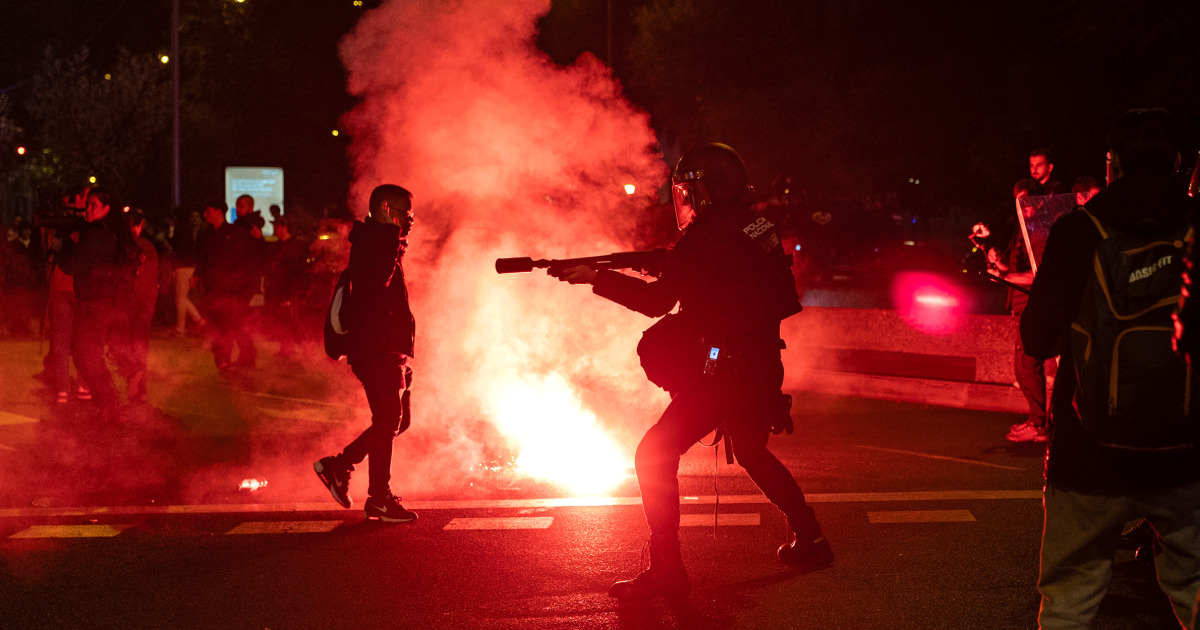
A Toledo judge banned anyone not involved in emergency, security, medical care or judicial work from entering the crash site, with an exclusion zone about a mile from the scene. Spain’s Foreign Ministry said Thursday that 42 foreign citizens from seven countries were involved in the crash, of whom one died and at least seven were injured. Authorities said 57 of the injured remained in the hospital. Several Americans were injured, according to the State Department, which did not provide further details. Jacksonville, Florida, firefighter Josue Garcia-Otero was on board with seven members of his family. “We first got to a safe location and then began treating other patients who were seriously injured,” Garcia-Otero said in a news release issued by the Jacksonville Fire and Rescue Department. “My wife is a nurse and she was also helping.” Promising an investigation and improvements to avoid a similar tragedy in the future, Sánchez said that “it was clear that we need to strengthen the safety of our train service to rebuild confidence in our high-speed rail.” The prime minister said that “it was not acceptable that a country like Spain suffered two high-speed train accidents in the same year.” In January, 46 people died in the south of the country after a train left the track and crashed into the side of a train going in the opposite direction. Both accidents affected trains operated by the state company Renfe and the private company IRYO. Oscar Puente, Spain’s Minister of Transport, addresses the media after the accident. Ángel Martínez/Getty Spain’s Transport Minister Oscar Puente said the accident was caused by what he called the “inexplicable” order from a central command center to resume operations after a safety system had failed. Puente, who faces calls to resign, said the train engineers were not to blame. A safety system stopped working due to a computer malfunction, causing all trains on the line to stop around 8:30 a.m. local time (5:30 a.m. ET). Shortly after, he said, central command had ordered the RENFE train to start running again without speed restrictions, adding that this should never have happened and ended up colliding with the stopped IRYO train at 8:53 am. A protest in front of the Spanish Ministry of Transport in Madrid on Wednesday night. Ananda Manjon / Europa Press via Getty Riot police used tear gas outside the Ministry of Transport on Wednesday night after far-right protesters gathered outside and pushed against a cordon set up by officers. Some threw flares and other objects while some chanted slogans against Puente and Sánchez. It is not yet clear what effect the accident will have on Sánchez’s political ambitions. The prime minister called a snap election next month after his socialist party suffered several defeats on legislation aimed at tackling the country’s housing crisis. Signs reading “Corruption kills” during a protest in Madrid’s Plaza de Cibeles.Fernando Sanche/Europa Press via Getty Sánchez’s minority government had introduced two decree laws aimed at protecting tenants in the rental market after nationwide protests broke out following the eviction of an 87-year-old woman from her apartment in Madrid. Maricarmen Abascal, who was wheelchair-bound, was eventually allowed to return, but died in hospital before she could do so. Sánchez, who took office in 2018, has overcome several crises during his term, including the Covid pandemic and rising global inflation. But he has faced attacks from right-wing parties over his liberal immigration policies and accusations of corruption against his party and his wife, which both deny. Polls show he faces an uphill battle to win votes ahead of next month’s election.