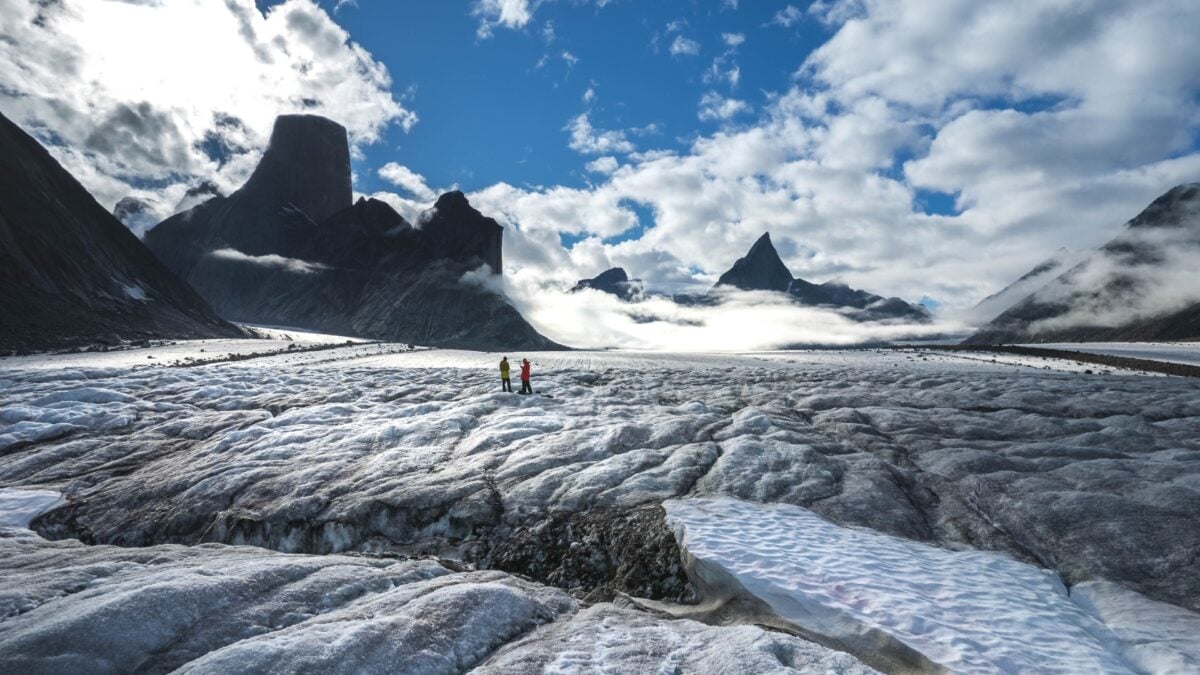
The shrinking ice sheet in Canada’s Arctic tells a surprising story of how humans may have stopped the planet’s next ice age by burning fossil fuels, according to new research. About 20,000 years ago, the once-vast Laurentide Ice Sheet stretched from the Arctic Circle to southern Illinois and was in places up to two miles thick. All that remains of it now is the Delaware-sized Barnes Ice Sheet on Baffin Island in the Canadian territory of Nunavut. About 2,000 years ago, this ice sheet began to slowly and steadily expand again. Its growth marked the beginning of a new period of glaciation, commonly called the ice age, according to a new study published in the journal Science. But around 1960, when human-driven climate change raised summer temperatures, the ice sheet began to shrink abruptly. “It was just beginning, everything was normal, the next ice age was about to happen, and yet it stopped,” said Nicholas Young, an author of the study and a geochemist at the Lamont-Doherty Earth Observatory, part of the Columbia Climate School. “It’s a very powerful example of how we’ve shaken up the system.” For millions of years, the planet has moved in and out of ice ages, driven by changes in Earth’s orbit, and the Laurentide Ice Sheet often serves as a starting point. Young and a group of scientists wanted to understand whether the ice sheet had once been smaller than it is today and then grown again. It’s a difficult task as geological clues are often erased as the ice grows back. The Barnes Ice Sheet, however, is frozen to its bedrock and does not slide, meaning it has preserved the plants it buried as it grew. Scientists gathered long-dead mosses near the edge of the ice sheet and analyzed them to determine when they were last alive. “In fact, we can track the expansion of the ice margin as it progressively covers the mosses and kills them,” Young said. They also examined nearby rocks to find out how long they had been ice-free by testing for a rare radioactive isotope that builds up once a rock is exposed to air. The techniques helped them reconstruct a picture of ice’s past. They found that the ice sheet reached its minimum size about 3,000 years ago and then began to grow again about 2,000 years ago in response to colder temperatures. This resurgence should be considered the beginning of a new ice age, but it never got beyond its infancy before reversing course in the 1960s, the study’s authors argue. “We think it’s no coincidence that that’s happening at the same time we’ve been pumping an extraordinary amount of greenhouse gases into the atmosphere,” Young said. Climate pollution has “essentially dominated” the other mechanisms that “want to cool that region,” he added. Meredith Kelly, a professor of earth sciences at Dartmouth College who was not involved in the study, said the research applies techniques including “novel radiocarbon dating of plants” to establish a good picture of the ice sheet’s advance and retreat. Conclusions that the advance of the Barnes Ice Sheet suggests the onset of an ice age could be correct, he added, but a comparison with glaciers in other regions that were also advancing at a similar time would help better understand the mechanisms at play. Andrey Ganopolski, a physicist at the Potsdam Institute for Climate Impact Research, said there has been a lot of research into whether carbon pollution can significantly delay the start of the next ice age. But, he added, other modeling studies, including his, conclude that the next ice age would not be expected for about 50,000 years, even without global warming. The growth of the Barnes Ice Sheet “is insufficient to support the conclusion that a new glacial cycle had already begun and was subsequently aborted,” he said. Young and his co-authors, however, argue that the first regrowth of the Laurentide Ice Sheet counts as the beginning of an ice age and that we don’t need to wait for huge ice sheets to form to declare that one has begun. The findings also shed new light on a controversial period in the 1970s, when some scientists suggested the world could be entering a new ice age, Young said. This idea was picked up by the media, including a now infamous article in Newsweek with the headline “The World Cooling,” which warned of a food crisis as the world cooled. ⛅ Get CNN Weather in your inbox. The forecast is just the beginning. We’ll send you expert coverage and the stories behind the weather, so you always know more than just the number. Subscribe to the newsletter It is a period when climate change skeptics and deniers often refer to debunking scientists as alarmist and incorrect. But Young believes the new research suggests they were right: “a new ice age had actually begun; it was just starting and now it’s stopped.” Young cautioned that the study should not be interpreted as suggesting that global warming has “saved humanity from an ice age.” Periods of glaciation occur over very long periods of time. Thousands of years would have passed before the ice sheet would have approached a size that would have affected people’s daily lives, he said. Instead, the findings reveal how deeply humans have thrown Earth’s systems out of balance. Not only have we avoided this ice age, Young said, but “we’ve probably postponed any possibility of another future ice age for a long, long time.”