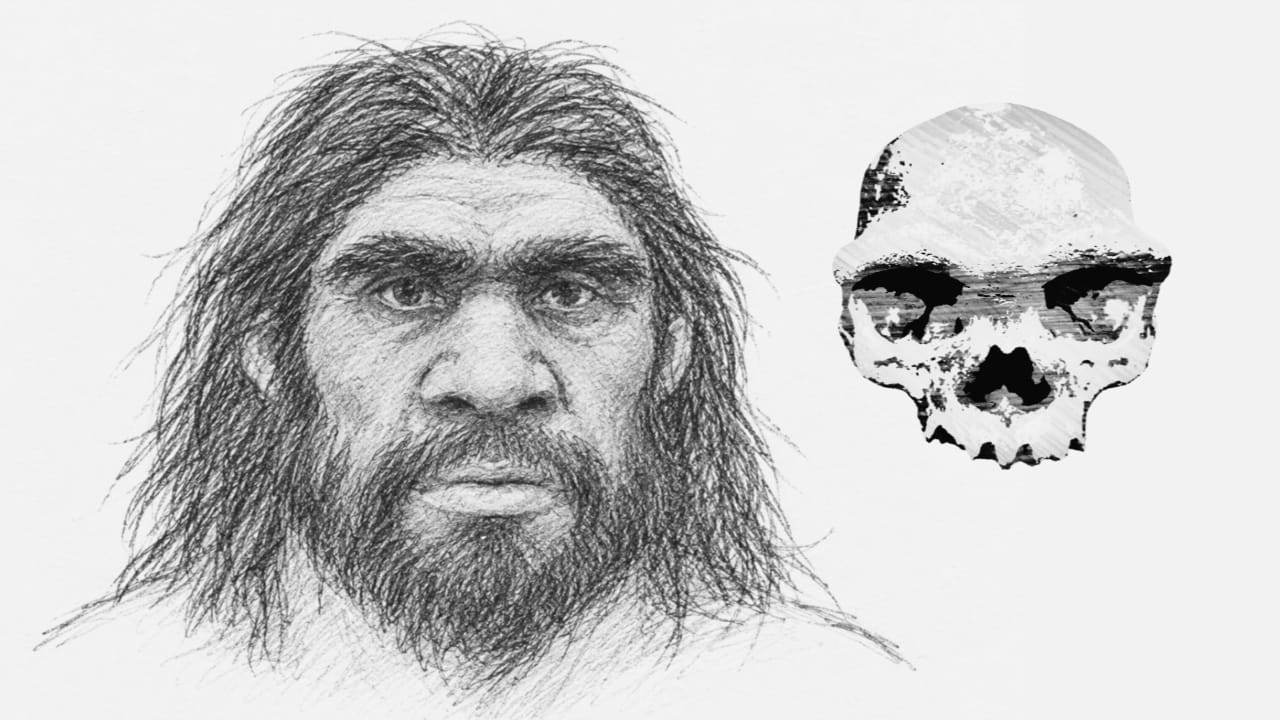
Scientists in China extracted ancient proteins from two bones found at the Xujiayao site and discovered that the people who left them were Denisovans. The result changes the way researchers classify a jumbled group of fossils from East Asia. Denisovans had a distinctive appearance, a study of proteins and skull suggests. Credit: Online archeology news magazine Xujiayao is located in the Nihewan Basin in northern China. Excavators recovered 20 fossils of skulls, jaws and teeth there between 1976 and 1979. The layers date from approximately 199,000 to 138,000 years ago. For decades, experts argued over what to call these people. Some said they were the first Neanderthals, others said archaic Homo sapiens, and a recent proposal gave them the name Homo juluensis. A team led by Qiaomei Fu of the Chinese Academy of Sciences took a different route. They drilled small holes in a piece of right parietal bone and the right mandible ramus, protecting the surrounding fossil, and extracted the proteins inside. The DNA had not survived, but proteins last longer. After the team filtered out the contamination, 18 original proteins remained, 13 from the skull piece and 15 from the jaw. Old collagen shows telltale chemical wear and tear called deamidation. Modern contaminants such as keratin showed almost nothing. The key clue was an amino acid at position 996 of a collagen protein called COL1A2. Neanderthals and modern humans carry arginine there. All Denisovans analyzed so far contain lysine. Both Xujiayao bones contained lysine. The team counted 57 peptides in the skull sample and 61 in the jaw sample with the Denisovan version, and only one missing peptide in each showed arginine. A pedigree constructed from 2,074 amino acid positions placed both samples within the Denisovan group with more than 99 percent statistical support. The data could not classify individuals better. Harbin skull. Fu et al. (2025). CC BY 4.0 Once the identity was established, the researchers studied the bones themselves. The Xujiayao skulls are short and wide, with thick walls, measuring 7.7 millimeters in one place and 12.0 in another. The temporal bone arches strongly, a trait observed in later humans. The jaw has a depression in a triangular patch called the triangular plane, which is rare in other Homo. The Harbin skull, also confirmed as Denisovan, adds a thick brow ridge, a flat midface, and a small jaw projection. Next, the team checked other Chinese fossils, including Jinniushan, Dali, Hualongdong, Xuchang, Xiahe and Penghu. Most share the same combination of characteristics, although no fossil shows them all. The authors maintain that these people also belong to the Denisovan lineage. This would expand the group’s range from Siberia to Taiwan and its time period from about 300,000 to 45,000 years ago. Brain size seemed like a problem at first. Xujiayao 6 contained about 1,700 milliliters, more than the 1,120 to 1,420 measured in other fossils. The authors note that the gap is within the range of modern humans, from 1090 to 1880, so they treat it as normal variation within a population. Publication: Xing, S., Wu, Z., Shao, Q., Ge, J., Bennett, EA, Rao, H.,… Fu, Q. (2026). The proteome of the Middle Pleistocene Xujiayao and the common morphology of Denisova. Nature. doi:10.1038/s41586-026-11132-z