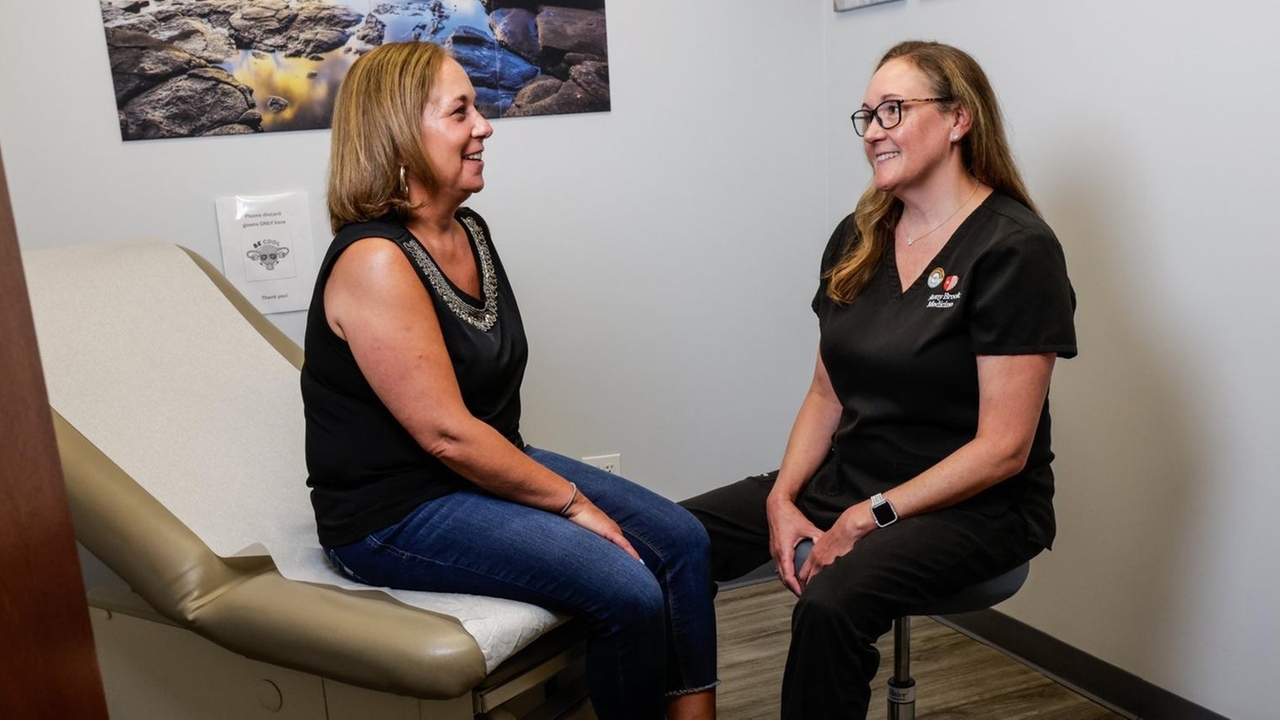
For years, patients came to Dr. Megan Lochner’s office with the same complaints: hot flashes, brain fog, sleepless nights. They were experiencing the common symptoms of perimenopause and menopause, and they were miserable. Lochner, an obstetrician-gynecologist at Stony Brook Medicine, would discuss the benefits of hormone therapy and, if they were a good candidate for the treatment, write a prescription. Dr. Megan Lochner, affiliated with Stony Brook University, at her office in Centereach. Credit: Newsday/Steve Pfost“They would come back and tell me they never started the medication,” Lochner recalled. “I asked why. One woman told me her pharmacist asked if her doctor was trying to kill her. Or if they got the prescription, they would see the “black box” warning — which was scary — and they would never start it.”The warning described risks of cardiovascular disease and breast cancer linked to combination hormone use.Newsday’s Women’s Health series explores what Long Island women need to know while going through perimenopause and menopause.This week’s installments will examine menopause hormone therapy, separate fact from fiction on social media and explore how women navigate menopause in the workplace. Check back on Newsday.com beginning Nov. 10 for Part 2.But now, following updated federal recommendations, Lochner’s waiting room is filled with patients looking for menopause hormone treatment. Pharmacists turn away customers because their supply of hormone patches has run out.“I’m counseling my patients the same way I did a year ago,” she said. “Except now, my patients are more comfortable to start their medication because the black box warning is gone.” I’m counseling my patients the same way I did a year ago. Except now, my patients are more comfortable to start their medication because the black box warning is gone.— Dr. Megan Lochner, an obstetrician-gynecologist at Stony Brook MedicineIn November 2025, the U.S. Food and Drug Administration announced it planned to remove the warning triggered by a 2002 study that many experts said was flawed in its risk analysis of menopausal hormone therapy for most women. And earlier this month, the American College of Obstetricians and Gynecologists updated its guidelines on hormone therapy (previously called hormone replacement therapy or HRT) for menopause symptoms, with a strong recommendation that most patients should receive it. Not all women experience uncomfortable symptoms while going through menopause, doctors note. But those that do said finding relief from them is vital for their well-being.Interest in the treatment — which can involve a combination of estrogen and progestin via pill, transdermal patch, gel, spray and vaginal cream — has soared. But the decision to pursue hormone therapy remains a personal one. And finding the right path isn’t always straightforward.Not feeling rightAngela Pesa, of Deer Park, shrugged off her irritability and sleeplessness to the stress of planning a wedding. Her doctor took blood work twice and said she was not in perimenopause. Her symptoms continued. Angela Pesa, of Deer Park, was hesitant to start hormone therapy. Credit: Newsday/Steve Pfost“My jeans weren’t fitting right but I was very active,” said Pesa, 46. “I run my dog two miles a day. I eat clean. I’m waking up at 3 a.m. like clockwork and my brain is just going. I was not feeling right, I knew something was wrong.”Pesa considered menopause hormone therapy, but said she was initially hesitant because she heard about its possible link to cancer.Her concerns reflect the uncertainty of a treatment that in the mid- to late-20th century was widely prescribed to treat menopause symptoms.’The Pendulum Swung’Menopause is said to have occurred when a woman has gone 12 months without a period, marking the end of her natural fertility. The transition leading up to it, known as perimenopause, can bring hot flashes, night sweats, trouble sleeping, moodiness, vaginal dryness and pain during sex. The average age for a woman in the United States to reach menopause is 52. The history of HRTEfforts to ease menopause and perimenopause symptoms reach back to at least the 1800s when scientists created medicine from the ovarian tissue of cows, according to a scientific paper titled “The History of Estrogen Therapy.” In 1941, Premarin, made from the urine of pregnant mares, was marketed as a way to replace a woman’s estrogen.For decades, menopausal hormone therapy was touted as a way to prevent hot flashes and night sweats, as well as stave off bone and heart disease in women. By the 1960s and 1970s, estrogen was commonly used as hormone therapy, with progestin later added to the regimen to protect the uterine lining.“Years ago, it was seen as the answer to everything,” said Dr. Erika Banks, chair of obstetrics and gynecology at NYU Langone Hospital-Long Island. “Then the pendulum swung.”In 2002, the Women’s Health Initiative, a long-term national health study, released a report that looked at more than 16,000 women between the ages of 50 and 79 on those medications and concluded there was an increased risk of heart disease and breast cancer.The reaction was immediate: women stopped taking hormones.“Providers were afraid to prescribe it,” said Banks. “People learned about it less in training programs.”Some doctors saw the study as too broad, focused on an older group of women, which didn’t reflect the women taking hormones during the perimenopause years. “The average age was 64,” Dr. Stephanie Trentacoste McNally, director of OB-GYN services at Northwell Health’s Katz Institute for Women’s Health, said of the study. “They reanalyzed the data and said a woman going through menopausal transition at that average age of 51 or 52 has a different risk profile.” Dr. Stephanie Trentacoste McNally, director of OB-GYN services at Northwell Health’s Katz Institute for Women’s Health and clinical lead of its menopause and midlife medicine program Credit: Northwell HealthIn an updated 2013 paper, the Women’s Health Initiative researchers said hormone therapy is “a reasonable option for the management of moderate-to-severe menopausal symptoms among generally healthy women in early menopause,” while cautioning against its use to prevent chronic disease.“I think it’s important to be transparent about what symptoms we know hormone replacement therapy treats and what we don’t know,” said Banks. “For hot flashes, it’s a no-brainer.” While many report great success in treating symptoms, hormone therapy is not for everyone. Women who take it may have a higher risk of developing a stroke, blood clots or breast cancer, according to The Menopause Society. They may also experience side effects of nausea, breast tenderness and irregular bleeding.“Sometimes people can feel bloated,” said McNally. “I spoke with one woman who said she felt worse. So she changed her diet, her lifestyle, her exercise and actually felt better by not being on hormones.”Results varyFor Pesa, answers came after a friend persuaded her to go see Dr. Katie Rowan, a menopause specialist in West Islip. Rowan said Pesa’s previous blood tests didn’t accurately represent what was actually going in her body. Dr. Katie Rowan at her hormonal health and menopause care office in West Islip. Credit: Morgan CampbellPesa started hormone therapy and had to try several formulations before she found a treatment that worked. The oral progesterone she was taking along with an estrogen patch only made her feel worse, but the combination transdermal patch was just right.”I feel happier, in a better mood,” she said. “I look forward to my daily runs when it used to feel like a chore. I feel positive about everything in my life again.”She’s also looking for more sun-drenched vacations with her husband.”Last year, I could not sit in the sun and I was miserable,” Pesa said. “So being able to enjoy the sun again and vacations is huge for us.”Her experience reflects why hormone therapy must be specific to a patient.Dr. Ilene Gewirtz, a gynecologist and menopause specialist in East Islip affiliated with NYU, said treatment decision should begin by reviewing a patient’s health history.Gewirtz noted that every patient needs individualized care, even though some come into the office looking to go on the same therapy as their friends.“What works for one person won’t always work for another,” she said. “You need patience when you go on it because in three months we may need to change it again.” What works for one person won’t always work for another. You need patience when you go on it because in three months we may need to change it again.— Dr. Ilene Gewirtz, a gynecologist and menopause specialist in East Islip affiliated with NYU’Like Myself Again”Heather Umhafer was 47 when she knew she had to do something about the fatigue and hot flashes that made it difficult to get through the day.“It was becoming brutal,” the Seaford resident said. “I would literally feel like my body was on fire. That’s the only way I can explain it.” Heather Umhafer, of Seaford, left, speaks with Dr. Megan Lochner, affiliated with Stony Brook University, about hormone therapy. Credit: Newsday/Steve PfostUmhafer went to see Lochner, who prescribed menopause hormone therapy in an estrogen patch and a progestin pill. But a nationwide shortage of patches made them difficult to find. So she used the estrogen gel on her leg.“The hot flashes stopped by the second or third night, and I haven’t had them since,” she said. “I definitely feel clearer minded.”Patches that are applied to a patient’s skin are the most popular form of menopause hormone therapy. Taking the hormones through the skin is considered by many to be safer than a pill since it does not have to be processed through the body and the liver.Experts said all women can benefit from making sure they follow proper nutrition and exercise. Some of the anxiety and mood swings can be treated with talk therapy and mental health medications. Studies have shown some prescription antidepressants, such as Lexapro, have been shown to reduce hot flashes in menopausal women. Lochner said the most satisfying words to hear from her patients is when they say, “I feel like myself again.”“There’s not that many times, honestly, that we get that kind of feedback.”Lesser-known menopause symptoms For many women, hot flashes and night sweats go hand in hand with their menopause journey. But they may also experience other symptoms they had no idea were part of going through menopause.Dry, itchy skin: The loss of hormones and collagen impacts skin during menopause. It loses some of its ability to hold water, according to the American Academy of Dermatology Association, leaving it feeling dry and thin. Skin may also bruise easier.Dry mouth: Estrogen helps the mucous membrane that lines the mouth, and it aids in the production of saliva, according to the Mayo Clinic. When estrogen production slows, your mouth might become dry.Facial hair: The balance of sex hormones shifts during menopause, according to the Mayo Clinic. As a result, some women might grow extra facial hair.Red, dry eyes: Some women feel their eyes are dry, burning or stinging during menopause, according to Johns Hopkins Medicine. They may experience excessive tearing or become more sensitive to light. Hormones impact the glands that produce oil in tears. Less oil makes them evaporate more quickly, the health system said.
Lisa joined Newsday as a staff writer in 2019. She previously worked at amNewYork, the New York Daily News and the Asbury Park Press covering politics, government and general assignment.