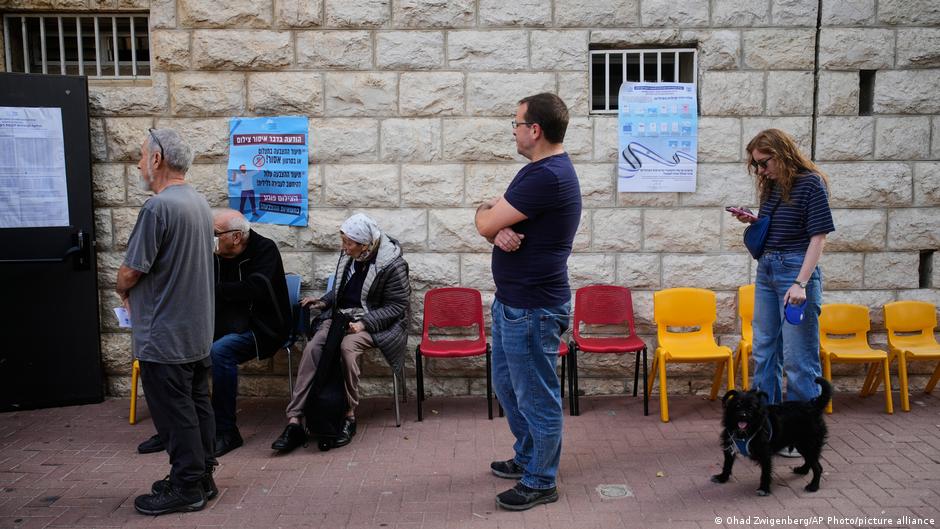
7.3 million people have the right to vote to elect the 120-member Knesset. Image: Mostafa Alkharouf/Anadolu Agency/IMAGO Who has the right to vote? About 7.3 million Israelis (including about 1.2 million Palestinian citizens of Israel) are eligible to vote on Tuesday. More than 640,000 young Israelis will be able to vote for the first time in a general election. Around 3.1 million Palestinians living under Israeli occupation in the West Bank do not have the right to vote in Israeli elections, but 500,000 illegal settlers in those territories do. Another 350,000 Palestinians live in Israeli-occupied East Jerusalem and cannot vote, while around 230,000 Israelis living there can. The US-Israel Coalition for Democracy (AID Coalition), a US-based nonprofit organization, has organized a “Fly&Vote” initiative, which will see up to 67,000 voters return to Israel to participate in the elections, based on expatriate surveys and registration data. The coalition said half come from the United States, and others from Europe, Canada, Australia and New Zealand. Israel does not have postal voting. How does the voting system work? Israel is a parliamentary democracy and voters elect a legislature rather than directly electing their prime minister. Voters choose a party “list.” Israel uses a system of proportional representation under which 120 parliamentary seats are distributed roughly in proportion to a party’s share of votes. To enter parliament (known as the Knesset), parties must receive at least 3.25% of valid votes, which is roughly equivalent to four seats. The party that can obtain a majority of at least 61 seats must form a government. No party has ever won an absolute majority, so Israel has always been governed by coalitions. Polls suggest this year will be no different. Unlike many other democracies in the world, Israel is not divided into geographic electoral districts. Instead of electing individual legislators to represent local areas, voters in Tel Aviv, Jerusalem and Haifa choose from the same party lists in a single national constituency. When the polling stations close at 10:00 p.m. local time (9:00 p.m. CET), broadcasters will publish their first exit polls, offering a first indication of the results. Official results are scheduled to be released on November 4. The youth vote could play a crucial role in Israel’s elections. To view this video, please enable JavaScript and consider upgrading to a web browser that supports HTML5 videos.