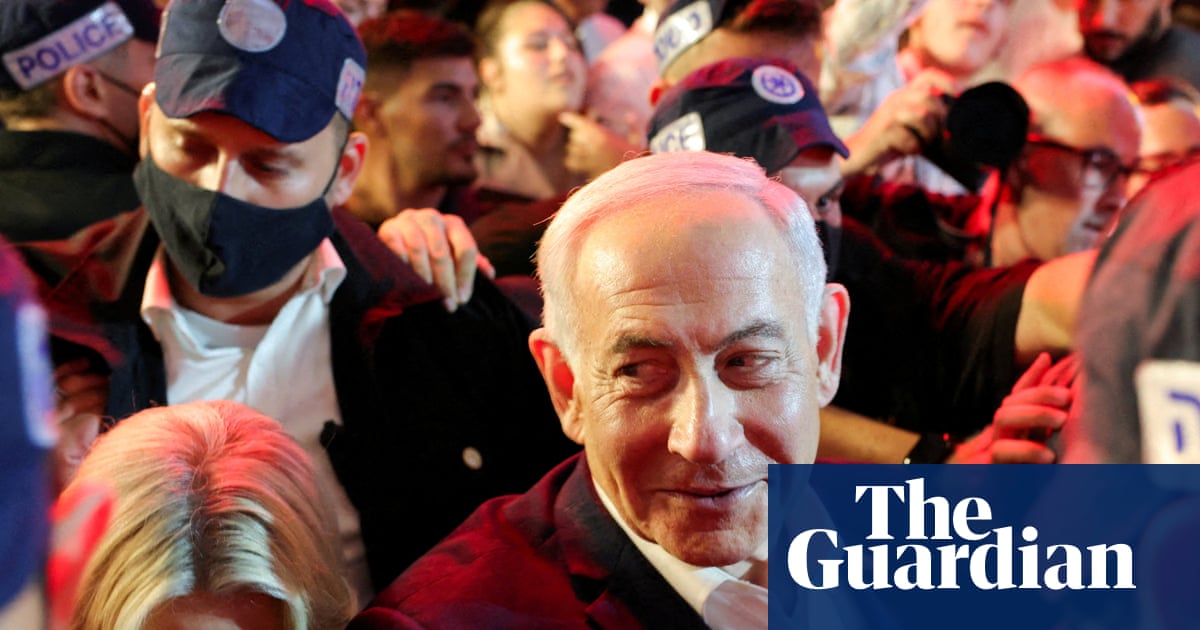
Benjamin Netanyahu has resorted to increasingly alarmist rhetoric and reportedly pressured Israel’s military to take action against Iran, as his far-right coalition trails far behind in polls ahead of Tuesday’s tight election. The Israeli prime minister posted an AI-generated image of a nuclear mushroom cloud destroying Tel Aviv, urging Israeli voters to elect him or risk nuclear annihilation. shaking hand before voting [the opposition]”He wrote in a social media post about Iran’s nuclear program. It is a very sensitive situation,” causing a miscalculation on Iran’s part. Zamir reportedly requested that the directive be presented to him in writing, the details of which were not specified. Netanyahu denied the report, and the Defense Ministry subsequently denied any intention to carry out military operations against Iran. However, on Monday, CNN reported that Netanyahu had tried to convince Donald Trump to launch a new attack on Iran in recent weeks, renewing the war the two men started in February. The Financial Times said Trump had ruled out any such action until the US congressional elections next week. The Israel Defense Forces (IDF) issued a statement on Monday that stopped short of denying the press reports. They simply insisted that their decisions were based exclusively on “security, professional, objective and national considerations.” Netanyahu’s warnings stood in stark contrast to his triumphalism immediately after the wars against Iran that were launched last year and this spring. destroyed Iran’s ability to enrich uranium and produce ballistic missiles, and in 2025 claimed a “historic victory” over Iran that would last for generations. Gadi Eisenkot, leader of the opposition bloc and Netanyahu’s most likely rival for the prime minister’s post, expressed confidence in Zamir. “We will not allow the IDF to become a pawn in Netanyahu’s survival campaign,” said Eisenkot, who is a retiree. General.Gadi Eisenkot, the leader of the opposition bloc, is Netanyahu’s most likely rival as prime minister. Photograph: Abir Sultan/EPA. Most polls suggest that the mainly center-right opposition bloc led by Eisenkot is poised to win more seats in Israel’s Knesset than Netanyahu’s coalition, but neither would be able to muster the 61 seats needed for a majority government. Most likely, the opposition will be able to gather a majority and overthrow Netanyahu. coalition with parties representing Palestinians with Israeli citizenship, about a fifth of the population, but conservatives within the Eisenkot bloc have ruled out such a coalition, raising the possibility of a minority government, another round of elections and a possible Netanyahu resurgence. As the election approached, Netanyahu viewed the country’s choice as existential. as the “left” in alliance with the Palestinians and enemies of the country “We see what is happening in Europe. The alliance between the left and Islam could destroy the State of Israel,” he said. The main opposition parties are right-wing or center-right, share Netanyahu’s firm opposition to the establishment of a Palestinian state and have largely supported the war in Gaza. Some opposition leaders have ruled out any kind of political alliance with Palestinian Israeli parties, which could emerge from the elections that maintain the balance of power in the Knesset. Palestinians in the occupied territories do not have the right to vote. The opposition bloc is held together more by their shared antipathy toward Netanyahu, who has dominated the Israeli political scene for the past three decades and has leaned increasingly toward authoritarianism, seeking to limit the independence of the judiciary and turn the police and the Shin Bet internal security service into political tools. The prime minister is also in the middle of a trial on corruption charges, and his legal danger could increase if he loses control of power. Benjamin Netanyahu has been emphasizing the support he has from Donald Trump in his campaign. Zwigenberg/AP In the final stages of the campaign, Netanyahu has also emphasized the open support he enjoys from Donald Trump, who repeated his endorsement on Sunday in a social media post, saying: “When you go to the polls, remember that Bibi has been an excellent warrior prime minister!” Israeli outlet Walla News reported that this repeated endorsement was the result of relentless pressure from Netanyahu’s office. The US president’s previous “full endorsement” on October 18 made no visible difference in the polls. In one poll, 64% of Israelis surveyed said it would not influence their vote, and 17% said it made them less likely to back Netanyahu, compared to 12% who said it had deepened their resolve to support Netanyahu’s Likud party. “Cryptocurrencies cannot serve as a means to circumvent sanctions,” the Bank of Israel said on Sunday evening. “The right path for the Israeli economy is to maintain economic relations with our main trading partners and focus on preventing sanctions and their negative impact on the economy.” He already forecast a bleak and isolated future a year ago, when he said Israel might need to become a militarized “super Sparta,” and then backed down in the face of fierce criticism from a horrified Israeli public. His return to this rhetoric and fear tactics, particularly after unexpected losses for far-right allies in Serbia and Brazil, raised questions about whether the last political survivor might finally be on the ropes. Few among his allies or enemies expected his government to survive long after October 7, much less complete. his term, but most polls have made it clear for more than two years that his current coalition appears to be on the verge of losing its slim majority.