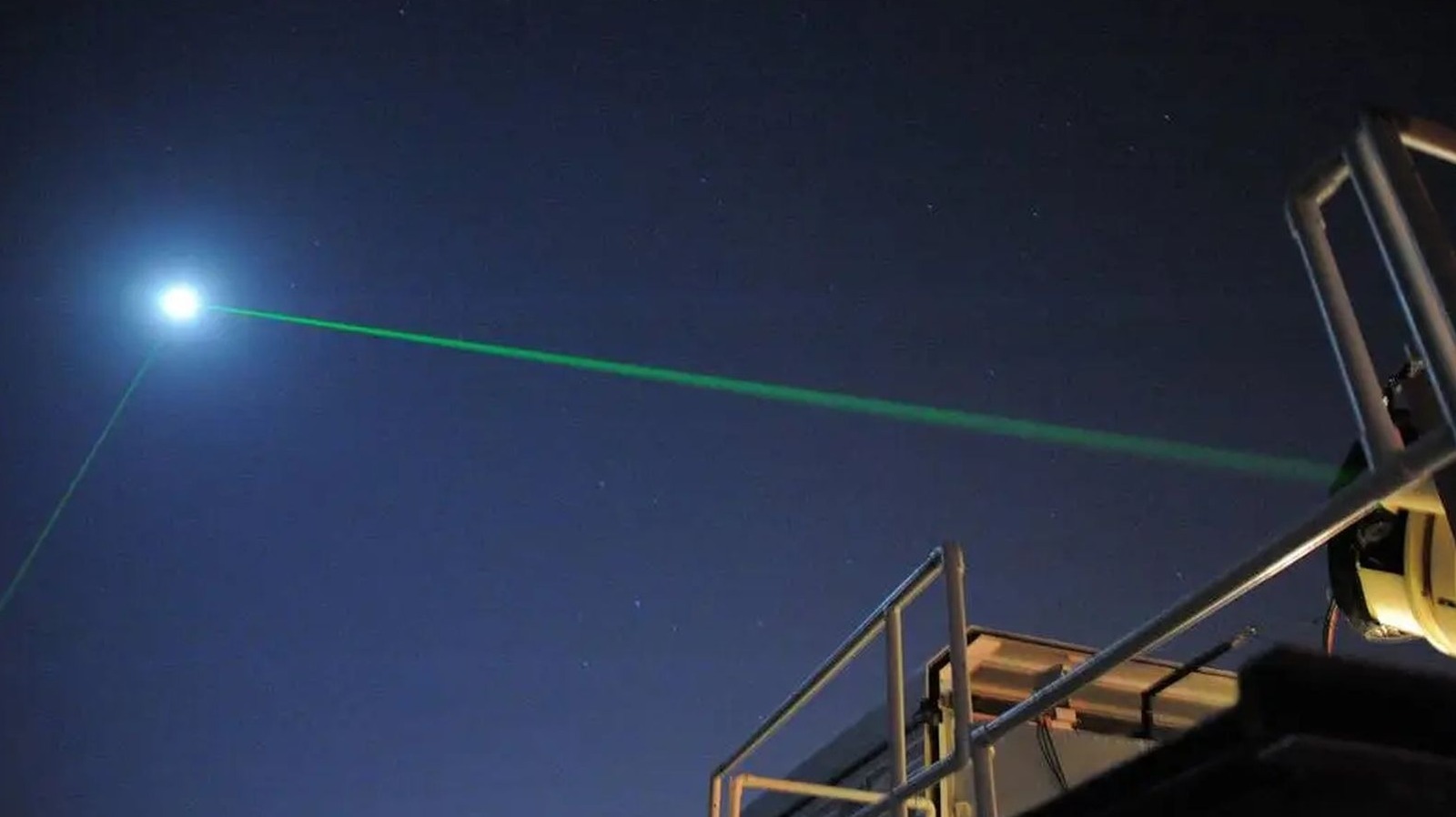
On average, the Moon is about 238,855 miles from Earth. Depending on where it is in its orbit, it can be as close as 226,000 miles or as far away as 251,000 miles. With a radius of about 1,080 miles, it is the fifth largest moon in our solar system, but it is only one-third the width of the big blue marble we call home. For better visual reference, think of the Earth as the diameter of a nickel and the Moon as that of a small pea or coffee bean. Approximately 30 nickels, or Earth-sized planets, would fit between the two. We’re not going to delve into how a laser works, but we do know that the compact beam of a laser is very different from the scattered light emitted by a light bulb or flashlight. The word “laser” itself is not a word at all, but rather an acronym for Light Amplification by Stimulated Emission of Radiation. A laser beam, which does not occur naturally, is made up of individual particles of light energy called photons. This tightly focused stream of coherent light waves will travel in one direction without scattering. So if the beam were fired into space, it would continue forever until it hit a solid object like the Moon. Aside from the ever-expanding universe, nothing can go faster than the speed of light, at least as we currently understand it. That universal speed limit is 670,616,629.3844 miles per hour. Although laser light differs from normal light, it is still light. Therefore, a laser beam would take between 1.21 and 1.35 seconds to reach the Moon, also depending on where it is in its celestial path. Lasers bouncing off the Moon Ah, but these numbers are not simply derived from a mathematical equation; have been measured in real life. Unless you’re a die-hard astrophile, you may not realize that there are currently five reflective panels on the Moon. These panels have what scientists call “corner cube” mirrors attached because they are literally corners of a glass cube that can reflect light back toward its source, no matter where it comes from. Do you see where we are going here? The first was laid down by the Apollo 11 astronauts in 1969, which had a total of 100 corner cubes. The Soviets launched their first robotic vehicle (Lunokhod 1) in 1970, which had 14 mirrors. In 1971, the Apollo 14 crew placed one with 100 corner cubes, while the Apollo 15 crew placed another with 300. The Soviet Lunokhod 2 (with 14 mirrors) was abandoned in 1973. The goal was to fire a laser beam from the Earth to the Moon to track the distance between them over time. On average, it takes light about 2.5 seconds to make a round trip. It turns out that these two celestial bodies actually move about 1.5 inches apart each year. But those old mirrors were starting to get dirty, probably from lunar dust kicked up by small meteorite impacts. Thus, in June 2009, NASA launched the Lunar Reconnaissance Orbiter (LRO) to study our closest celestial body from its own orbit. Attached was a new, improved, clean reflector that NASA said was “the size of a paperback novel.” Interestingly, it took more than a decade for lightning to reach its target, but it finally did so in August 2020.