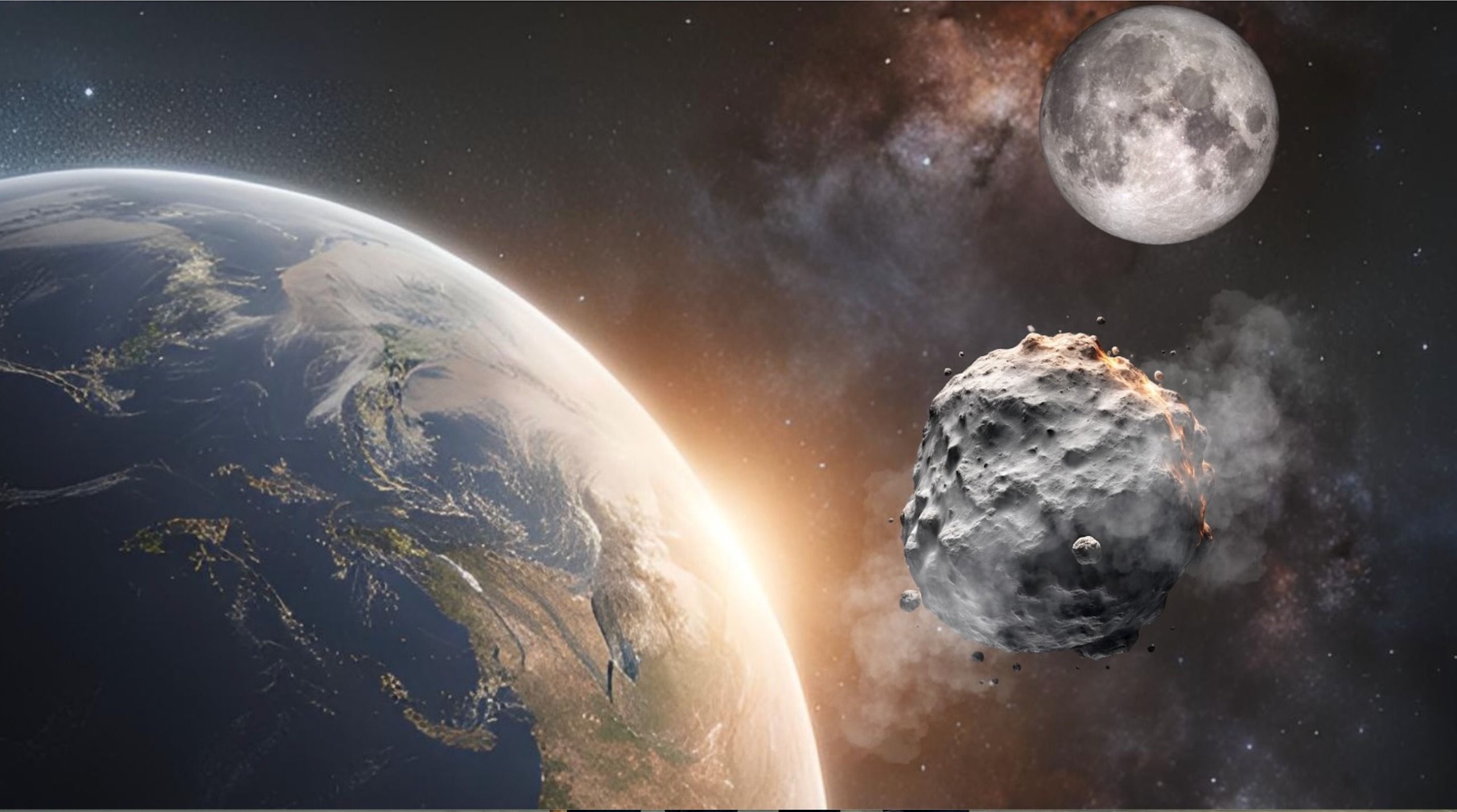
Follow us Add us as a preferred source on Google Newsletter Subscribe to our newsletter The Earth almost always has more than one moon. The others are simply very small and never stick around for long, but they could provide accessible and unique information about the solar system. Temporary satellites, or minimoons, are small asteroids that approach Earth and are briefly captured by our planet’s gravity. A typical moon stays for about nine months and circles the Earth about three times before escaping back into orbit around the Sun, Grigori Fedorets of the Finnish University of Helsinki said in a presentation at the Europlanet Scientific Congress (EPSC) 2026 in The Hague in September. Fedorets’ modeling suggests that the largest minimoon around Earth at any given time is usually only about 75 centimeters (30 inches) wide. An asteroid about 3 meters (10 feet) wide should be captured every 10 to 20 years. “This is not just a theoretical construct. There is observational evidence,” Fedorets said. However, only two minimoons have been confirmed to date: 2006 RH120 and 2020 CD3, both discovered by the Catalina Sky Survey in Arizona. Two fireballs, seen over the Czech Republic in 2013 and Australia in 2016, were traced to objects that had been in geocentric orbits. Two other asteroids, 2022 NX1 and 2024 PT5, were captured only briefly, without completing a full orbit. Fedorets noted a possible third minimoon: the recently detected Sar2901, which could also be an artificial object. Sar2901 has since disappeared from view, but should become observable again in mid- to late November, according to the Minor Planet Center. You might like Little Rocks, Big Questions Minimoons are so small that scientists know little about them. For objects between 1 and 10 meters (3.3 to 33 feet) in diameter, near-Earth asteroid population models do not agree with numbers suggested by records of fireballs in Earth’s atmosphere. The minimoons are located right in that space, so finding more of them should show which image is correct. They can also reveal how much of the material in Earth’s neighborhood originates from our moon, as some small asteroids may be pieces of the lunar surface launched into space by impacts. During the temporary flyby of asteroid 2024 PT5, for example, scientists found that its spectrum was closer to lunar rock than typical asteroids, according to a 2025 study led by Theodore Kareta, which Fedorets described as the strongest evidence yet for lunar ejecta among Earth’s small neighbors. Kamo’oalewa, a much larger asteroid and quasi-moon on Earth, reached by China’s Tianwen-2 mission in July, has been the subject of debate over possible lunar or asteroidal origins. Rubin changes the rules of the game and throws in budget samples. The Vera C. Rubin Observatory’s 10-year Legacy Survey of Space and Time (LSST) transformer should find many more minimoons, although more work will be needed. On its own, Fedorets estimates, the study should detect a minimoon about once every two years. Fedorets and his colleagues are setting up a dedicated system running on a virtual server at the Scientific Computing Center of Finland, to filter Rubin alerts through the real-time astronomical data broker ANTARES to flag potential minimoons for follow-up observations, which could increase detections to two or three per year. What to read next Making periodic discoveries could open doors for future missions, providing targets for relatively easy and low-cost asteroid sample return missions. The minimoons’ proximity to Earth and their low relative velocities mean that less rocket propellant is needed to reach these tiny targets and return to Earth. Initially, Fedorets envisions cubesat technology demonstration missions, which would pave the way for medium-sized missions that could collect samples. He sees the Tianwen-2 low-energy sampling mission as a possible stepping stone toward resource utilization, while noting that, at the higher end of the scale, there have been programs such as NASA’s canceled Asteroid Redirection Mission (ARM) and plans by, for example, TransAstra to put a 100-ton asteroid into a stable orbit around Earth. “This is not science fiction,” Fedorets said. “These people are really thinking about this kind of thing.” The short warning times and instability of minimoon orbits dictate potential mission profiles. A spacecraft could wait in Earth-Moon space, ready to head to a newly discovered mini-moon, similar to how ESA’s Comet Interceptor will launch and then wait for a suitable comet to be studied. Asteroids could also be pushed into more stable orbits, allowing for longer future missions. “The LSST is now online, and over the next 10 years, we are expected to find many more of these temporary moons,” Fedorets said. Regular discoveries could pave the way for exploration in the early 2030s and sampling missions later in the decade.