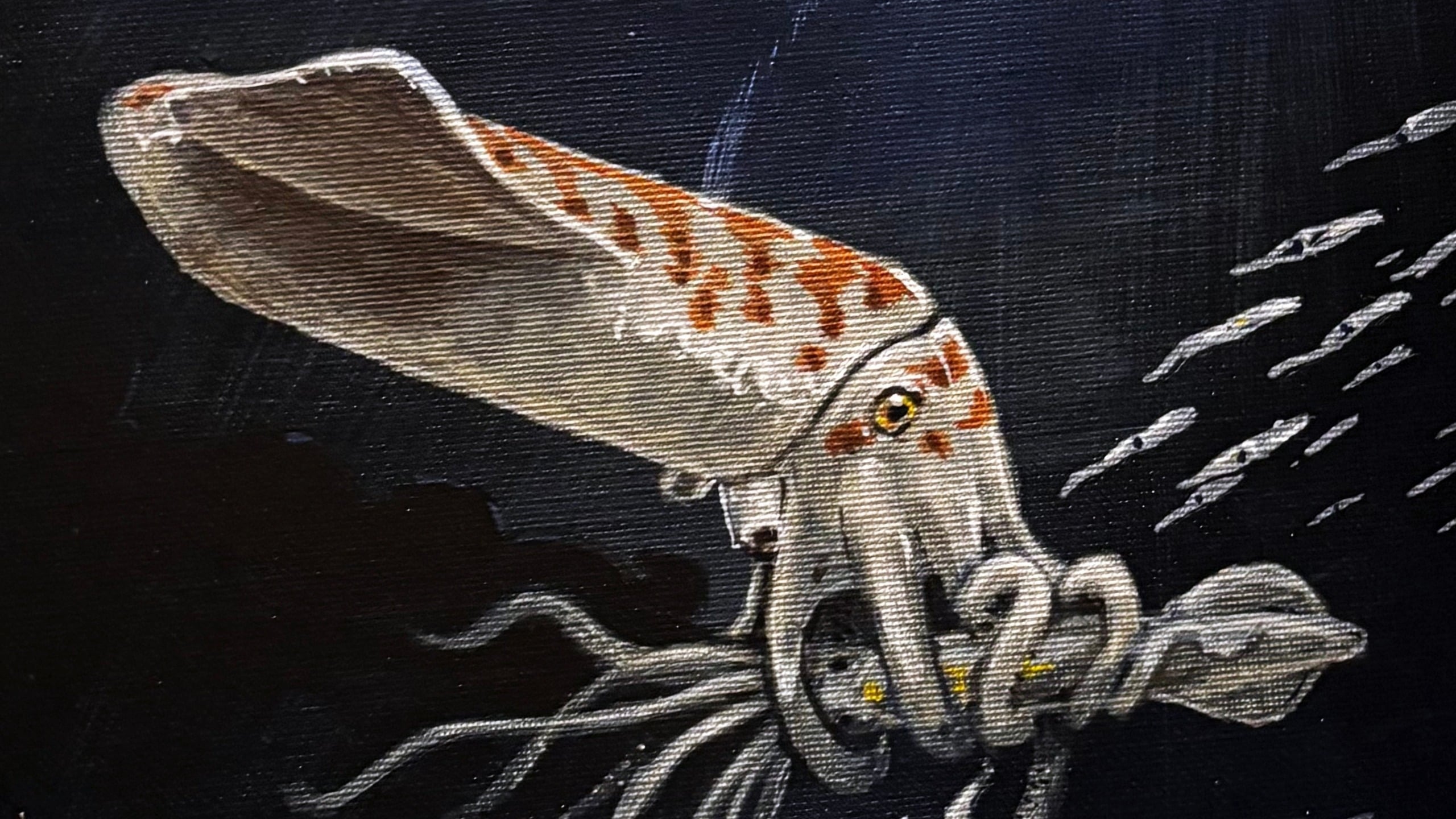
Paleontologists have identified an entirely new squid-like creature from the Jurassic from a pair of fossils recovered from the floor of an ancient inland sea in Wyoming. They say it is one of the “thickest known species” of its prehistoric group. Wyoteuthis linsterorum is the name of the species, in recognition of the experienced fossil collector Cliff Linster, who discovered one of the fossils, but died earlier this year. It is the only species of Wyoteuthis so far. The species made its scientific debut in the journal Papers in Palaeontology. A map showing where the fossils were found, in the Redwater Shale layer of the Sundance Formation. (Ippolitov et al., Papers in Palaeontology, 2026) Wyoteuthis is a member of an extinct order of cephalopods, the belemnites, which proliferated during the Jurassic. Its living relatives include octopuses and squid. Like modern squids, belemnites had 10 appendages, but they also had a cone-shaped inner shell. Part of the shell was made of aragonite, like that of modern cephalopods. You may have seen the floating, foam-like bone of a cuttlefish washed up on the beach: that’s aragonite. But the other part of a belemnite’s internal structure, known as the guard or rostrum, is made of calcite. They are those calcitic structures found scattered throughout the Sundance Formation and other fossil deposits around the world, evidence that belemnites were once abundant in Jurassic seas. Wyoteuthis fossils are around 160 million years old. But Wyoteuthis is unlike any other belemnite experts have ever seen, with a face so round that even scientists have literally described it as “one of the thickest species known in the group’s paleontological history.” Wyoming paleontologist Bill Wahl, who has been searching for fossils in Wyoming for much of his career, says the species “sticks out like a sore thumb.” thumb.” Paratype and holotype of Wyoteuthis linsterorum with scale bar. (Jessica Lippincott) Most belemnite fossils found in Wyoming (and there are large quantities of them) measure between 50 and 100 mm (2 to 4 in) long and between 10 and 20 mm wide. “With a diameter reaching ~60 mm at the anterior end, these rostra are the thickest yet known for belemnites,” write belemnites expert Alexey Ippolitov and his colleagues. The specimens are a bit broken up, but based on what remains, the researchers estimate that Wyoteuthis’s rostrum was between 160 and 175 mm long. “In other words, Wyoteuthis was a ‘thick’ but rather short squid,” the team writes. Existing methods for calculating the total length of a belemnites, with arms and all, suggest that Wyoteuthis was between 55 and 60 cm (22 to 24 inches) long, from the tip of its mantle to the end of its arms. But, the researchers add, “the size of the rostrum does not automatically indicate a large size of the animal and a high position in the trophic pyramid.” “Wyoteuthis linsterorum is a thick, peculiar belemnite, rarely seen in the Redwater Shale member of the Sundance Formation,” they note. It was part of the family Megateuthididae, which includes Megateuthis, the largest known belemnite, a group that had a very good run after the Toarcia extinction, when the The ocean lost massive amounts of oxygen. Creatures that are more resistant to change can thrive under these circumstances, and cephalopods are especially known for that ability. But then, in the Middle Jurassic, most megathutidid lineages became extinct, overtaken by other belemnites. The researchers say Wyoteuthis is most likely “a burly survivor of a lineage that would otherwise be lost to the depths of geological time.” Paleontology. This article was fact-checked by Rebecca Dyer and edited by Rebecca Dyer. While we take pride in our process, we’re human. If you spot an error, please let us know.