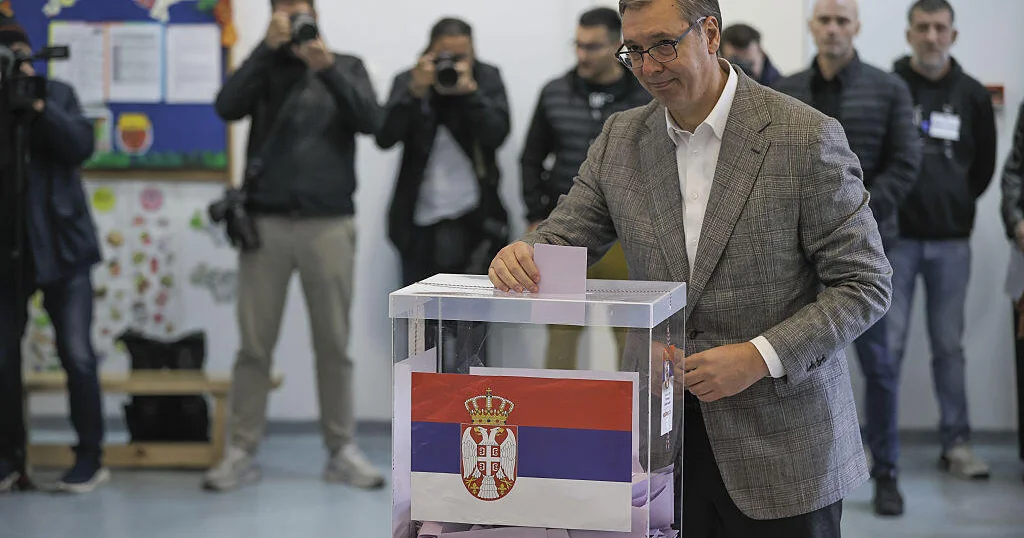
Serbia’s veteran leader Aleksandar Vucic admitted defeat Sunday in an election that pitted him and his right-wing party against a diverse student-led opposition movement that spent two years protesting against his government. It was a seismic political shift in the Balkan country where Vucic, who had been backed by Russian President Vladimir Putin and who denounced the student movement as a foreign-led attempt to overthrow him, ruled with virtually absolute power for 14 years. High turnout and rising tensions marked the hotly contested parliamentary elections that were a showdown between Vucic and his right-wing Serbian Progressive Party and university students who, accusing the government of corruption and dismantling democracy, had gained a popular following across the country. Serbia’s 6.4 million voters were electing lawmakers to the 250-member Parliament. In conceding the election, Vucic said his party projects its opponents, the youth-backed Student List, will win between 135 and 140 seats, while his SNS party will have about 105. “The Student List has won,” Vucic told supporters at his party’s election night event, though he blamed Serbia’s independent media as well as alleged interference from unnamed European countries and an “American deep state” for the election. loss. Aleksandar Vucic casts his vote at a school polling station in Belgrade, Serbia, on October 25, 2026, during the country’s early parliamentary elections. Samir Jordamovic/Anadolu via Getty Images Vucic said his SNS party got about 1.7 million votes compared to the Student List, which he said got about 2.2 million. Student List supporters immediately flooded the streets of Belgrade and other cities, honking horns, shouting and chanting: “Aleksandar is gone,” referring to Vucic. The result, which Vucic announced just an hour and a half after polls closed, came after tensions rose as voting progressed throughout the day. Police in riot gear cordoned off an area in central Belgrade around the electoral commission headquarters. Special police vehicles could be seen near a Belgrade park where Vucic loyalists have been camping for more than a year, and large groups of men dressed in black had gathered at various points in the city. Vucic was seeking to become Serbia’s prime minister after two nearly full terms as president. He resigned from the presidency last month to lead the campaign. Support for the populist had eroded since 16 people died in 2024 when a concrete canopy collapsed at a train station in Novi Sad. That sparked a wave of youth protests who blamed the collapse on high-level corruption, cronyism and rampant graft during renovation work at the station. Despite the protests, Vucic retained considerable support among many of Serbia’s voters. His admirers saw him as a capable leader who can lead the nation through global uncertainties – the image that was carefully crafted by the mainstream media. While the increasingly authoritarian Vucic has consistently outmaneuvered Serbia’s fractured opposition in the past, the leaderless youth movement proved a tough opponent that shook his firm grip on power in Serbia like no other in the 14 years since his party took power. The newly formed Student List movement was formed by university students, but none appeared on the electoral list. Instead, their candidates are little-known experts, athletes, farmers and artists. This approach was intended to counter Vucic’s one-man rule and restore a sense of community and solidarity. The students’ message during the campaign focused on a nonpartisan effort to rebuild Serbia’s economy and restore its democracy. Students have used youthful energy to attract voters disillusioned with local politicians. Vilified by the pro-government media, they cycled and walked across the country to reach voters in rural areas, Vucic’s traditional strongholds. The student victory echoed the recent electoral defeat of a Vucic ally in Hungary, where youth participation helped topple autocratic Viktor Orbán after 16 years and form a new pro-European government. It was likely to resonate beyond Serbia, as countries across Europe have faced protests by angry youth and students. Observers predicted that total turnout in the elections could reach around 70%, something not seen in Serbia since 2000. Throughout the day, long queues formed at polling stations in Serbia and cities around the world. Some members of the Serbian diaspora were forced to vote in the middle of the night after authorities linked voting hours to local Serbian time. Recent Serbian elections had been marred by irregularities and the EU was closely watching developments in Sunday’s vote in a nation candidate for membership in the bloc. Independent election observers on Sunday reported dozens of cases of irregularities, including photos of ballots suggesting pressure on voters and attempted vote buying. Both international and local election observers had expressed concerns about the security and fairness of an election campaign marked by arrests, near-total government control over the media, and reports of surveillance and cyberattacks against activists. Local elections earlier this year in 10 Serbian municipalities saw violent attacks against journalists and activists. The previous parliamentary vote in 2023 was followed by opposition protests alleging fraud. In: