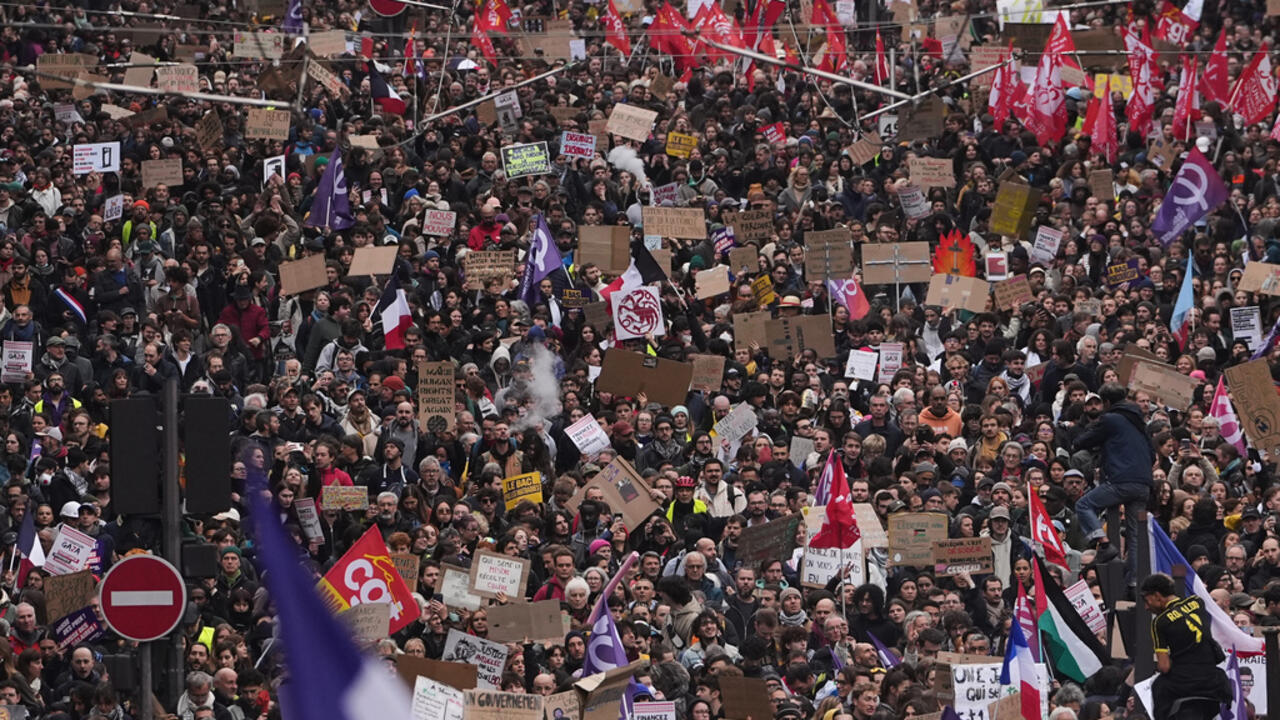

Clashes broke out Saturday in Paris and other French cities amid protests a week after others that degenerated into street violence and sparked a strong security reaction as President Emmanuel Macron seeks to restore order. Police arrested almost 1,000 people as officers faced “an extremely high level of violence” by black-clad “ultra-left” extremists, Interior Minister Laurent Nuñez said. Squads of riot police fired tear gas at protesters in the capital, as well as in Marseille, Lyon, Bordeaux, Lille, Toulouse, Montpellier and Nantes. Read moreFrench police deploy in large numbers, major Paris museums close ahead of new protests Two people were “seriously” injured, Nunez said: a man in Toulouse, whose fingers were reportedly blown off, and another person in Clermont-Ferrand. He did not provide details of any of the cases. The authorities had deployed 70,000 security forces throughout the country for the new marches, called to protest the cost of living. The violence came a week after riots in which public buildings were vandalized, hundreds of stores looted and 2,700 people arrested, casting a shadow over a country that will go to the polls in six months to elect a successor to Macron after 10 years. Núñez said Saturday’s result was more “positive” than a week ago, with more police on the streets acting more quickly, conducting more pre-demonstration checks and better protecting businesses. However, there was widespread anger against the government for its crackdown on protests, seen as an attack on the right to protest. Police fight against “troublemakers” Saturday’s demonstrations attracted between 410,000 and 800,000 people throughout the country, according to different estimates by the authorities and the organizing union CGT. The main march in Paris had between 110,000 and 250,000 attendees, according to these sources. Paris: The protest begins at Porte d’Italie, after a last-minute change of route. To display this YouTube content, you must enable ad tracking and audience measurement. OK Manage my options One of your browser extensions appears to be blocking the video player from loading. To view this content, you may need to disable it on this site. Try again Cover image: © France 24 Macron’s government has ordered police to prevent protesters from reaching city centers where shops are concentrated, and in Paris and some other cities partial curfews were imposed in certain urban areas. The French president had ordered that non-union demonstrations be banned as “illegitimate.” In Paris, where many shops had boarded up windows to prevent looting and the Louvre and Musée d’Orsay museums closed for the day, the main demonstration passed largely peacefully. Read moreFrance to deploy 70,000 police officers as students call for new protests on Saturday The march had been pushed to the southeastern edge of the capital by last-minute order from the authorities. However, clashes later broke out as the crowd dispersed. Núñez said the clashes lasted two hours and involved “500 rioters” at the end of the march. Protests continue as police fire tear gas at protesters. To display this YouTube content, you must enable ad tracking and audience measurement. OK Manage my options One of your browser extensions appears to be blocking the video player from loading. To view this content, you may need to disable it on this site. Try again Cover image: © France 24 AFP journalists saw police charge several times and forcefully use tear gas and batons against some protesters, mostly young people. “The police started approaching everyone, telling them to get down and back away. They were just knocking people down, hitting protesters,” a protester, bleeding from a blow to the face, who identified himself as David, told AFP. Ultra-right versus ultra-left In the western city of Nantes, thousands of protesters broke police lines, launching tear gas and water cannons to reach the city center, according to an AFP journalist. Emma, 23, while marching in the northwestern city of Rennes, said she was angry at “everything that is happening right now”, denouncing bans on demonstrations and the “repression” of high school student protests. Marching in the rain leading the protest in the northern city of Lille, Delphine, 47, insisted: “Neither the president nor the weather will stop me from demonstrating.” In Lyon, police used tear gas to disperse about 1,000 people gathered in the south of the city. Read moreNearly 1,000 arrests in the framework of Saturday’s protests, says the government “If they ban the protests it means that we are heading more and more towards a fascist, that is, dictatorial, regime,” said a 20-year-old protester in Lyon, who only gave his first name, Silem. In the southern cities of Cannes and Montpellier, far-right activists took to the streets seeking clashes with “ultra-left militants,” in what authorities said was an unprecedented development. There was looting on the sidelines of the marches in Marseille and Grenoble, police said. Meanwhile, the yellow vests, who staged disruptive protests against Macron eight years ago, called for more demonstrations on October 31 for “the freedom to protest.” Far-left presidential candidate Jean-Luc Melenchon, who participated in the Paris rally, said Macron “will understand that this will be repeated every week.” Protest against Le Pen’s party Tensions intensified with a demonstration in the city of Orleans by the National Rally party of far-right leader Marine Le Pen to begin its campaign for the presidential elections. Thousands of counter-protesters chanting anti-fascist slogans marched through the city. Police estimated the number at 13,000, while organizers said twice as many participated. The riots across France highlighted the febrile political atmosphere ahead of the vote, in which Le Pen leads the polls. Inflation in France, which particularly affects the cost of fuel, has soared since the start of the war in the Middle East in February. There have also been protests in Italy, Belgium, Spain and Portugal over different issues, although with some overlap regarding inflation and educational problems. Italy has mobilized 500 soldiers to Milan after street violence there. (FRANCE 24 with AFP)