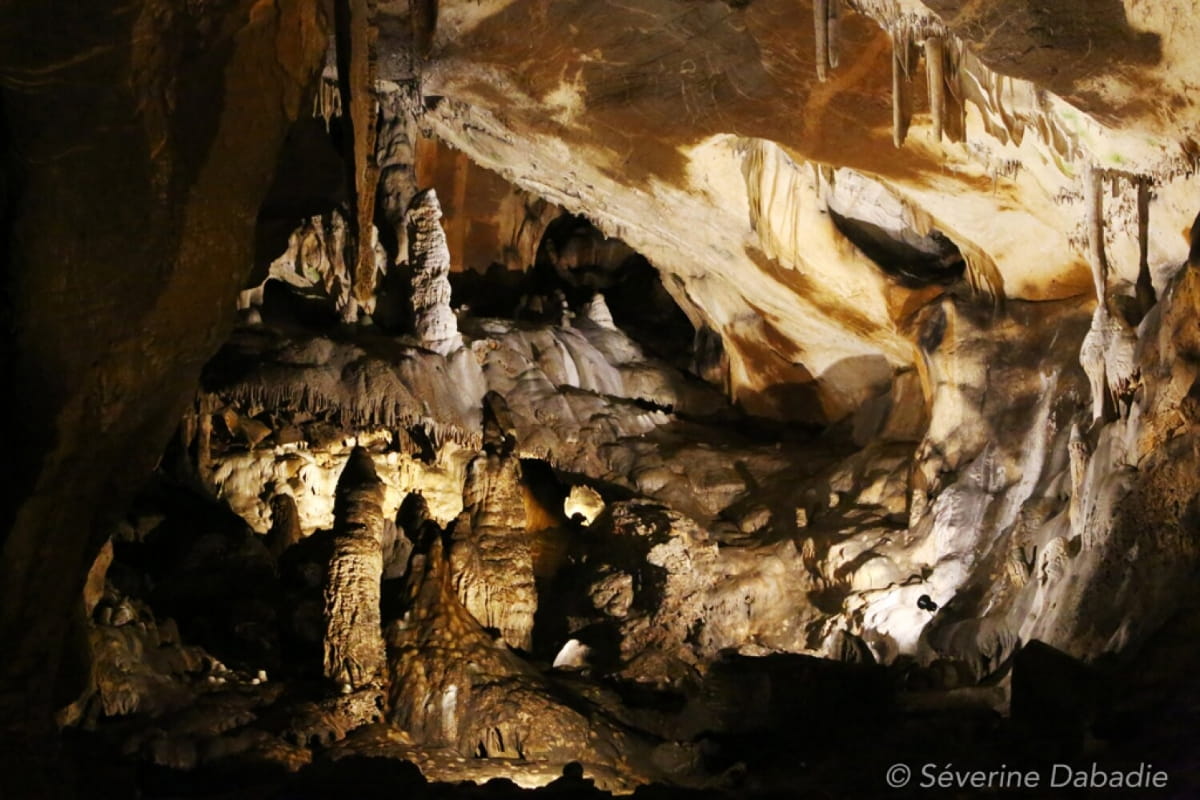
People who lived in Europe more than 30,000 years ago were more connected than scientists believed. A team led by the University of Vienna found new genetic evidence of contact between eastern and western groups of the Gravettian culture. Isturitz Cave, cavity in which the bone of a Gravettian woman was found. Credit: Severine Dabadie The study appears in Science Advances and combines genome data from rare human remains with human DNA recovered from cave sediments. The Gravettian culture spread throughout Europe from about 34,000 to 25,000 years ago. Artifacts from many sites point to extensive contact between regions, and archaeologists have long advocated for shared tools and trade over great distances. Previous genetic work told a different story and showed two fairly stable ancestry groups, one in the east and one in the west. The new data changes this picture. A woman from the Isturitz cave in southwestern France lived about 30,000 years ago. Their genome-wide data is the oldest from a modern human in southwestern Europe. Most of his ancestry was along the Western European line, but he also had ancestry linked to Central and Eastern European groups. Genetic models date this mixture between 32,500 and 31,500 years ago. A person from Ormesson, France, studied earlier, shows a similar sign. The first author, Pere Gelabert, states that Eastern and Western Europeans were less isolated than researchers assumed. Gene flow across such distances adds a new layer to how scholars view Gravetian links. Together with the archaeological findings, the results suggest that Isturitz served as a meeting place for different groups. Genomic data from four new individuals from the Gravettian and Solutrean cultures. Credit: P. Gelabert et al., Science Advances (2026) The team also found long-term roots in the southwest. Genomes from Chufín Cave in northern Spain show that Western ancestry remained in the region for thousands of years. At the El Mirón cave in Cantabria, researchers extracted enough human nuclear DNA from a 22,000-year-old layer to read ancestry, even though no human bones or teeth turned up there. They recovered around 14,000 genetic markers from the sample. The DNA matched the Fournol lineage and shows that this lineage lasted until the Last Glacial Maximum, approximately 26,500 to 19,000 years ago. This supports the idea that the Iberian Peninsula was a refuge during those years. Lead author Ron Pinhasi says DNA from sediments gives researchers a way to recover genetic information when human remains are missing and to link archaeological layers to the ancestry of people who lived at a site. In southern Italy, the team studied Ostuni1b, a male fetus and likely the son of Ostuni1, a female studied earlier. His father probably came from the same genetic pool, although the parents were not closely related. This points to mating habits that kept inbreeding low. Previous models assumed a stable local ancestry from the Aurignacian to the Solutrean, about 24,000 to 19,000 years ago, and the new results challenge them. Taken together, the findings show that regional groups remained rooted in place while genes were still moving over long distances. Gelabert’s team now combines sediment DNA with protein studies to trace the early expansions of modern humans across Europe and their interactions with carnivores at sites where organic remains are scarce. Publication: Gelabert, P., Sawyer, S., Villalba-Mouco, V., Cheronet, O., Oberreiter, V., Gárate, D.,… Pinhasi, R. (2026). Early genomic data from the Western European Gravettian reveal population movements before the LGM. Scientific Advances, 12 (43). doi:10.1126/sciadv.aeh6128