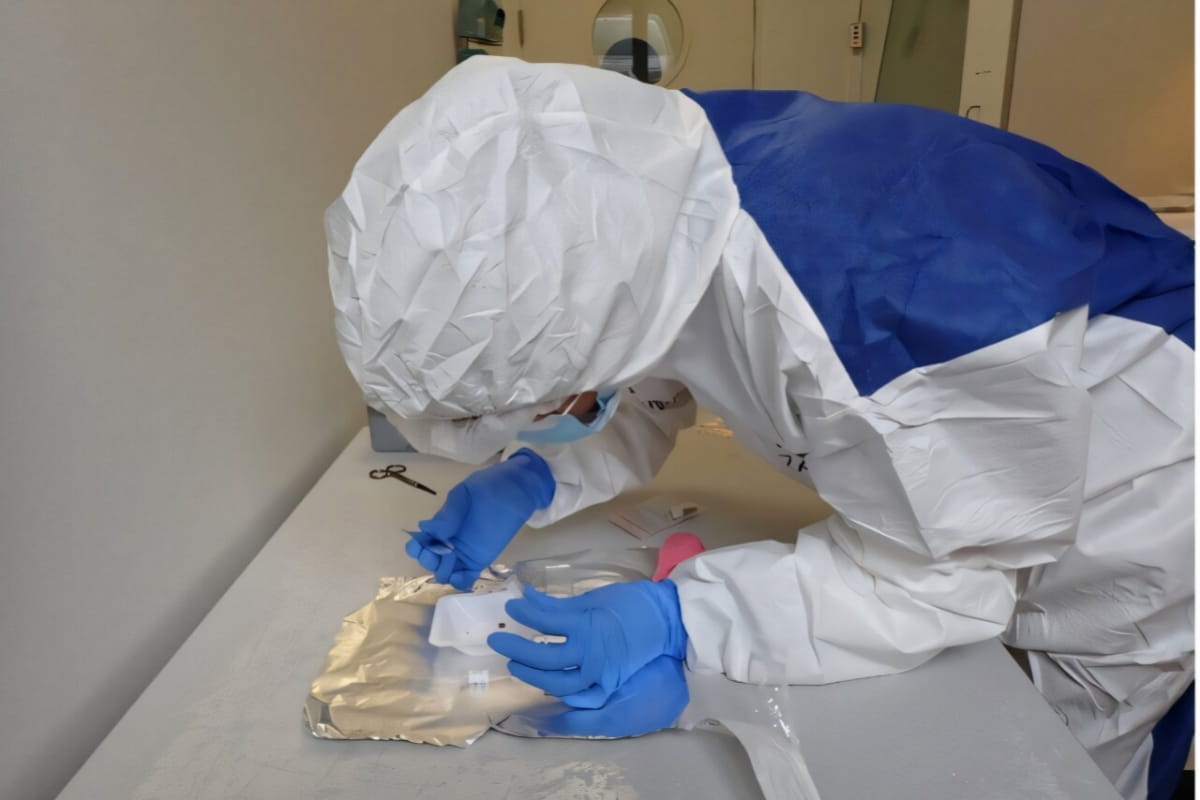
Researchers have found traces of animal protein mixed in a 60,000-year-old layer of red ocher in South Africa. The protein comes from the common eland, a large antelope native to the region. A team from Kyushu University, the University of Bergen and the University of Copenhagen published the results in Proceedings of the Royal Society B. First author Zahra Haghighi photographed the preparation of a sample in a clean laboratory for paleoprotematic analysis. Credit: Takumi Tsutaya/Kyushu University The material comes from the Klipdrift Shelter, a Middle and Late Stone Age site on the coastal cliffs of the De Hoop Nature Reserve. The Howiesons Poort layers have a flat surface rich in ochre. The surface extends more than a meter long, about 40 centimeters wide and up to a centimeter thick. Ocher is a colored terrestrial pigment. Archaeologists consider the use of ocher as a sign of modern human behavior, as people used the powder for both practical and symbolic work. Records from southern African cultures show powdered ocher mixed with organic materials, and some of those materials are protein-based. Finding such proteins at ancient sites is rare, because few traces last that long. To look for them, the team turned to paleoproteomics, the study of ancient proteins. They took archived sediment samples from the surface of Klipdrift and extracted proteins from the soil. They then ran the samples through mass spectrometry, a method that breaks proteins into small fragments and measures each one of them. The fragments were compared to large protein databases and a custom collagen assembly to find the species of origin. An eland is a large plains antelope found in eastern and southern Africa. Credit: Takumi Tsutaya/Kyushu University Two samples gave a clear match. All of the peptides, which are short chains of amino acids, targeted the same species. Both contained type I collagen from the common eland, Taurotragus oryx. The result points to two possible stories. Either people mixed eland material with ocher on purpose, or they treated eland skins with ocher on site. The complex surface structure supports the first idea. The find is important because direct evidence of organic matter mixed with ocher is very rare, especially in Africa. DNA rarely survives in hot African soils. The proteins last longer, so they could be the only trace left of the animal’s name. Proteins resist decay better than DNA, so they remain readable in samples where the DNA no longer exists. This work shows that scientists can recover proteins from the sediment itself, meaning bones and teeth are no longer the only source. A photo of the Kilpdrift Complex located within the coastal cliffs of the De Hoop Nature Reserve in South Africa, where samples for the study were collected. Credit: Ole F. Unhammer/Universitetet i Bergen The eland occupies a special place in San mythology, which makes the result interesting for another reason. The authors say that human action most likely put the protein there, for everyday needs and early symbolic acts. One example is not enough to prove that eland had ritual weight in the Middle Stone Age. The team plans to repeat the work at other sites of the same age. More results would prove whether the animal’s symbolic role dates back tens of thousands of years. Better instruments and data tools are expanding what paleoproteomics does. Tests on sediments and other new materials should show where the protein residues in the soil come from and what people in the past did with the ocher-rich deposits. Publication: Haghighi, Z., Tsutaya, T., Velliky, EC, Armitage, S., Miller, C., Mackie, M.,… Cappellini, E. (2026). Paleoproteomic investigation of archaeological sediments associated with the use of ocher in the Middle Stone Age of southern Africa. Proceedings. Biological Sciences, 293(2081), 20253300. doi:10.1098/rspb.2025.3300