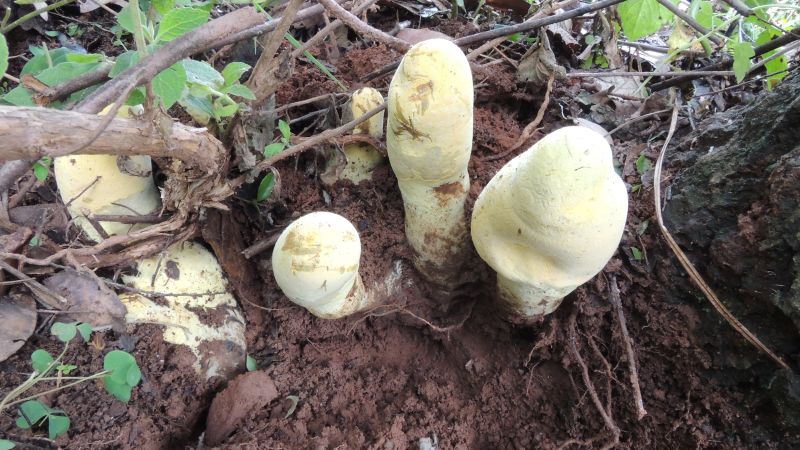
When the reign of the dinosaurs collapsed some 65 million years ago, a new royalty rose from the ashes: a king among the fungi. Scientists recently identified Dianjunus rex, a gigantic species of mushroom in what is now China that shares part of its name with Tyrannosaurus rex, the renowned “king” of the dinosaurs. D. rex belongs to a family of fungi that appeared after the extinction that wiped out all non-avian dinosaurs, along with about 75% of all plant and animal life on Earth. D. rex outshines its fellow fungi with its upright, pale yellowish reproductive structures or fruiting bodies called stromas that can grow up to 20 inches (50 centimeters) tall (about the height of an airline carry-on suitcase) and weigh nearly 5 pounds (2.2 kilograms). “It’s always interesting to hear about a new type of fungus or species of fungus that has a spectacular size,” said Kabir Peay, a professor of biology and earth system science at Stanford University in California, who was not involved in the new research. “It helps point out all the really exotic forms of fungal life on this planet that haven’t had a chance to be described by science.” Scientists recorded D. rex in the forests of southwest China’s Yunnan province during fungal diversity surveys conducted in 2024 and 2025. The findings were published Sept. 28 in the journal Frontiers in Fungal Biology. Farmers in the region had previously seen the fungus’s fleshy, finger-like stromas clustered around a dead tree. While the giant mushroom has not been tested for toxins, some locals have even tried it and reported no ill effects, said study co-author Indunil Senanayake, an associate professor at the Kunming Institute of Botany in China. “However, no one noticed it as a big deal,” Senanayake told CNN in an email. But when a curious local man sent photographs of the peculiar fungus to scientists, the researchers quickly realized they were seeing something special. The new study describing D. rex draws attention to how much there is still to be discovered about biodiversity in fungi. According to the study, the mass extinction that caused the demise of the dinosaurs may have created an environment for the giant-sized fungus to evolve and thrive. D. rex was not only a newly discovered species, but it belonged to a unique family of fungi. Through genetic analysis and comparisons with other fungi, the researchers found that the new family, called Dianjunaceae, probably emerged about 1 million years after the asteroid impact that ended the Cretaceous period (145 to 66 million years ago). “During this event, photosynthesis was suppressed and huge amounts of dead leaves, wood, roots and corpses accumulated,” Senanayake said. At a time when other life forms were struggling to survive, decomposers such as fungi that consumed dead organic matter could take advantage of that banquet. In size, D. rex is not on par with T. rex, but it does tower over other mushrooms. This species is the largest known in the phylum Ascomycota, which is the most diverse group of fungi and contains around 65,000 species, including morels, truffles and yeasts. Before the discovery of D. rex, the largest known member of Ascomycota was a brown bulbous mushroom in Kenya called Engleromyces goetzei, which has a diameter of nearly 12 inches (30 centimeters) and weighs about 7 pounds (3.2 kilograms), Senanayake said. All other ascomycetes, also known as sac fungi, that are close relatives of D. rex range from microscopic to a few centimeters in height. One question scientists want to answer next is why D. rex is so large compared to other fungi in its phylum, Senanayake said. “Generally, ascomycetes do not produce large stromae, since it is a waste of energy,” he explained. Sack fungi reproduce by actively expelling their spores; In D. rex, the top of the fruiting bodies contains thousands of small pores that release spores. However, the forest floor of their habitats is densely covered with fibrous plant material that can trap spores, Senanayake said. The fruiting body of D. rex rises high above the forest floor, which may allow spores to disperse more widely and improve reproductive success, he suggested. Fungi are essential organisms that contribute to the Earth’s carbon cycle and support the health and nutrition of many plant species. “It’s really important that we understand what they do,” Stanford’s Peay said. “The first step to understanding what they do is to describe them, recognize their existence, and then try to understand more details about their ecology.” Scientists have described around 150,000 species of fungi to date, but some estimates indicate that there are between 2 and 13 million species on the planet. “It’s a very underrated and underdescribed group of organisms,” Peay added. Fungi can be surprisingly difficult to detect in their forest habitats, even specimens as large as D. rex. A fungus is largely made up of threadlike filaments called hyphae, known collectively as mycelium. These tendrils are usually buried in soil, decaying wood or vegetation, and the reproductive parts (stromas) emerge from the soil “when environmental conditions are suitable or the fungus reaches the end of its life cycle,” Peay explained. These characteristics make discovering a new mushroom often a matter of being in the right place at the right time. Otherwise, “even really impressive fungi like this can go unnoticed or undescribed,” he said, referring to D. rex. Mindy Weisberger is a science writer and media producer whose work has appeared in Live Science, Scientific American, and How It Works magazines. She is the author of “Rise of the Zombie Bugs: The Surprising Science of Parasitic Mind-Control” (Hopkins Press). Subscribe to CNN’s Wonder Theory science newsletter. Explore the universe with news about fascinating discoveries, scientific breakthroughs and more.