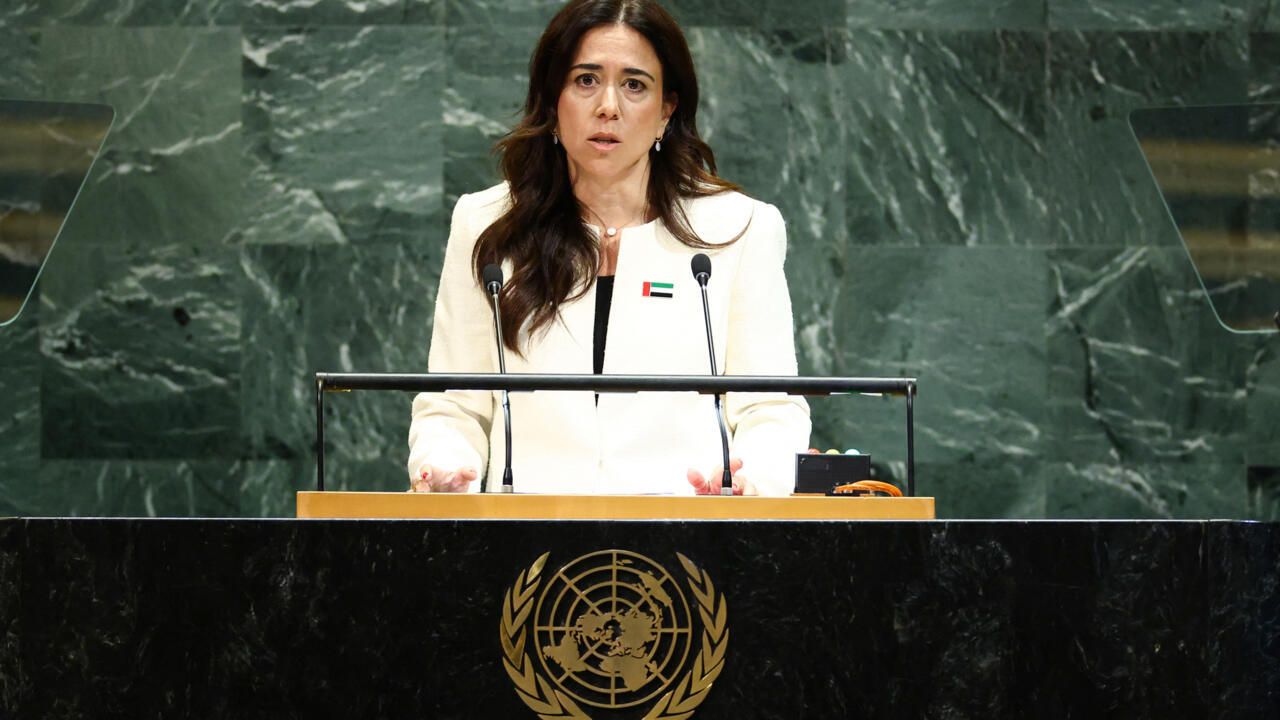

The United Arab Emirates has nominated Lana Nusseibeh for secretary-general of the United Nations, according to a report by state news agency Emirates. Nusseibeh, a minister of state in the UAE Ministry of Foreign Affairs and her country’s first female ambassador to the UN, has been rumored for months as a potential candidate. He joins six other candidates vying to be the next top UN diplomat. The news agency wrote: “His Highness Sheikh Mohammed bin Zayed al-Nahyan, President of the United Arab Emirates, submitted the nomination” as required as part of the UN secretary-general selection process. He is quoted citing “Nusseibeh’s deep experience at the United Nations, his judgment in addressing ongoing international challenges, and his record of constructive work.” The General Assembly president’s office did not confirm whether the required documentation for Nusseibeh’s nomination was received, saying Khalilur Rahman, who presides over the current Assembly session, is traveling. However, FRANCE 24 and PassBlue received a separate email from Teneo, a New York-based public relations firm for the United Arab Emirates Ministry of Foreign Affairs, confirming Nusseibeh’s nomination. “I am writing to you following today’s announcement of HE Lana Nusseibeh’s candidacy for UN Secretary-General,” Jan Hromadko, CEO of Teneo, wrote in the email, attaching Nusseibeh’s vision statement. In the statement, Nusseibeh wrote, in part: “The Charter gives the Secretary-General neither an army nor a vote. But the position, well-held, carries a different kind of power. Her independence enables her to get others to compromise, and that depends on trust. I will be the stubbornly optimistic and relentless diplomat I have always been in this endeavor… There will be no exemptions for friends and no hard feelings against critics.” Nusseibeh added that he had taken “a leave” from his government position to focus on his candidacy. Current Secretary-General Antonio Guterres’ term ends on December 31, 2026, so UN Member States must decide on a successor by then. Nusseibeh, born in 1978, entered the race late, but as a well-known name in international circles due to her time as the UAE’s ambassador to the UN from 2013 to 2024, along with her country’s strong ties to the United States, a permanent member of the Security Council. Still, as a candidate, she will need to win over the other four veto-wielding permanent members – Britain, China, France and Russia – and defend her candidacy as UN secretary-general against Abu Dhabi’s controversial human rights record and its role in the Sudan war. A candidate needs at least nine votes from the 15-member Security Council, and not be vetoed by a permanent member, or “P5,” as they are called. A former diplomat from the Global South told PassBlue/FRANCE 24 that Nusseibeh would not have jumped into the race now if he had not thought the P5 agreed with his nomination. “Its launch has been quite slick, and UN experts assume it will have offset its veto powers before going public. It looks like it could be a coronation,” said Richard Gowan of the International Crisis Group. Black marks on human rights As a candidate, Nusseibeh will undoubtedly face scrutiny over the Emirates’ human rights record, both at home and abroad. Human Rights Watch’s 2026 report on the United Arab Emirates outlines severe restrictions on expression, association, and assembly in the country, among other detailed criticisms. Nusseibeh’s father is of Palestinian origin, but his country has moved closer to Israel in recent years. They were one of the first Middle Eastern powers to join the Abraham Accords. Nusseibeh was seen as having supported Palestinian civilians’ need for humanitarian aid during Israel’s blockades of food and other essential items in Gaza when he represented the United Arab Emirates on the Security Council from 2022 to 2023. Johnnie Moore, an American evangelical preacher and former director of the Gaza Humanitarian Foundation, welcomed his candidacy on X-Day, calling Nusseibeh “one of the only diplomats in the world who could pass through the Security Council.” in the current circumstances.” To display this content from X (Twitter), you must enable ad tracking and audience measurement. Accept Manage my options Brett McGurk, who served in the Biden administration as a senior national security adviser, tweeted on October 21: “How did the UAE become the world’s largest provider of humanitarian aid to Gaza, according to UN data? Thanks to Lana Nusseibeh, a diplomat who knows everyone and works with them at GSD (Get S*** Done). She would be an inspired choice for this impossible job.” To display this content from X (Twitter), you must enable ad tracking and audience measurement. Accept Manage my choices However, there are aspects of the UAE’s geopolitics that draw scorn not only from a number of human rights groups but also from non-governmental organizations that focus on conflicts and humanitarian crises. Nathaniel Raymond, executive director of the Humanitarian Research Laboratory at the Yale School of Public Health, said that if Nusseibeh becomes U.N. chief, it could be a “catastrophe” for the U.N.’s work in Sudan, Yemen and other parts of the Middle East and North Africa. “She has a dual allegiance, a conflict of interest, between the United Nations and a state that is credibly accused by the UN itself of directly aiding and abetting the El Fasher massacre, which the UN itself has determined bears the ‘marks of genocide,’” Raymond said of Sudan. See moreThe fall of El-Fasher: A turning point in Sudan’s brutal civil war? In Sudan, the United Arab Emirates has been accused by independent panels of UN experts of arming and financing the paramilitary Rapid Support Forces (RSF), which fights the government army, the Sudanese Armed Forces. Amnesty International reported in May 2025 that Chinese-guided bombs and howitzers used by the RSF were re-exported by the Emirates, violating the arms embargo on Darfur. The Emirati government rejected the findings and denied providing arms or military support to either party. Separately, the International Court of Justice dismissed Sudan’s case against the Emirates for lack of jurisdiction, but did not resolve the underlying allegations. “Next week is the first anniversary of El Fasher,” added Raymond. “The UN should not celebrate by turning a government official – from the country that made the massacre militarily possible – into UN SG.” Latin Americans on the edge The selection process for the next secretary general officially began about a year ago to find a successor to Guterres, a former Portuguese prime minister. As part of the procedure, the Council recommends a candidate to the General Assembly for final approval. All of the current candidates have gone through public hearings held by the 193-member General Assembly, as well as numerous informal polls conducted by the Security Council. One of the early candidates, Michelle Bachelet, twice former president of Chile, could not recover from criticism from the United States of her defense of women’s rights. He abandoned his studies at the end of September. Guyana’s Carolyn Rodrigues Birkett, second, has to defend her government’s position on the Gaza war while assuring the Council (mostly the United States) that Guyana’s position – that Israel has been defying international law in the conflict – would not influence its decisions if elected secretary-general. She finds it difficult to balance that conversation. In the series of six surveys conducted by the Council, none of the candidates obtained the consensus of the members. The top three (Rebeca Grynspan of Costa Rica, Rodrigues Birkett and Rafael Mariano Grossi of Argentina) each earned two “discouragement” votes from a P5 member in the latest poll on Oct. 16, but the results do not spell the end of their candidacies, some experts say. They suggest, however, that the candidates must negotiate more to overcome the initial “red cards,” as one diplomat put it. Nusseibeh’s nomination gives the Council, particularly the P5, another option and adds a fourth woman to the race. The UN has never had a female secretary general, an 81-year gap that this race was supposed to rectify, according to a General Assembly resolution. The race was also meant to be the Latin American and Caribbean region’s unofficial turn to take the top spot. Nusseibeh and another candidate, Olara Otunnu of Uganda, squander that potential. (Senegal’s Macky Sall recently dropped out of the race.) Ricard Moscoso, Panama’s deputy permanent representative (Council member) has expressed his opinion on his region’s turnaround, recently tweeting: “The veto powers may not care, but any other new candidate will have to go through a round of color coding plus public scrutiny by the General Assembly in Council dialogues and informal dialogues.” (Color-coded ballots began in the Oct. 16 poll, revealing “discouragement” and “encouragement” votes from P5 members.) An informal poll that was expected to occur on Friday, Oct. 23, was postponed until possibly next week to give the United Arab Emirates time to submit Nusseibeh’s nomination, sources told FRANCE 24 and PassBlue. But diplomats hope Nusseibeh will participate in an interactive General Assembly dialogue before the Council holds its next survey. Rahman, the current president of the General Assembly, also apparently has different modalities in mind for the upcoming interactive dialogues than the previous ones. “The President of the Assembly has reiterated his promise that any new candidate that emerges will be presented to the wider UN membership, in accordance with the relevant revitalization resolutions,” Rahman spokesperson Melissa Summers told FRANCE 24 and PassBlue in an email on October 21. The other candidates are Olara Otunnu, a former UN official from Uganda; María Fernanda Espinosa, former president of the General Assembly of Ecuador; and Ivonne A-Baki, politician from Ecuador. This report was published in partnership with PassBlue.