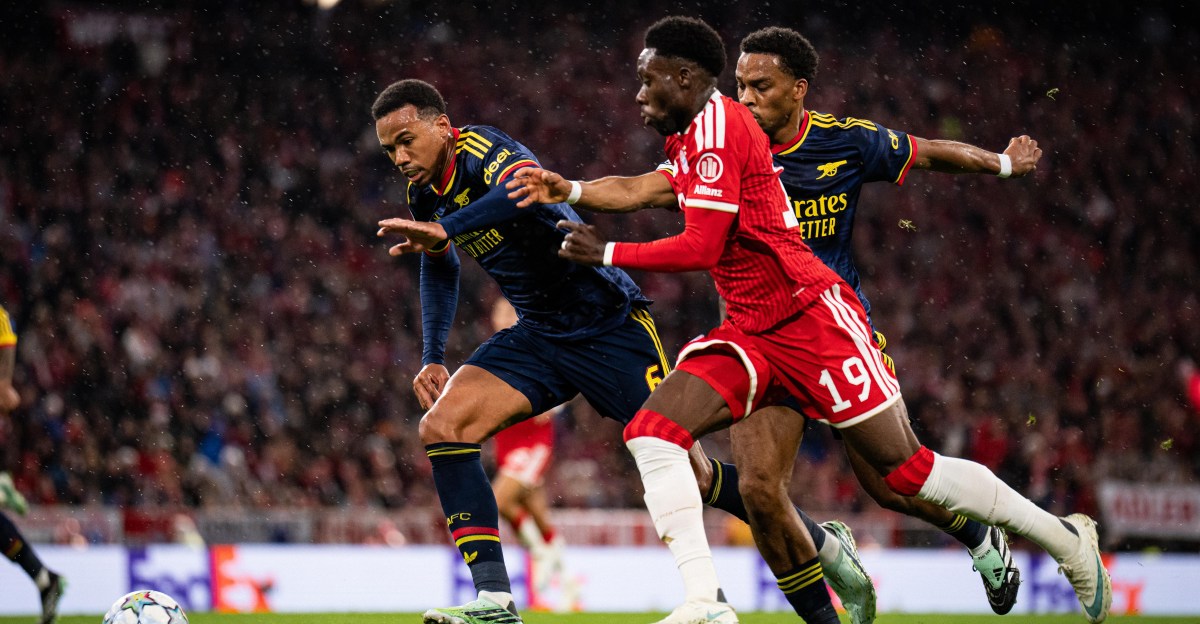
Some will say that Vincent Kompany abandoned this game. Others will say that Bayern Munich were unlucky. If Michael Olise and Joshua Kimmich had been available to start, perhaps Arsenal would not have escaped the Allianz Arena with a draw. That ignores the reality of what’s really important. Arsenal FC with Mikel Arteta is a top-level team. Of course, in an ideal world, Kompany would like to beat them. However, in the absence of ideal conditions, I had a second option: try something new. Which is precisely why fans were greeted with the disconcerting sight of Alphonso Davies on the left flank, with Ismael Saibari and Serge Gnabry joining Harry Kane in attack. While an in-form Nathaniel Brown was benched for a struggling Josip Stanišić. Kompany was obviously looking for a win, but more than that, he needed information. He needed to get to the root of how his team plays. No, Bayern Munich did not beat Arsenal. They were prepared to do it, but they stumbled at the last obstacle. Here’s the valuable information Kompany can glean from a game like this: Surround Harry Kane with fast runners and you’ll have a cheat code. His pass to Alphonso Davies was just one of many quarterback-style plays he made throughout the game. Kane has played deep before, but his teammates never had the pace to take advantage of everything he can offer. Why does this matter? Well, Davies may not start on the left wing very often, but the manager now has a plan D when A to C doesn’t work. Aleksandar Pavlović and Tom Bischof CAN go toe-to-toe with a physical midfield that includes Declan Rice, one of the best DMs in the world right now. They still can’t replace Joshua Kimmich’s creative spark, but once again, this gives Kompany data they can use later. As a bonus, Jürgen Klopp was in the stands, watching his future midfield take on the best. Extremely valuable information. Ismael Saibari may not be a perfect player, but he can run the press. This became especially evident when he was substituted, causing Arsenal to regain momentum and completely overtake FC Bayern’s midfield and counter-pressing system. Change the scenario and imagine Saibari comes in to close out a game in the final 30 minutes. Kompany now knows how to take advantage of the talent that the Moroccan possesses, while little by little he polishes his weaknesses and integrates the rest of his team into the system. Josip Stanišić is not improving no matter who you pair him with. He is not necessarily a bad player, but his mismatch with the system comes down to fundamental aspects that the coach cannot change. The new cornerback scheme isn’t perfect, but it’s much better than what the team had last year. Zero goals conceded from set pieces against Mikel Arteta’s Arsenal is always a good image. We have final and definitive proof that Serge Gnabry is no longer a reliable winger. It’s time to close the curtain on that stage of your career. Some may say it was a waste to carry out these experiments against Arsenal, with so much at stake. On the contrary, the fact that it was Arsenal in an important Champions League match is what makes the experiment worthwhile. Proper field testing, under field conditions, produces important results. There are games like these maybe half a dozen times a year, and if you’re going to miss your best players anyway, why not take advantage of the situation? Some think Kompany made a mistake, but he probably got most of what he wanted from his team. The only thing missing was victory. There are good teams and there are great teams. Then there are the world-class teams. What distinguishes them? People notice the obvious, the superstars and the fundamental tactics. They rarely realize that another type of player holds the superteam together: the multi-role specialists. This type of player is extremely rare, rarer than “world class”. Even having one puts you among the best teams in the world. Bayern Munich has three. Harry Kane saw his team deprived of 90% of their creativity and decided it was his problem. In the absence of Olise and Kimmich, he dropped deep and took advantage of defenders’ play, splitting defenses with passes that would embarrass a running playmaker. He had to partially neglect his forward duties to achieve this, but it paid off for the team in the form of goals. There are no strikers in the world who can do what he does. Erling Haaland is just as world-class, but he lacks this great breadth of play. It is absolutely unique. Alphonso Davies plays like two players in one. This doesn’t mean he has the qualities of both a full-back and a winger (which he does), but he also plays his role in such a way that it seems like Bayern have an extra player on the flank every time they play. You don’t get Davies as a full-back or Davies as a winger, you get BOTH at the same time, when you need them. In this game, the needle tipped towards the extreme. In others, he usually points to the defender. Nuno Mendes may be the best LB in a vacuum (highly debatable), but Davies does much, much more. Dayot Upamecano covers three roles at once. He maintains the center of the defense on his own, covers whoever plays at right back and also attacks forward to support the midfield. The enormous responsibility placed on his shoulders would crush a lower level player, even if he were a better pure defender. Upa can do a little bit of everything. He can create plays, he can carry, he can dribble, he can recycle possession, he can win runs with the wingers. The only thing it can’t do is split into three. If Bayern had three more like him, the defense would be the best in the world. There are other world-class players on this team. Michael Olise It goes without saying that Joshua Kimmich should count if it weren’t for some divided opinions. However, when it comes to players who can do many things at once, who makes it look like the coach has a twelfth, thirteenth or fourteenth man on the field? These are incredibly rare and should be handled with care. It’s incredibly difficult to train a system where certain players can do three different things depending on the context. This is a “use it or lose it” situation. Kompany must step up and squeeze every last drop of performance out of these versatile actors. Otherwise, they will not gain the advantage needed to win a Champions League title. After the second goal, FC Bayern made changes and gradually became enclosed in a shell. This is not the first time this has happened this season and the pattern is alarming. Bayern Munich is not a team that can “wait” for a result. Not under normal circumstances. Especially not against world-class opponents like the Gunners. If there is any lesson that Vincent Kompany draws from this result, it has to be this. Either the approach has to change, or the team has to do something radically different in terms of game management. THERE ARE teams that can sit back and relax with a one-goal lead. They can even do it against the best offensive players in the world. FC Bayern does not play like one of them. This team has the DNA of playing on the front foot and controlling the game through possession. As soon as the momentum is lost, the danger multiplies. The Gunners took advantage of this in the second half and eventually overtook Bayern to score the equalizer. Kompany did most things right given the context of this match, but this trend towards passive action in the later stages of close games needs to stop. Trying to wait for a result may work for Augsburg. It doesn’t work for Bayern Munich. Register for a user account and get: New improved notification system! Fewer adsCreate community postsComment on articles, community postsReceive comments, community posts