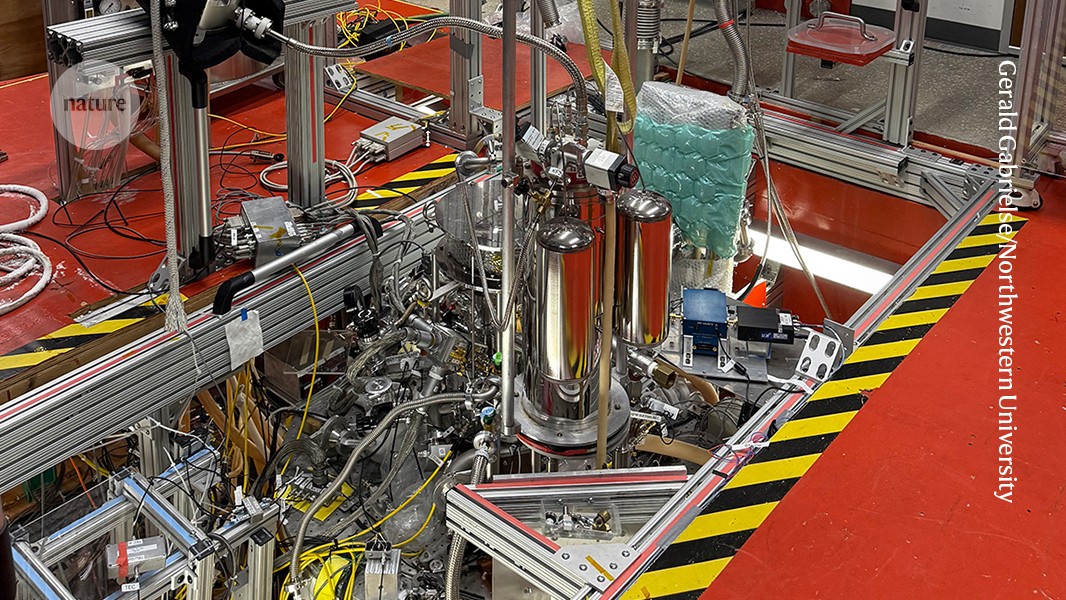
The researchers devised a single-positron quantum cyclotron to probe the particle’s properties. Credit: Gerald Gabrielse/Northwestern University Physicists have now suspended a single positron (the antimatter equivalent of an electron) in air and cooled it to its lowest possible energy state. The facility will allow researchers to study the magnetic properties of the positron with unprecedented precision. Physicists hope to detect subtle differences between matter and antimatter that could shed light on one of the biggest mysteries in physics. No one knows why the world is overwhelmingly composed of matter. The best current theory of particles and forces, the Standard Model, suggests that the same amount of antimatter should have been created during the Big Bang. But when they come into contact, matter and antimatter (which have the same mass but opposite properties such as charge) disappear in a burst of energy. If they had been created in equal quantities, “all matter and antimatter would annihilate and there would be no universe left,” says Gerald Gabrielse, a physicist at Northwestern University in Evanston, Illinois, who led the work. Finding a mismatch in measurements between matter and antimatter “would be revolutionary in physics,” says Gabrielse. The Standard Model has proven to be tremendously accurate in predicting experimental results even though it is known to be incomplete. It cannot, for example, explain the apparent existence of dark matter, a substance believed to interact primarily through gravity. The experiment, detailed in Physical Review Letters on October 21,1, is a “remarkable achievement” that will provide “a powerful probe for physics beyond the Standard Model,” says Barbara Maria Latacz, an antimatter physicist at CERN near Geneva, Switzerland. “I can’t wait to see their first precision measurements,” says Stefan Ulmer, a physicist at Heinrich Heine University Düsseldorf (HHU) in Germany. Find the Difference Since the 1960s, physicists have studied antimatter in increasing detail, hoping to find discrepancies with matter. They have observed a slight preference for matter in the behavior of a handful of particles, but not enough to explain the composition of the world. So far, exquisitely detailed comparisons of protons and antiprotons have uncovered no such differences. Now, Gabrielse’s group hopes to compare a property that can be measured with 10,000 times greater precision in electrons and positrons: their “magnetic moments,” which determine how the particles wobble on their axis in a magnetic field. Capturing a positron To conduct their experiments, the team first faced a major challenge: capturing a positron. They started with fast-moving positrons arising from radioactive decay and slowed them down by scattering them from atoms in a tungsten crystal. Although many were wiped out, the team selected the slowest survivors and put them in a trap.