The flames came quick and strong.
Pushed by westerly winds, they’d already devastated Saumos, France, 14 kilometres away, and in the early morning hours of last Friday, were heading, like a match to gunpowder, through an exceptionally dry forest of pines, in an exceptionally hot summer, toward Le Porge.
When Stéphanie Dhont looked outside her window, sparks were raining down.
“Everything was orange and since it was all so dry, even the smallest bush would instantly burst into flames,” said Dhont, whose husband had left only hours before, around 1 a.m. local time, to rescue the couple’s 15-year-old daughter from an evacuation order at her summer camp in Biscarosse, south down the coast, where another wildfire had broken out.
Only Dhont and her 18-year-old son, Timothée Collin, a lifeguard and surfer, were left to defend the family’s home near the centre of the town in southwestern France against the encroaching wildfire.
Dhont’s family is one of many in Le Porge who says they felt abandoned in dealing with a new climate disaster reality.
“So we did what we could to save our house,” the 45-year-old mother said of the wood home they built 13 years ago.
The mother and son pulled out the garden hose and started spraying the outside walls, the hedges, the roof, “everything.”
Within an hour, Dhont says, the village was surrounded by flames.
There had been no phone alerts, no text messages, “nothing — not even a siren.” Instead, neighbours drove by honking, yelling at everyone to leave, she said.
“It was total panic, it was hell.”
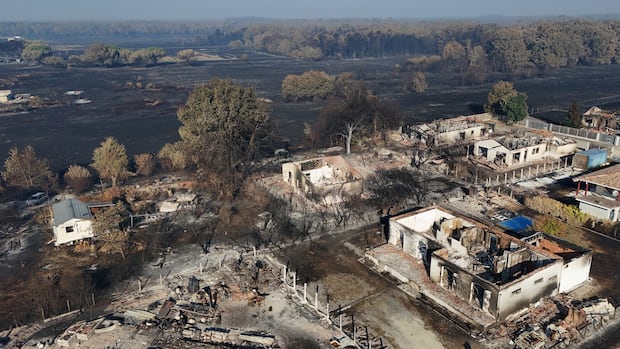
One hundred and eighty three homes burned in Le Porge in the hours that followed.
“A field of ruins,” the town’s mayor, Martial Zaninetti, called it.
The wildfires that have burned in the area near the city of Bordeaux may be smaller than those Canada and the U.S. are used to — totalling over 100,000 hectares — but French authorities and wildfire experts say they are unprecedented in Europe in terms of size, scale and impact.
The small communities that pepper the pine forests around Bordeaux have been left reeling. Many residents stayed behind to help fight the fires, which only began to let up Thursday morning as a light rain fell.
‘We’ve had to fend for ourselves’
On Wednesday, they’d scrambled, along with firefighters from across the country, in punishing 40-degree heat to tamp out spontaneous re-burns — when heat and dryness cause the smouldering ground to ignite.
But with the emergency out of the way Thursday, and 84,000 out of over 220,000 people allowed to regain in their homes in nine communities — but not Le Porge — resident volunteers there were starting to absorb the extent of their town’s destruction and the sense that they’d been left to their own devices.
“We’ve had to fend for ourselves,” said Didier Deyres, 65, a farmer and the vice-president of the local forest fire defence department.
Standing outside Le Porge’s party hall, which had been converted into a bustling volunteer and firefighter hub, Deyres decried a lack of resources from the French government he said his town has received since its residents had to flee nearly a week ago.
“We’re starting to lose heart,” said Deyres. “We need help. We are going to start seeing traumatic shocks, but there’s also going to be [health] problems because of the smoke.”
A sign at the hall warned of high rates of carbon monoxide in the air and said masks were “mandatory.” Few people wore them.
Deyres says he believes that if the French government had been better prepared and had more ressources, including more water bombers, his community would have shouldered far less destruction.
France owns 12 Canadair water bombers, but it can only use five at the moment due to maintenance issues — a fact most people affected by fires in France will mention.
In the back of the party hall, ad hoc health care is underway. Young volunteer health and body workers sit on cots they’d arranged in a corner to treat members of their community.
Emma Jambert, a 25-year-old osteopath from Le Porge, said the solidarity of the town has been motivating, but she, too, wondered aloud when more help would come.
“There’s a lot of fatigue,” Jambert said. “The aftermath is going to be complicated.”
CBC News gets a frontline look at France’s pitched fight against unprecedented wildfires in the historic Bordeaux region, where another heatwave is expected to fuel flames that have forced at least 250,000 people from their homes.
‘Solidarity,’ but questions remain
A group of residents are planning a class action against French authorities who ordered firefighters to leave Le Porge as the fire raged Friday and direct their efforts to Lège-Cap-Ferret, where a wealthy community sits on a nearby peninsula.
The government has justified its actions, saying there is only one route out of Cap-Ferret, making a rapid evacuation nearly impossible.
Dhont and Deyres said the town had been “abandoned” and “sacrificed.”
Zaninetti, the mayor, says he “understands their pain.”
He prefers to focus on the future, noting he has started gathering local associations and collaborating with nearby communities on a reconstruction plan in an effort he says resembles the response to the COVID-19 pandemic.
“What keeps us going is this solidarity … without it, I think we would have collapsed.”
Along with the solidarity, there has been a sense of guilt.
Dhont served meals to a lineup of other volunteers and firefighters at the hall. She, her husband, daughter and son have been working late into the night every day over the past week.
“I’ve been asking myself: why them and not me?”
She hopes all the media attention will result in more help for Le Porge, where she says everyone knows each other cares for each other.
Her home is in the centre of town, where most were spared, but down the road, along the Avenue du Bassin d’Arcachon is a kilometre-long stretch of ashes where homes used to stand.
Blackened trunks reach out of a carpet of cinders. Cars are carcasses and stone walls stand like ancient ruins without roofs without their interiors, their couches, their beds, their curtains. Without shoes in the entryway or homework on the kitchen counter.
‘No turning back now’
Timothé Collin, Dhont’s 18-year-old, used to drive through down the Bassin every day to get to high school.
Now, it’s unrecognizable. Every once in a while, a house, a tree, a shed, or a car is left unscathed.
“It’s a lottery,” Collin said, while driving through the devastation. “A gust of wind can make the difference.”
In the months and years to come, the residents of Le Porge say they want accountabily — for the warning signs that were missed, the air water bombers that weren’t ordered or delivered, the help that didn’t come or left, the water the firefighters didn’t get enough of to keep flames at bay.
Europe is the fastest warming continent. France has had four heat waves this season alone. These fires were only a matter of time, Collin said.
“There’s no turning back now and it’s our fault, humans’ fault,” he said.
“I try to keep things in perspective; I tell myself that things will change and that all the little things I do — all my small efforts to bring about change — matter. I tell myself that with all these catastrophes, people’s mindsets are shifting. I believe in it, I do. We have to, because if we don’t, nothing will ever change.”