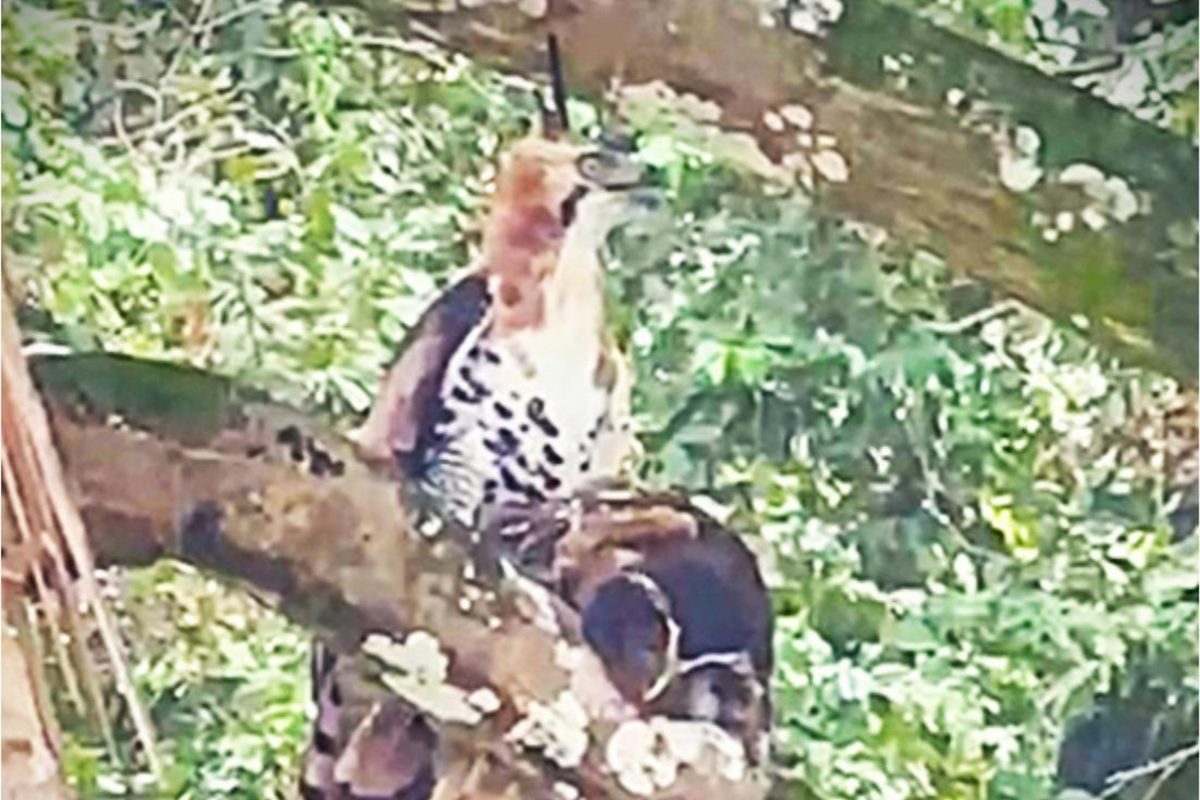
During a field trip in the lowland forests of Costa Rica’s Corcovado National Park, researchers observed a new predation event: an ornate hawk eagle capturing and killing a great crested owl. Predation of a crested owl (Lophostrix cristata) by an ornate hawk eagle (Spizaetus ornatus), to the best of scientists’ knowledge, has never been documented before this record. What makes the incident even more extraordinary is the arrival of a third species of raptor: a common black hawk (Buteogallus anthracinus). The burly falcon, which had been closely following the event from nearby, was seen swooping down to try to steal the prey, a feeding strategy known as kleptoparasitism, in which one animal deliberately takes food from another. Unwilling to give up its food, the eagle aggressively fought the intruder and restrained the owl, before moving it to a high branch within the forest. Location where the ornate hawk eagle fed on a crested owl in Corcovado National Park, Costa Rica. Credit: José Manuel Mora et al., Caribbean Journal of Science 2026 Ornate hawk eagles, found in the tropical Americas, are powerful birds with a wingspan of more than one meter. They are known to prey on a wide variety of medium-sized birds and mammals, including cracids (a type of Neotropical bird), toucans, monkeys, and squirrels. “However, direct observations of intraguild predation events involving owls are exceptional,” the authors say. Intraguild predation occurs when species competing for the same resource or prey also kill and eat each other. The team, which recently published its findings in the Caribbean Journal of Science, says the record suggests that “even medium-sized nocturnal birds of prey [such as crested owls] It may occasionally be vulnerable to attack by large forest eagles. “While a single observation cannot determine the frequency of such events,” they note, “reporting them increases basic knowledge of predator-prey dynamics in tropical raptor assemblages.” More wildlife stories from around the world. Image credit: Pablo Largaespada Caamaño | José Manuel Mora et al., Caribbean Journal of Science 2026, licensed under CC BY-NC-ND 4.0.