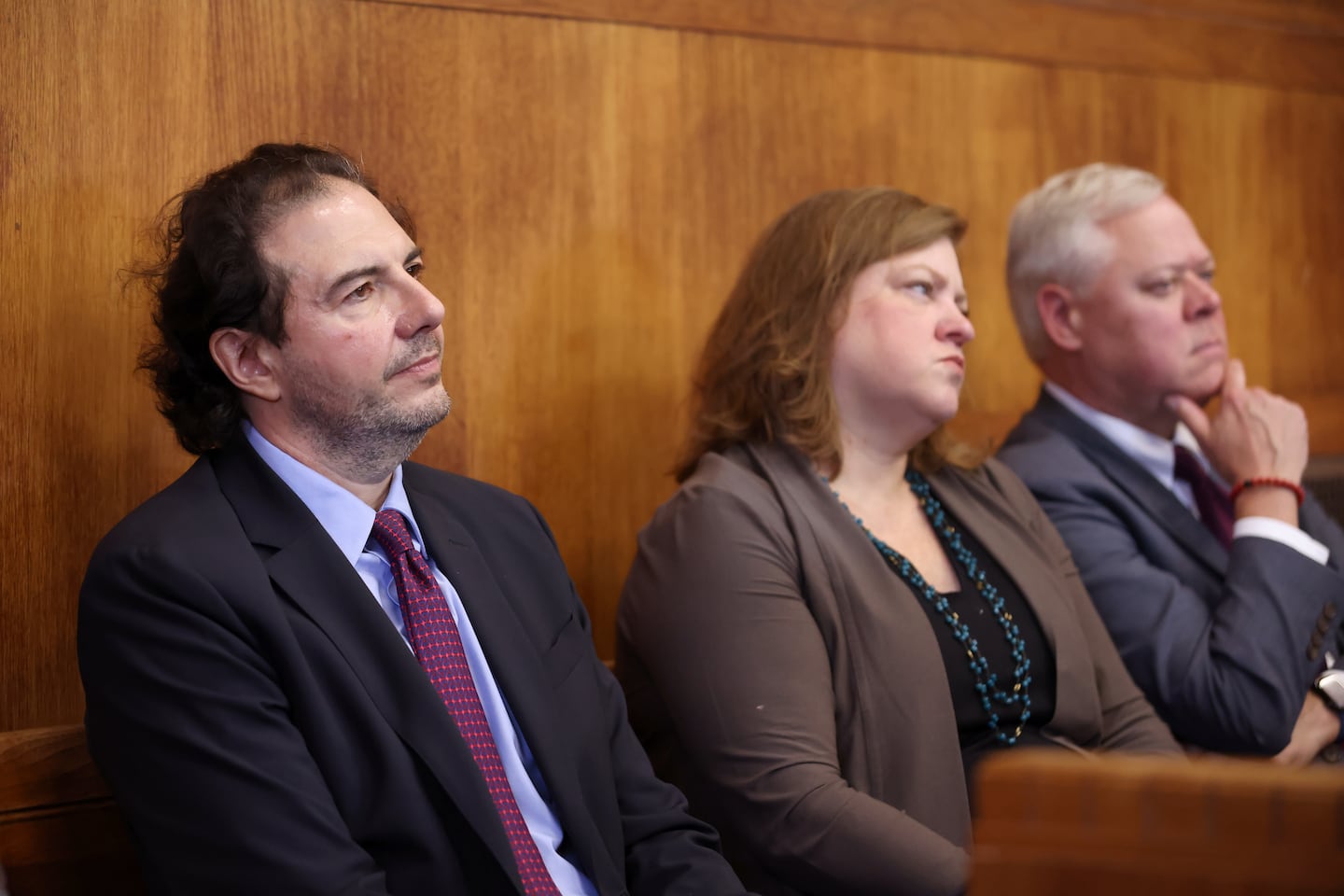
But the latest development — when a Suffolk County jury last week unanimously awarded him $6 million in damages in his civil suit against Knouse, while dismissing her allegations of retaliation and harassment against him — are scenes he describes in vivid detail. How the light went out on the judicial officer’s desk, indicating that the jury had reached a verdict. How the clerk passed the envelope with his decision to the judge and then back to the president, who read each count aloud. How he didn’t react to the announcement of the compensation he had been awarded, but instead held his brother’s hand when all of Knouse’s charges were dismissed. “To be honest, I don’t know if I still believe it,” he said in a phone interview Sunday. Knouse, contacted through her attorney, Ellen Zucker, declined to comment. She will appeal the ruling, Zucker said. The last five years, when Sabatini went from a prominent biologist who generated Nobel Prize buzz to an outsider with whom schools refused to work, were “the most difficult years of my life,” he said. The three-week trial included grueling testimony, where some former lab members said Sabatini fostered a toxic, sexually charged lab culture, and others praised his mentorship. He was also a mentor to Knouse: He first met her when she was a graduate student and he ran a high-profile lab at Whitehead. In a countersuit, she claimed he forced her into a non-consensual relationship and abused his position of power. A few years ago, Sabatini rebuilt a lab in the Czech Republic, thanks to Bill Ackman, a New York hedge fund billionaire, who pledged $25 million over five years, along with an anonymous donor, to get Sabatini back on track. But when he received the keys to his new space in Prague, it was an empty room, and Sabatini found it difficult to hire people to fill it. “I started from scratch,” he said. “I remember thinking, ‘Wow, I had a lab that did crystallography, chemistry, mouse work, ovarian cancer and Parkinson’s.'” He has since opened a second lab in Boston and travels between the two on “too many planes,” he said. “I miss my son. I miss my family and I’m always jetlagged.” Now, Ackman, who has been highly critical of elite institutions including MIT, is among those staunchly defending Sabatini online and calling on the university to explain itself. In a series of posts on “In light of what has occurred in this grave miscarriage of justice, MIT has the opportunity and obligation to right a grave wrong here,” Ackman wrote. Ackman, contacted through his company spokesperson, had no further information. comment. “Bill saved my life,” said Sabatini, who denied speculation that Ackman helped fund his legal defense. It is unclear how Knouse, who is currently an assistant professor of biology at MIT and a faculty member at its Koch Institute for Integrative Cancer Research, will pay the $6 million in damages awarded to Sabatini, plus interest. In response to the verdict, Kimberly Allen, an MIT spokeswoman, said that the Whitehead Institute “is an independent, nonprofit research institution with its own facilities” and that the university was not a party to Sabatini’s original lawsuit, which was filed against Knouse, the Whitehead, and Lehmann, the director. In a statement, the Whitehead Institute’s board of directors said it has “full confidence” in Lehmann’s leadership and his workplace policies, which included the investigation into Sabatini’s lab. The court previously dismissed all claims brought by Sabatini against the institute. The university stood by its previous public comments on the matter, with a letter from then-president L. Rafael Reif. Reif wrote that “Sabatini behaved in a manner incompatible with the responsibilities of being a faculty member,” announcing Sabatini’s decision to resign in 2022, after a review committee recommended that his tenure be revoked. Sabatini said he would like to see more “accountability for how these decisions are made, more transparency” from MIT and Whitehead. “I was clearly in a situation where it was okay to step aside,” he said. “I didn’t matter there. I think anyone can find themselves in that situation.” Jeffrey Flier, former dean of Harvard Medical School, was among a chorus of scientists who weighed in on social media, with a post on X asking what the jury’s verdict implies about the validity of MIT’s response to Sabatini at the time. In a written statement, he said he had “significant prior concerns about the due process of the investigation.” with memories of dear friends, “incredible students, incredible colleagues,” he said. That includes Knouse, whom she called her “best friend in Boston,” and shared that she played video games and baked blondes with her now-teenage son. “A big part of me still wishes him the best,” he said. As for his old laboratory, he remembers a “nice place” that he does not regret. He was able to train students to conduct their own research, and nearly 50 former members of his lab now conduct theirs. “It was definitely a hard-working lab, definitely very hard. People had passion,” he said. “Were silly, foolish things done at times? Yes. But was there cruelty and meanness? There wasn’t.” The last five years have changed you—they’ve thinned your hair and taken a physical and mental toll on you—but if you were offered the chance to return to MIT, to “be healthy” and continue training the next generation of scientists, would you do it? “The answer is yes,” he said. “But in the right conditions.” You can contact Michaela Towfighi at michaela.towfighi@globe.com. Follow her on X @michaelatowfghi.