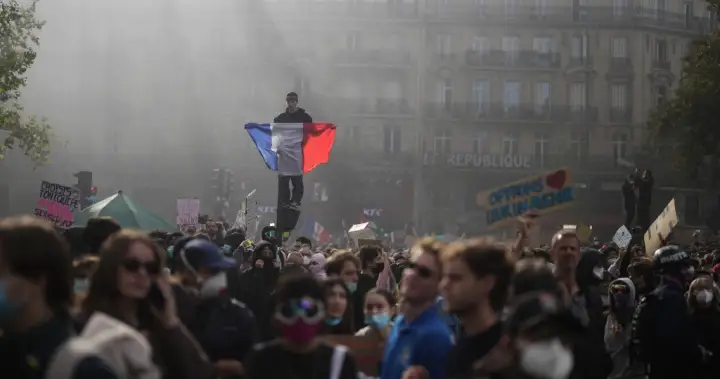

French Prime Minister Sébastien Lecornu says he has instructed prefects, the government’s regional representatives, to impose “very limited” and “localized” curfews to prevent further rioting and looting, following weekend violence that targeted town halls, other public buildings and thousands of businesses across the country. Speaking after an emergency meeting with senior government officials, Lecornu said that “on Saturday, despite scenes of serious violence and extensive property damage, no one died, and that is a miracle,” while defending the work of police officers in the face of violent groups of people. Lecornu said details of the areas that will be placed under curfew will be provided later on Monday. 1:58 Anger grows, protests turn violent in France and Europe The instructions come as Interior Minister Laurent Nuñez offered his resignation on Sunday, but President Emmanuel Macron rejected it “given the need for continued command of law enforcement in the current context,” Macron’s office said in a statement on Monday. He ordered Núñez “to take all necessary measures to ensure full transparency about the failures in planning and intelligence gathering that led to the violence,” according to the statement. Get daily national news Get daily Canadian news delivered to your inbox so you never miss the day’s top stories. Macron also called for the introduction of “new police tactics on the ground as soon as possible” to put an end to the violent events. On Sunday night, groups set fire to garbage containers, bicycles and other objects in the streets and looted businesses in Paris, Lyon, Marseille and other cities. This came after widespread violence during Saturday’s nationwide protests against rising living costs and poor conditions in schools. At least 2,400 people were arrested across the country. Authorities estimated Monday that at least 3,000 businesses were damaged or looted in several cities during the weekend violence. In Marseille, the prefect banned any protests or other gatherings from noon to 8 p.m. on Monday. “I submitted my resignation because I am responsible for everything that is happening,” Núñez said on France Inter radio. “Now, the real problem is ensuring that this does not happen again… Obviously we need to better anticipate the type of mobilization that is developing.” Núñez blamed the violence on “hordes of rioters and looters” and “far-left activists,” and said police strategy must adapt “in the face of extremely mobile groups.” Authorities said groups of hundreds of people clashed with police and attacked public buildings, including city halls and other public offices. Núñez acknowledged that authorities had “lost control” in some major cities on Saturday, when hundreds of businesses were looted. More about the world More videos “You can’t look merchants in the eye when hundreds of businesses have been looted and say we haven’t lost control in some of these major cities,” Núñez said. 1:58 Montrealers rally to support ongoing student protests in France Previous video Next video Flames engulfed the 19th-century City Hall in Limoges, central France, causing its roof to collapse and nearly destroying the building. In Paris on Monday, cleaning crews and firefighters removed broken glass and other debris from the streets. Ouri Zagoury, owner of a video game store near Paris’ Place de la République, said he closed the store on Saturday afternoon but then saw “There were so many people coming and going. And even though I called the police, they said not to intervene, that they would come, but they never did, which is another problem,” Zagoury said. Jordan Bardella, president of the far-right National Rally party, pointed to the government’s inability to prevent violence. “The government has failed, the head of state has failed in his essential duty to protect the French people,” he told reporters at party headquarters. “I call on the people of France now, beyond their right to protest, to use their voting power,” Bardella said. He is campaigning alongside far-right leader Marine Le Pen, whose poll numbers have suggested for months that she is the favorite for next spring’s presidential election. © 2026 The Canadian Press