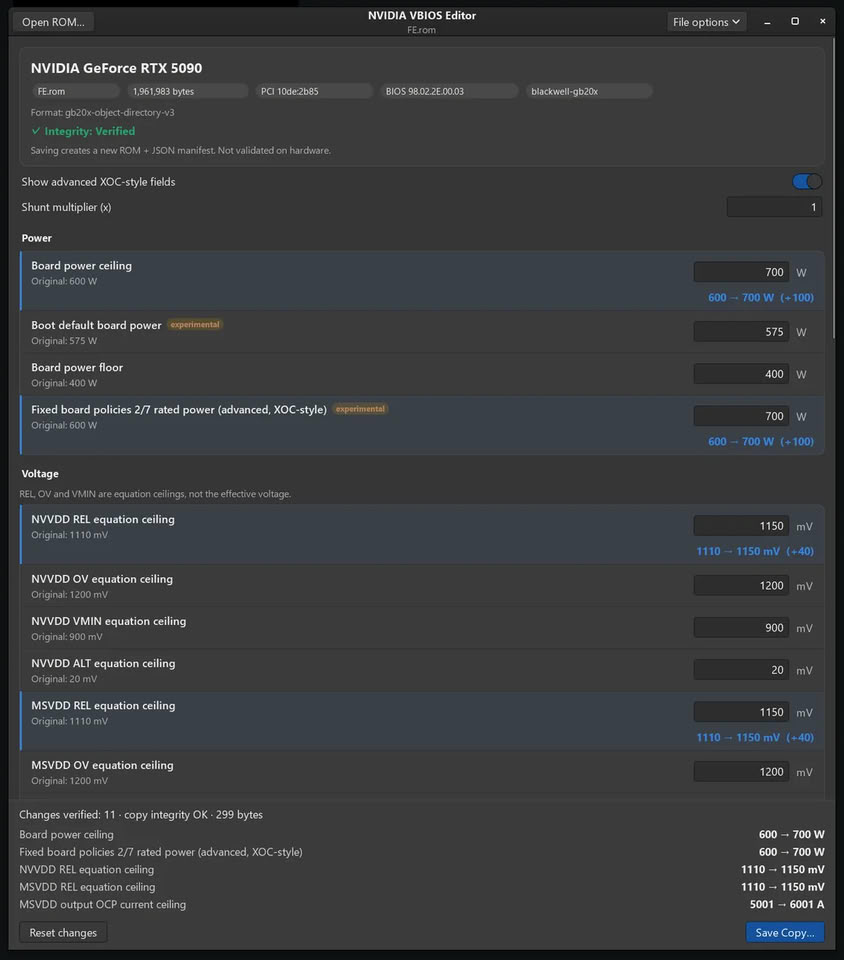
A developer calling himself Panchovix has released three tools that allow owners of the NVIDIA GeForce RTX 50, RTX 40, and RTX 30 series to run a modified VBIOS without writing anything to the card’s flash chip. The first is a VBIOS editor for Windows and Linux that can change power limits, voltage limits, current limits (OCP), fan channels, and core and memory offset ranges. The edited images maintain the original NVIDIA signature, which no longer matches, so they cannot be updated with nvflash. The patched tools broke the NVIDIA BIOS signature lock for cross-flashing in 2023, but this approach bypasses flashing entirely. On Windows, the loader stores the edited image in the GPU driver registry key, where it is overridden by the driver every time the device starts and only requires a quick restart of the GPU. Instead, the Linux loader patches NVIDIA’s open kernel modules so that the GSP firmware starts with the custom image, with Fedora 43 being the only distribution tested on real hardware so far. The screenshots show how this works in practice. In what appears to be an RTX 5090 Founders Edition ROM, the board’s power limit has been moved from 600W to 700W and the NVVDD and MSVDD voltage limits have been moved from 1110mV to 1150mV. An RTX 4090 ROM increased its power limit from 666W to 750W and its core offset range doubled to +2000MHz, and nvidia-smi later confirmed that the card’s power limit went from 550W to 671W. Apparently, an RTX 5090 hit 800W, an RTX 5080 went from 360W to 500W and an RTX 5060 Ti from 185W to 300W in the developer’s own tests. RTX 40 GPUs in laptops cannot yet be edited and memory timings cannot be changed as the card reads them directly from the flash chip. The Windows loader requires driver 616.56 or newer, which is interesting since NVIDIA closed unlocking the RTX 50 mVolt+ power cap with a driver update in August. The loader even writes the same register values that mVolt+ uses to load a VBIOS, and it is unknown if NVIDIA plans to close this path as well. Both loaders are open source, although the publisher’s GitHub page lists them as closed source binaries. Raising the power and voltage limits also carries a real risk, and readers trying this are advised to keep a copy of their original ROM and try it on a GPU that doesn’t drive the display.