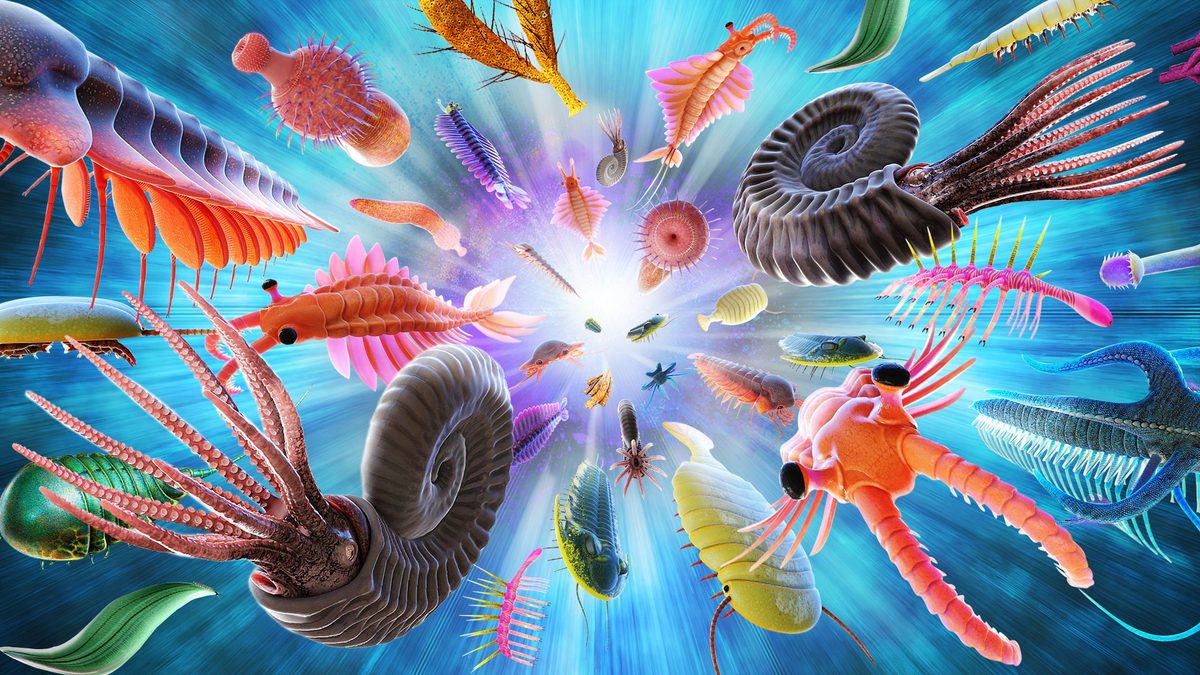
The history of life on Earth does not begin with the Cambrian Explosion. However, this was the time when almost all major animal groups appeared, proliferated and diversified. For centuries, scientists have debated what caused this sudden boom in diversity, without reaching clear conclusions. Now a team of scientists from Australia and Germany have proposed that an eruption of excrement may have been the catalyst. What was the Cambrian explosion? The Cambrian Explosion is a time interval marked by a sudden increase in the diversity of complex life. This is the point in the history of life on Earth, which began about 538.8 million years ago and lasted between 13 and 25 million years, at which almost all of the major animal phyla emerged, from mollusks, arthropods, and echinoderms to chordates, animals with rigid supporting spines known as notochords. This radiation of life took place at the beginning of the Cambrian and saw animals experiment with a wide range of different body plans. It is these body plans that help scientists place animals (both living and extinct) into different phyla. A phylum is a level of biological classification just below kingdom (e.g., animals, plants, fungi) and just above class (e.g., mammals, reptiles, amphibians). There are about 32 animal phyla, depending on which definition you use, and most of them appeared during the Cambrian. That said, in recent years scientists have discovered elaborate body fossils in rocks of Precambrian age, suggesting that some phyla may have appeared before the famous Cambrian Explosion. What was life like before the Cambrian explosion? While the Cambrian Explosion may be the time when animals really burst onto the scene, this realm of life may have its roots much further back. In fact, the first animals may have appeared 800 million years ago, just before a period known as “Snowball Earth,” when our planet was almost completely covered by ice. Animal of the Cambrian period. 3D visualization of anomalocaris. Credit: Keybal/Getty Images These early animals were very simple and resembled sponges and/or comb-shaped jellyfish (known as ctenophores). There is much debate surrounding the identity of the first animals, with some arguing that sponges arrived on the scene first and others claiming that comb jellies beat them to it by a few million years. Regardless of which group arose first, animal life before the Cambrian was very different from what it was like during and after this evolutionarily important period. The animals that lived at this time had soft and largely immobile bodies, rooted themselves on the sea floor and extracted food from the water column using their strangely shaped bodies. Some of these early animals could move, although not in the same way that modern animals do. Dickinsonia is an example of one of these early mobile animals. It looked like a large, flattened leaf, but it was an animal and through rhythmic muscle contractions it could move slowly over the seabed. As Dickinsonia and other early mobile animals moved across the seafloor, they secreted digestive enzymes, breaking down microbial mats and allowing them to absorb nutrients. Other animals, such as Kimberella, used radula-like structures to physically scrape pieces of algae from the seafloor. A functional intestine then helped them digest this food. Dickinsonia, Kimberella and other Precambrian animals known as Charnia and Spriggina lived during a period known as the Ediacara, which lasted from 635 million to 541 million years ago. These animals are known as the Ediacaran Biota, and while they were once seen as failed evolutionary dead ends, they are now considered a pivotal chapter in early animal evolution. What was life like during the Cambrian? As the Ediaracan developed into the Cambrian, the seafloor (and its associated biological communities) became much more complex. What was once a drab marine desert relatively devoid of life quickly transformed into a rich marine ecosystem filled with active and complex animals. This transition caused animals to develop heads, tails, and complex muscles defined for digging, swimming, and hunting. The arrival of active hunters also sparked an arms race between predators and prey, which needed hard parts such as shells and skeletons. This sudden appearance of hard, mineralized parts is why the fossil record improves dramatically after the Cambrian! There are several recognizable animals that lived during the Cambrian, including woodlice-like hard-shelled animals known as trilobites and voracious, predatory shrimp known as radiodonts. The radiodon Anomalocaris was one of the deadliest predators during this period and used a pair of large, spiny front appendages to catch its prey. Anomalocaris, prehistoric creature from the Cambrian period. Credit: dottedhippo/Getty Images Other lesser-known animals from the Cambrian include Hallucigenia, a spiny, worm-like creature that looks more alien than animal, Opabinia, a soft-bodied arthropod with five eyes and a proboscis, and Wiwaxia, a hedgehog-like creature that still confuses scientists as to where it falls on the tree of life. The Cambrian was also the period during which our first spine-bearing ancestors evolved. The oldest chordate currently known to science is the eel-like animal known as Pikaia. This was the first step in the long evolutionary journey towards us humans. There may be little resemblance between you and Pikaia, but within Pikaia is the key feature that separates you from about 95% of other animals (i.e. non-chordates): a notochord. From Pikaia came fish, and when their limbed descendants emerged from the water about 375 million years ago, they opened the door to a whole new world, one that was soon dominated by amphibians, reptiles, mammals, birds and, eventually, humans. What do scientists think caused the Cambrian explosion? There have been many suggestions about what may have caused the Cambrian explosion, from an increase in oxygen levels and mineral content in seawater, to the work of ecosystem engineers, such as worms and other burrowing organisms. For the first two billion years of its 4.5 billion-year history, the Earth had no significant free oxygen: the oxygen that animals breathe today, both in air and dissolved in water, is the byproduct of billions of years of photosynthesis. At first, the oxygen produced by photosynthesis was bound to minerals such as iron. However, once these minerals were bound together and depleted, oxygen began to exist as free molecules in the atmosphere. From there it dissolved into the oceans, raising oxygen levels beyond a threshold that could support complex life. An increase in dissolved mineral content may also have exceeded a certain threshold during the Cambrian. The release of mineral-forming elements, such as calcium and phosphorus, from seafloor volcanic vents and the erosion of land rocks during this era provided many early animals with the materials they needed to begin building hard parts. In addition to changes in the environment, scientists also point to animals themselves as possible catalysts for the Cambrian explosion. While animals can be greatly shaped by the environments they live in, they can also change and shape the environments around them. For example, animals began digging burrows around the Cambrian. This disturbed the seafloor, aerating it and releasing minerals and nutrients that were previously inaccessible. It is thought that excavations may have made the seabed during the Cambrian more hospitable, creating new niches in which animals could evolve. Another factor that scientists believe may have caused, or at least fueled, the Cambrian explosion is the aforementioned arms race between predators and prey. As animals became more active and moved into more predatory niches, their prey responded in kind by developing spines, armor, and other defenses to avoid being eaten. Some scientists have even suggested that this period of prehistory may have been more of a backfire than an evolutionary explosion. These scientists suggest that the Cambrian Explosion may simply represent the crossing of a threshold of genetic complexity: organisms that use more oxygen have the opportunity to produce more complex proteins, which, in turn, facilitates the evolution of a broader range of body plans. Hallucigenia, prehistoric aquatic animal from the Cambrian Period. Credit: dottedhippo/Getty Images Did an increase in fecal matter really cause the Cambrian explosion? In July 2026, paleontologists Julien Kimmig and Russell Bicknell proposed a new catalyst for the Cambrian explosion: the so-called “fecal revolution.” This preliminary study looked at the record of coprolites (i.e., fossil scat), the evolution of animal digestive tracts, and their potential effects on the ocean’s biological pump, the natural process that circulates nutrients from the ocean surface to the seafloor. Kimmig and Bicknell found that “the rapid acceleration in the size of organisms during the Cambrian radiation increased the size of the coprolite, which produced a positive feedback loop, further accelerating the establishment of these organisms.” [complex] ecosystems.” In other words, as larger, more varied butts appeared and did their thing, spreading excrement throughout all levels of the ocean, important nutrients became available to flourishing groups of animals. According to this new theory, the “poop power” literally fueled the evolution of complex animal life. There are still many outstanding questions that Kimmig and Bicknell plan to answer with more research, primarily what elements and nutrients these excrements were composed of and how they may have been used by the early animals. To answer these questions, they will have to go through a lot of poop, both figuratively and literally. Cover Image: Cambrian Explosion or Cambrian Radiation Credit: canbedone/Getty Images More wildlife stories from around the world: