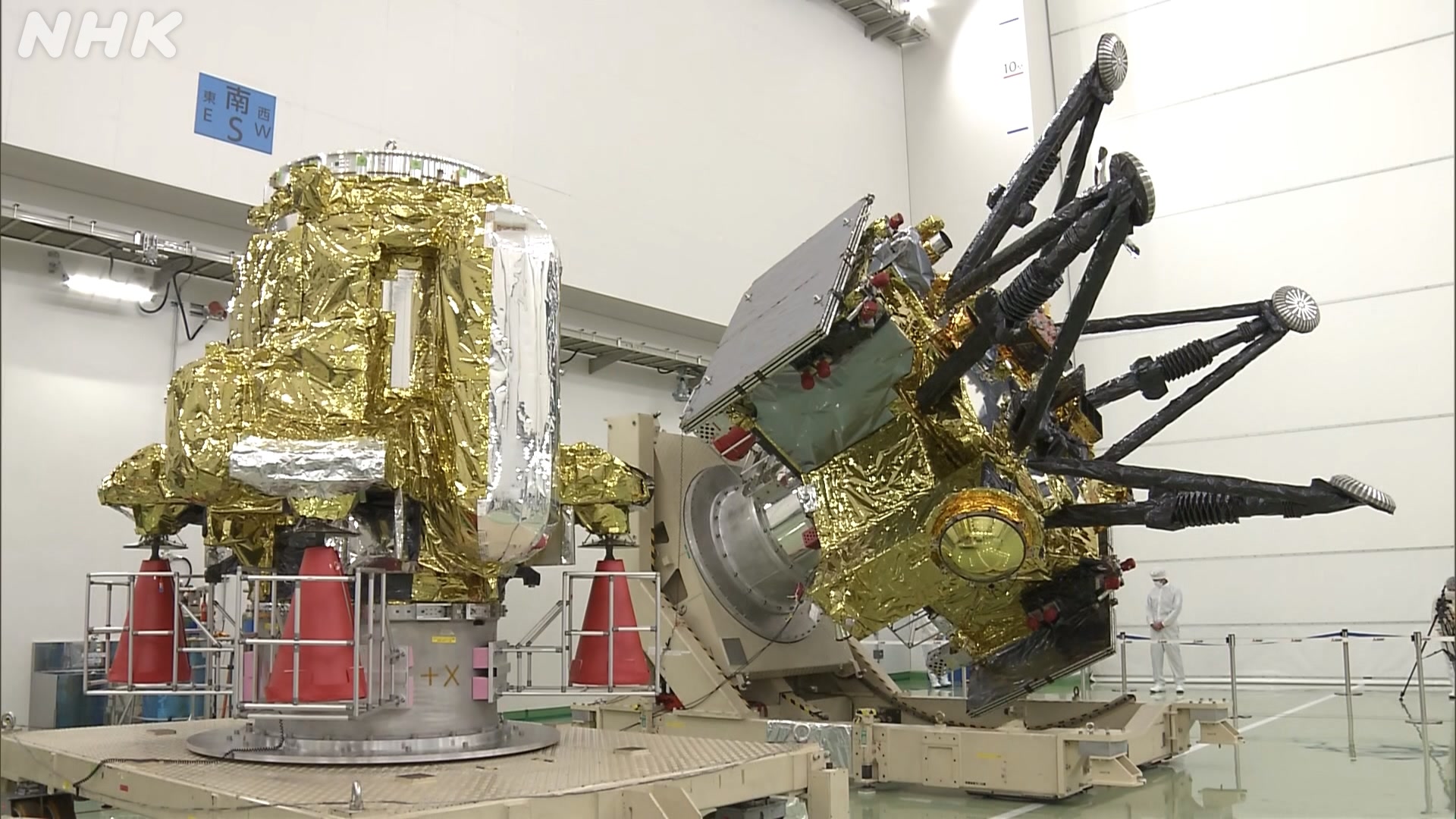
A Japanese mission to bring samples from a Martian moon to Earth will launch into space from the southwestern prefecture of Kagoshima. The Martian Moons eXploration mission, or MMX, will lift off on an H3 rocket from Tanegashima Space Center around 4:41 a.m. Tuesday Japan time, which is 7:41 p.m. Monday UTC. The mission is designed to become the first in the world to land on the Martian moon Phobos, collect samples from its surface and deliver them to Earth. The Japan Aerospace Exploration Agency, or JAXA, led the project to develop the three-module mission. The total development cost of the mission is 55.3 billion yen, or about $350 million. The exploration module has four landing legs designed to land on Phobos, which has only about 2,000 of Earth’s gravity. It also carries sampling equipment, various observation instruments and two super-high-vision cameras jointly developed by NHK and JAXA. The mission is expected to reach the vicinity of Mars about a year after launch. He will then spend three years making observations. The exploration module is planned to land on Phobos and collect at least 10 grams of sample material from the moon’s surface layer at a depth of 2 centimeters or more. The return module is likely to deliver the samples to Earth during the fiscal year ending in March 2032. JAXA hopes the mission will help it develop the techniques needed to explore the Martian sphere. He also hopes the mission will shed more light on the origin of Phobos.