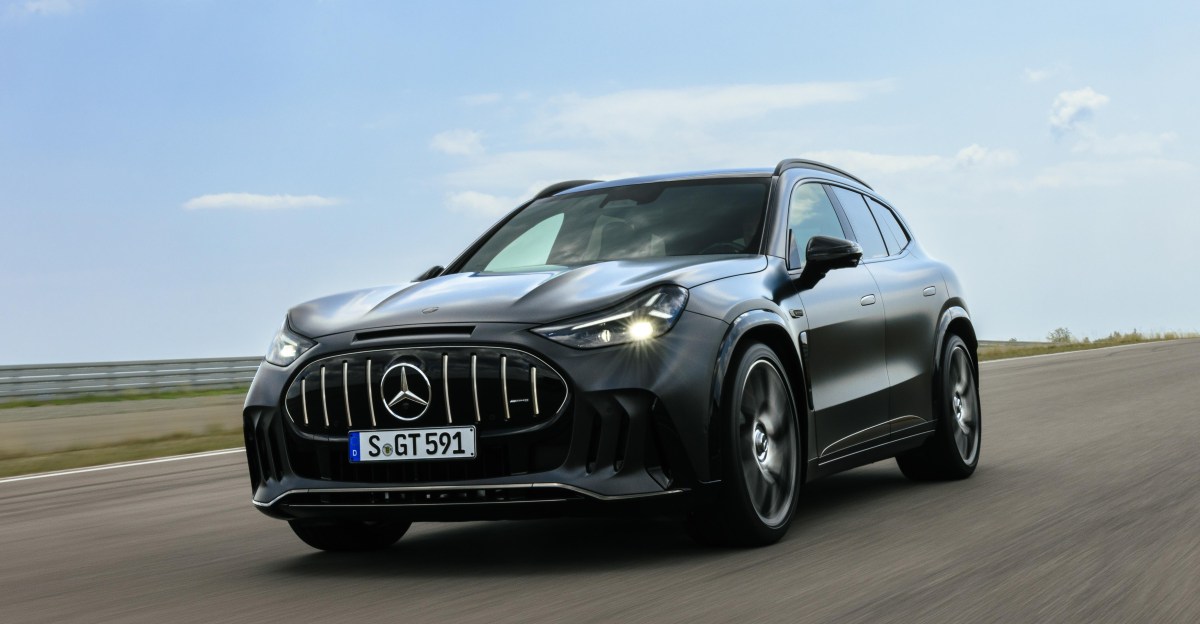
Earlier this year, Mercedes’ AMG performance brand caught our attention with the four-door GT coupe, a souped-up sports sedan with three axial-flow motors delivering more than 1,150 horsepower. Well, now meet its beefier cousin, the 2028 Mercedes-AMG GT SUV, an equally powerful electric people mover with ultra-fast charging. The AMG GT SUV (let’s say five times faster) marks the first time in the performance brand’s 59-year history that it has developed a full-size SUV entirely in-house from the ground up. Scheduled to arrive in the U.S. next summer, the new electric vehicle is built on Merc’s high-performance AMG.EA architecture to combine the handling of a sports car with the suburban practicality of a full-size SUV. It will be available in three versions: GT 53, GT 55 and the flagship model GT 63, with the top model delivering 1,153 hp through the same three axial flow motors that power the four-door coupe. That beats the Porsche Cayenne Turbo Electric with Launch Control, which is sure to make for some awkward showdowns in Stuttgart. Thanks to an 800-volt architecture, the SUV supports incredibly fast charging speeds of up to 710 kW with the 128 kWh battery (GT 63 / GT 55) and 600 kW with the 106 kWh battery (GT 53). Drivers can charge between 10 and 80 percent in 12 minutes or gain up to 450 km (about 280 miles) of WLTP range in just 10 minutes. The 128 kWh battery models will have an estimated maximum range of 435 miles. That battery, by the way? It uses F1-inspired technology with specialized NCMA cathodes, silicon-containing anodes and cylindrical cells. An electrically non-conductive oil flows directly around each individual cell for uniform thermal management, enabling continuous high power delivery and long battery life. Mercedes has been quietly at the forefront of battery technology for some time now, and the AMG GT SUV is just the latest example. The 710 kW charging speed, in particular, could give Mercedes another advantage over Porsche’s 320 kW speeds. For a full-size SUV, the AMG GT looks like it could handle like a vehicle half its size. Mercedes-AMG replaced traditional mechanical anti-roll bars with a newly developed suspension that uses active hydraulic elements to eliminate pitch and roll during acceleration, hard braking and cornering. Combined with three-stage air springs and six-degree active rear-axle steering as standard, it aims to balance track precision with long-distance comfort. But just because he’s a beefy guy doesn’t mean he’ll tip the scales. The AMG GT 63 SUV weighs 5,941 pounds, making it slightly lighter than the Lotus Eletre R (6,007 pounds) and Lucid Gravity (6,100 pounds), and almost identical to the Porsche Cayenne Turbo Electric (5,960 pounds). Silence is golden, except for the electric vehicle engineering team of a high-performance brand. That means including recorded sounds from real AMGs (in this case, the legendary AMG V8 and six-cylinder engines) to preserve AMG’s “emotional” identity. Mercedes prides itself on using real engine sounds instead of synthetic EV tones, although some may disagree. The system even simulates mechanical gear changes with paddle controls, offers adjustable sound profiles, and integrates physical seat vibrations, so you can still feel like there’s a real engine under the hood rather than a 78-liter frunk. The driving program called AMGFORCE Sport+ is offered as standard in all three versions of the Mercedes-AMG GT SUV. Inside, you’ll find the MB.OS platform on its 14-inch screen, with an army of AI agents from ChatGPT, Microsoft, and Google at your disposal to control. Use them to set up navigation, discover random locations, perform web searches, tell bad jokes, or anything else people use AI for in their cars. Merc’s own onboard AI system can handle physical aspects, such as adjusting the HVAC, changing drive modes or manipulating lighting, all through voice commands. PreviousNext1/1Beyond voice and navigation, the AMG GT SUV applies artificial intelligence to high-performance track driving through something called Predictive Performance Manager. Mercedes says PPM uses track mapping data to dynamically accelerate or increase electric motor power depending on topography, conserving battery power on downhill or technical twisty sections, so that full power is available on steep inclines and long straights. That could also mean faster, more consistent lap times by eliminating battery overheating and power throttling during track driving, something an AMG lover would probably appreciate. Mercedes has not yet released the official price, although we can expect something closer to its official launch. Follow this story’s topics and authors to see more like this on your personalized home page and receive email updates. Andrew J. HawkinsCloseAndrew J. HawkinsPosts from this author will be added to your daily email digest and homepage feed.FollowFollowSee all by Andrew J. HawkinsCarsCloseAutosPosts from this topic will be added to your daily email digest and homepage feed.FollowFollowSee all carsElectric carsCloseElectric carsPosts from this topic will be added to your daily email digest and homepage feed.FollowFollowSee all carsElectric carsCloseElectric carsPosts from this topic will be added to your daily email digest and homepage feed. your home page.FollowFollowView all electric carsMercedes-BenzCloseMercedes-BenzPosts in this topic will be added to your daily email summary and your home page feed.FollowFollowView all Mercedes-Benz newsCloseNewsPosts in this topic will be added to your daily email summary and your home page feed.FollowFollowView all newsTransportCloseTransportPosts of this topic will be added to your daily email summary and your home page feed.FollowFollowSee all transportation