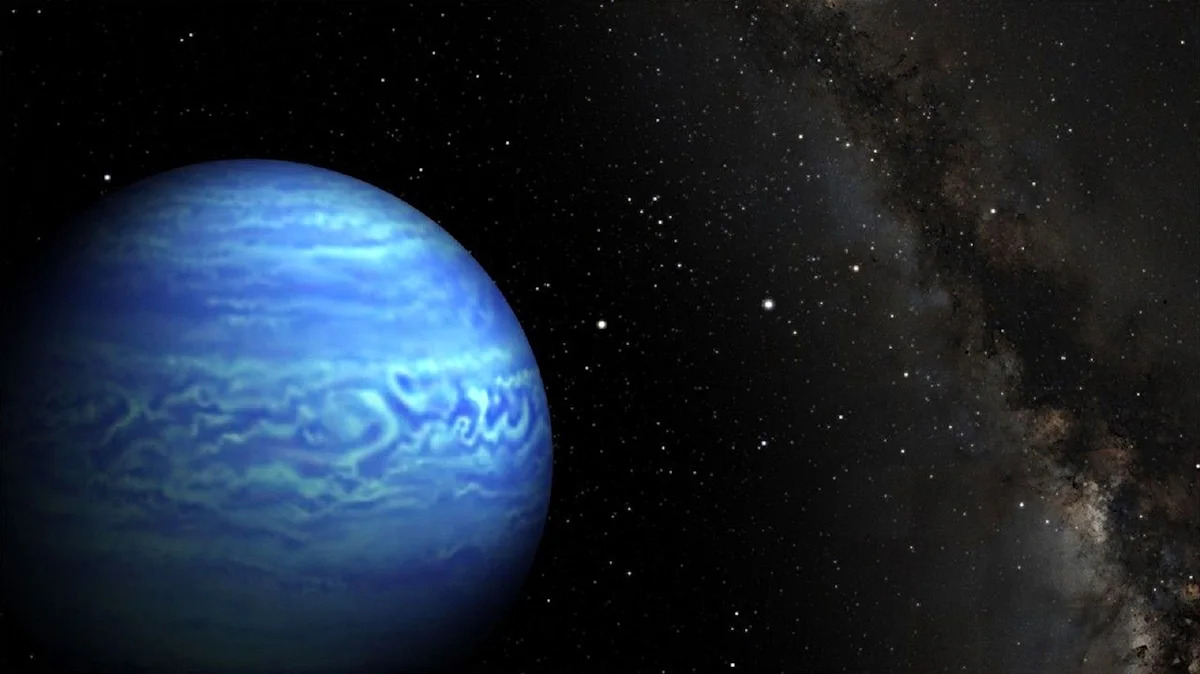
Through recent observations, astronomers have discovered that an exoplanet (technically a brown dwarf) that we have known about for years looks much more like our planet Earth than previously believed. The world, designated WISE 0855, has water clouds that are changing in thickness, indicating that it also has a progressive climate. WISE 0855 is a Jupiter-sized brown dwarf located about 7.5 light-years away. Photographed in 2010 by the Wide-Field Infrared Survey Explorer (WISE), it was officially discovered by Kevin Luhman in 2014 while reviewing data. Initial observations revealed that WISE 0855 appeared bluer than it actually is because the images were contaminated by background sources. Recent observations revealed much more, including water patterns and cloud cover. The team at the University of Arizona’s Steward Observatory, responsible for the most recent discoveries, used the James Webb Space Telescope’s infrared observatory to observe the brown dwarf for 11 hours. During that time, they gathered a spectrum of light every 15 minutes, essentially capturing a timed series of the world. They shared their findings in a study published in The Astronomical Journal. Using JWST, the Steward Observatory team noticed that clouds came in and out of focus, changing over time as WISE 0855 rotates, although things work a little differently than simple weather changes at home, since the atmosphere contains gases rising from the depths. Ultimately, WISE 0855 is probably not a habitable world and probably has a much closer similarity to Jupiter than to Earth. Additionally, brown dwarfs like WISE 0855 are not considered true planets. planet with infernal clouds of metal swarming through its atmosphere. Therefore, the cloud details of WISE 0855 are not necessarily the highlight of this news. There are two other very interesting facets to this discovery. The first is that WISE 0855 is only 7.5 light years away (about 44 trillion miles) and, in addition to the fact that it is the coldest brown dwarf ever discovered, it is also relatively close, cosmically speaking. For comparison, astronomically, the closest star system to Earth is Proxima Centauri, which is about 4.25 light years away. WISE 0855’s distance puts it in virtually the same neighborhood: just 3.25 light years farther than Proxima. The other notable element is that the James Webb Space Telescope was able to detect the clouds, their movement and their overall composition to allow for true observations. This is the first time a team like this has been able to confirm water clouds and also observe how they become thicker and thinner. One of the researchers on the Steward Observatory team, Brittany Miles, said it best. Before James Webb, astronomers and researchers only had access to photometry technologies, which “mixed the effects of clouds, chemistry, and temperature.” Now, all of those properties can be distinguished and observed. It’s also what helped the team better understand WISE 0855 and its actual composition compared to previous research. Subscribe to BGR’s free newsletter and add us as a preferred search source or follow us on Google for the latest in tech and entertainment, plus tips and advice you’ll actually use. Read the original article on BGR.