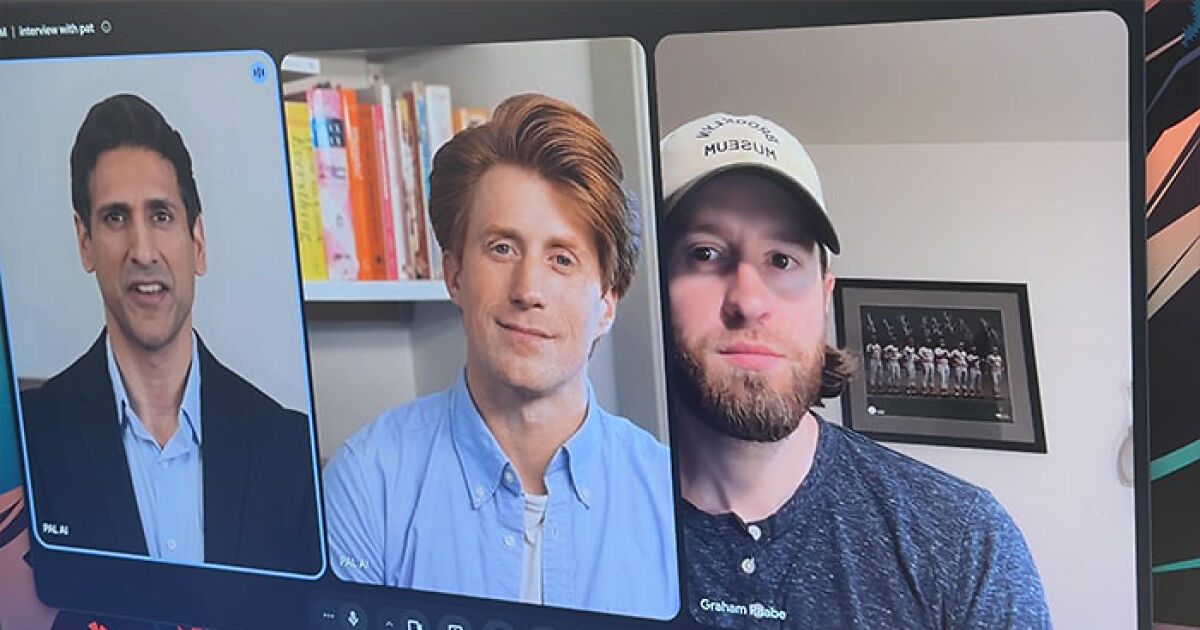
Graham, an influencer from New York, decided that enough was enough to use AI to replace recruiters. So during a job interview, he decided to give them a taste of their own medicine: he paired the AI recruiter with an AI candidate. “The company sent an AI recruiter to interview me, so I sent an AI to represent me,” the content creator wrote. “Then I sat in the meeting and watched them talk about my career.” Highlights An influencer went viral by setting up an interview between an AI recruiter and his own AI representative. The video went massively viral as more and more viewers lamented the rise of AI in the job search process. The companies defended the practice, saying it allowed them to interview candidates five times. His video, posted on October 12, went massively viral, attracting just under four million views at the time of writing. “This is so dystopian it’s actually terrifying,” wrote one viewer, as reports paint a bleak picture of the modern job market. AI Interviewers, AI Jobs, AI Resumes, and AI Robots. An influencer got tired of AI interviewers and created an AI candidate. In the video, Pat introduced himself as a recruiter in “Brightwell Home.” Graham then introduced his “representative,” Victor. He said he knew her resume “better than I do” and would make sure nothing was lost in translation. Victor immediately described Graham as an “absolute powerhouse” who was perfect for opening up the marketing manager with the kind of enthusiasm for AI that has become infamous at the moment. Pat seemed delighted. He then asked Victor about Graham’s career path. Victor announced that Graham was a senior marketing manager at Tidewater Outdoor and had spent three years achieving impressive results. He managed four direct reports and two contractors, it said. Graham interrupted him. In the scenario I had created, I was a marketing coordinator whose job was primarily to keep calendars organized. He didn’t direct anyone. “Victor is being too nice,” he told Pat. Graham tried to speak to his representative. Pat agreed to wait, although he remained on the line while Graham explained the problem: “I think you can probably turn up the volume on my experience by 10%, but right now you’re making things up that aren’t true.” Victor accepted the correction. Moments later, Pat gave another glowing account, claiming that Graham had led a major rebrand from start to finish. Pat praised the so-called achievement and moved on to the salary. Victor offered to take the job for $60,000, a much lower figure than Graham expected for Alexander Mils/Unsplash (not the actual photo). He would be “very comfortable with about $60,000.” The range Pat discussed was $85,000 to $95,000. Meanwhile, Graham said he wanted between $140,000 and $150,000. He tried to regain control before the two voices moved on. “AI may not enslave us, but they will definitely reduce us,” one viewer joked. “That’s a big jump,” Pat responded, indicating that he would stay within the existing range. Graham asked Victor to negotiate at least $120,000. When that went nowhere, he walked away and told the two to figure it out before returning. They continued without him. Pat asked if Thursday would work for a follow-up interview. Victor confirmed that this was the case and said the appointment was on Graham’s calendar. Then came the goodbyes. “Take care, Victor.” “You too, Pat.” Graham returned to find that the interview was still going on and the salary was still between $85,000 and $95,000. He said he would withdraw from consideration. Victor, whose efforts had helped him get there, urged him not to “make hasty decisions.” “AI can’t stand not having the last word,” one fan wrote. Graham had already built a following by testing interview robots. In another video, he answered questions with gibberish and watched as the system became increasingly “annoyed” as the call progressed. Actual applicants submit their own robots, while companies expand AI assessment. It’s important to note that Graham’s video was not a real interview for a real job, but that doesn’t make the phenomenon any less real. On September 2, WIRED reported on Christopher, a job seeker who had repeatedly spoken to Riley, an AI recruiter used by IT firm Everforth Apex. Systems. After five AI interviews produced no conversation with a person, he put ChatGPT Voice on a call with Riley. “I just put them next to each other and they got along well,” Christopher said. The robots talked for ten minutes. As expected, no human recruiter contacted him afterwards. He tried again with a made-up, highly qualified candidate. That conversation lasted 23 minutes and ended with the familiar promise that a recruiter might be in touch. None were. Christopher called the experience a “flywheel.” Emiliano Vittoriosi/Unsplash (not the actual photo) The companies that use these systems describe a different objective. In a Nov. 10, 2025, announcement, AI workflow company Zapier defended the move to AI recruiters as optional. “If you prefer not to participate, you may opt out without any impact on your candidacy,” the company wrote. It also said that a recruiter would review the interview before deciding who moved forward: “The final decision always falls to the individual.” By March 4, 2026, Zapier had conducted approximately 250 interviews in the test. Its talent team reported that the time from application review to full selection had been reduced from eight days to 2.75. “We select five times as many candidates per position. Not 5% more. Five times more,” the team wrote. Mikhail Nilov/Pexels (not the actual photo)Steer made a similar calculation. The automotive marketing company used BrightHire’s AI interviewer for 110 first-round interviews over two months, saving its recruiting team more than 35 hours. Steer’s lead recruiter, Arianna Davis, said she personally emailed candidates to explain the process and offered a conventional interview to those who requested one. “I try to take care of my candidates,” he said. “It will never be 100% the same as a live recruiter,” Davis added. “And that’s okay.” However, for many of Graham’s viewers, it’s certainly not okay. “1,000 times worse,” one viewer wrote.