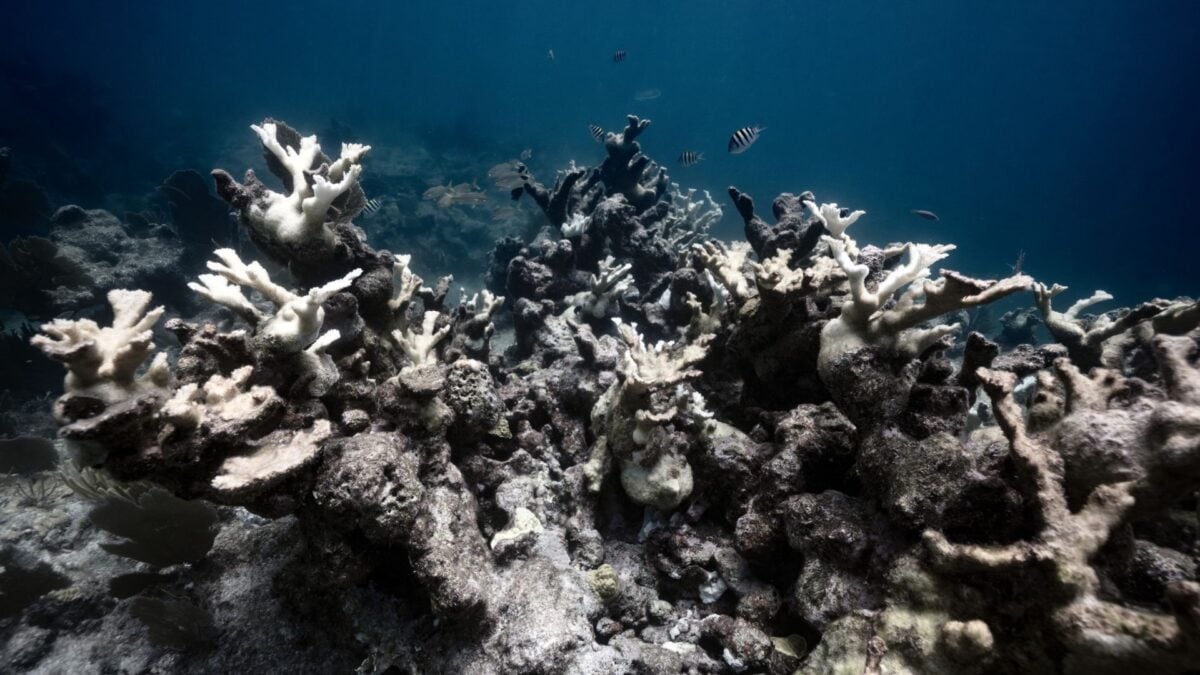
Let’s leave aside the fact that coral reefs are essential sources of marine biodiversity, colorful aquatic oases that feed countless animals along the entire ocean food chain. These reefs are also critical for humans. According to one assessment, the global societal benefits of coral ecosystems – including protected coastal infrastructure, habitats that support commercial fishing, tourism and even drug discovery – provide an estimated value of $9.8 trillion a year. Therefore, it is important that approximately 84.4% of the world’s coral reefs suffered levels of bleaching due to heat stress during the last major marine heat wave, from January 2023 to September 2025, and more than half have already been lost compared to coral cover in the 1950s. Basically, corals bleach when rising temperatures kill off their symbiotic algae, a form of Single-celled phytoplankton known as dinoflagellates. Left to their own devices, these coral reefs can (if they’re lucky) slowly repopulate their essential partners from dinoflagellates floating in the marine environment, but all too often that incremental organic rejuvenation occurs too slowly to save a reef from certain death. “Bleached corals are often considered a lost cause because recovery after a heat wave is very slow, if it occurs at all,” explains Fiorenza Micheli, a marine ecologist at Stanford University’s Center for Ocean Solutions. But there is good news, thanks to a new study published this Wednesday in the journal Science Advances: Stanford marine ecologists have discovered that bleached corals can be revived through contact with a healthy neighboring coral, which (like a good neighbor) shares its photosynthetic and symbiotic algae (Symbiodiniaceae) with its peers. “This incredible new result (that rapid and complete recovery is possible in bleached corals) may inspire solutions that could eventually be scalable,” Micheli, co-author of the study, told Nature magazine. Dino might Stanford marine scientists gathered 10 pairs of coral fragments, one bleached sample and one healthy sample each, to test how simple contact helped revive genetically identical specimens. Credit: Danny Collins Stephen Palumbi, a research scientist at Stanford’s Hopkins Marine Station in Pacific Grove, California, was the first to stumble upon the regenerative properties of neighboring corals last year, when he detected the phenomenon occurring by chance between two specimens in the laboratory. Soon Palumbi began collaborating with Danny Collins, a doctoral student working with Micheli at Stanford, whose previous work had investigated how microbial diseases spread from one coral to another. “Harmful bacteria enter corals through physical contact,” Collins said. “We were curious what would happen if we used contact to reintroduce something good.” Collins collected 10 pairs of test corals of the same species, Pocillopora damicornis, each composed of one bleached and one healthy coral fragment. Half of these test pairs touched each other, while the other five were separated by only a few millimeters. That distance was enormous. Unlike their controls, bleached corals in contact with healthy corals recovered in just eight weeks. The speed of this effect took Palumbi by surprise. “Once beneficial algae get onto bleached corals, they don’t just spread,” Palumbi said. “They flood and begin to divide at the fastest rate observed in corals.” Reef relief The team tracked the flow of algae and symbiotic nutrients from healthy coral to their bleached companions through new microscopic imaging equipment at Hopkins Marine Station. Credit: Danny Collins / Jana Sipkova At the moment, there is only one downside to deploying healthy corals to revive their comrades in the world’s oceans. This healing contact phenomenon only seems to work between genetically identical coral specimens. “Genetically identical corals recognize each other when they come into contact,” according to Palumbi, a professor of oceans at Stanford’s Doerr School of Sustainability. “Your tissues fuse if they come from the same clone. We see something similar in humans. Organ transplants are usually successful if the donor is your identical twin.” However, the surprising discovery of this method, along with other techniques that marine conservationists are actively pursuing (including the successful freezing and recovery of at-risk corals taken from Hawaii), could offer threatened reefs the lifeline they need. Contact with corals could boost other efforts, such as selective breeding of heat-tolerant corals and cultivation of protected coral nurseries. “They open the door to what is possible,” Micheli said, “and can lead to the breakthrough we need to accelerate reef restoration.”