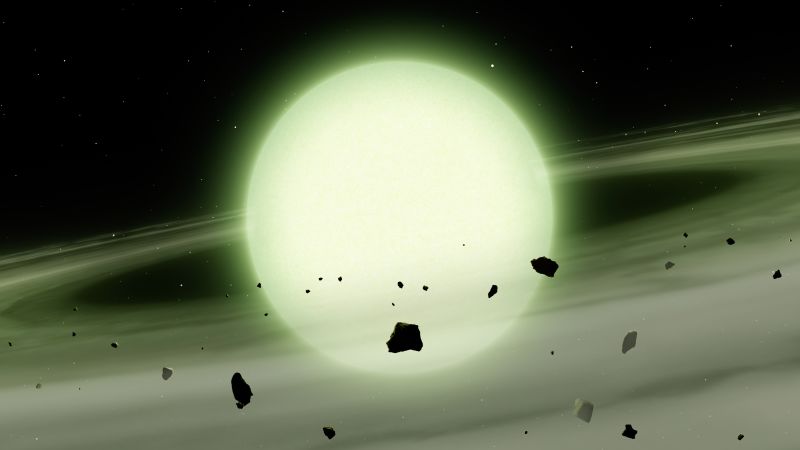
Astronomers analyzing white dwarf stars have for the first time found a star that would appear green to human eyes, according to a new study. While for most stars, color depends on temperature and is limited to a few shades, white dwarfs, which are the dense remains of Sun-like stars that have died, can shine in an incredible range of colors, the study’s lead author, Mark Hollands, an astrophysicist at the University of Warwick, England, said Thursday. “The colors that normal stars can have are pretty much just orange, white or blue,” Hollands told CNN. “What we found is that, for most white dwarfs, that’s also the same. But there are some special cases where the physics in the outer layers of these stars is strange enough to cause quite large deviations in terms of their spectrum,” he said. These deviations are due to the interaction between the helium in its atmosphere and traces of other elements, which vary between white dwarfs, depending on the material that has interacted with the star throughout its life. For example, iron, magnesium and sodium, elements commonly found in rocks, can be found on the surface: potential evidence of a nearby ancient planetary system, or “something like an asteroid venturing too close to the white dwarf,” Hollands explained. “It turns to dust and then those rocky bits of dust and debris fall onto the white dwarf,” he said. “And then that is mixed with the outer layers, and then you can use that to measure what the rock matter was formed from,” Hollands said. “So we can use the white dwarf as a kind of diagnostic tool to measure the chemistry of the planetary material,” he added. “The white dwarf is dismantling the planets, and we can see what was actually inside that planet (the ratio of different elements) and that gives us clues about how these planets formed,” said Adam Burgasser, a professor of astronomy and astrophysics at the University of California, San Diego. “It’s a crime scene, and we’re reconstructing the evidence that we’ve left at our disposal, and that allows us to reconstruct the history of what the planet was and how it formed long, long ago in history.” For this study, Hollands examined all 151 known white dwarf stars that lie within 20 parsecs, or about 65 light years, of Earth. As for the green star, the main elements present are calcium, sodium and lithium, Hollands said. “It kind of stimulated my interest in looking deeper into that object and why it has so much material accumulated on it,” said Burgasser, who was not involved in the study. “It may excite both the public and scientists to learn more about some of the, I would say, more extreme objects in this display.” Another notable star was “almost like a salmon pink,” due to the presence of a high density of carbon molecules, Hollands added. While white dwarf stars cannot be seen directly from Earth, Hollands was able to calculate their color using data from the stellar spectrum, which a statement from the researchers defines as “the ‘footprint’ produced when starlight is split by wavelength, much like a prism splits sunlight into a rainbow.” Hollands explained that the research has also brought these space objects much closer to home. “It gives you a nice human connection to these very distant things that are so far away that sometimes, even as a researcher, you feel quite disconnected from these objects that you study,” he said. “But then you can add a human element to it and it feels much more tangible.” The observations on the green star are based on existing data and may not provide new insights into white dwarfs, but the study offers an intriguing approach and insight into these celestial bodies, said Agnès Kim, an astrophysicist and professor of physics at Penn State Scranton, who was not involved in the work. “To me, doing a study that goes from the spectrum to what the human eye would see is an interesting intersection of physics and biology,” Kim wrote in an email. “I love that some of them look green to us if they were close enough for us to see them, and it’s even more fun that some of them look pink.” Burgasser added that the study’s categorization scheme using temperatures and atmospheric properties may be useful in advancing the field. “Some things are purplish-pink, and others were greenish and blue, and that type of classification, which by the way we do all the time in astronomy, is classifying things, allows us to focus on: why do these types of objects have these colors and are they related to each other based on their composition?” Burgasser said. “We have that information in other forms, but I think this is perhaps a simplified way of organizing that data.” Next, Hollands plans to continue analyzing more spectra of white dwarf stars, with advances in scientific techniques meaning researchers will be able to observe a new group of stars that are even further from Earth. “We know of white dwarfs for which we don’t have spectra,” he said, “but that’s all about to change because there are quite a few spectroscopic studies” that are going to start providing data. “We will get a tenfold increase in the number of white dwarfs that have spectra,” Hollands said. “And then maybe, if we’re lucky, we’ll go from one or maybe two green white dwarfs to 10 or 20.” The study was published in the journal RAS Techniques and Instruments, or RASTI. Subscribe to CNN’s Wonder Theory science newsletter. Explore the universe with news about fascinating discoveries, scientific breakthroughs and more.