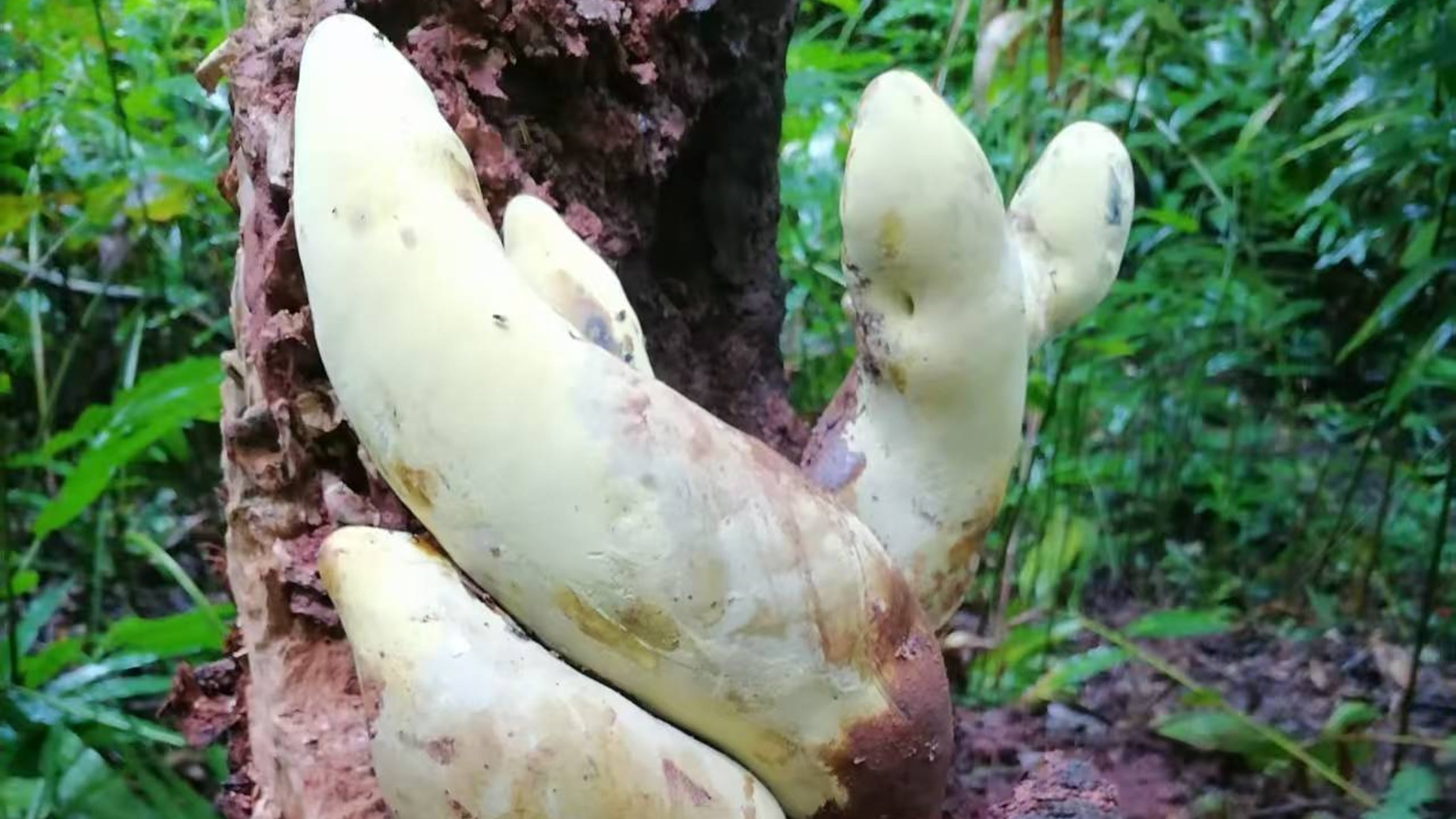
China’s Yunnan province is famous for its mushrooms, but somehow, scientists have just found a new species that has rightly earned the name “king.” Called Dianjunus rex (or D. rex for short), its giant club-shaped fruiting bodies can grow up to 50 centimeters tall, about a foot and a half, or the height of a traffic cone. A researcher holds up two D. rex fruiting bodies to show their impressive size. (Provided by Indunil Senanayake) But its impressive size is not the only interesting thing about this mushroom. Their genes also contain clues to an important moment in the history of life on Earth. Mycologist Indunil Senanayake of the Chinese Academy of Sciences and her colleagues describe the new species in a paper published in Frontiers in Fungal Biology.D. rex is the only known member of its family, Dianjunaceae. “This extraordinary species… offers a rare window into the evolution of extreme fungal body shapes,” Senanayake says. “The discovery illustrates how much fungal biodiversity still remains to be discovered in the forests of East Asia.” The fungus in its natural habitat. (Provided by Indunil Senanayake) Researchers discovered that the Dianjunaceae family diverged from its closest known relatives about 65 million years ago, by comparing its DNA to hundreds of other fungi whose evolutionary history is well known. “This moment raises an intriguing possibility,” Senanayake says. The family emerged just 1 million years after the Chicxulub asteroid impact, which triggered a mass extinction event. The dramatic changes in Earth’s climate that resulted from the asteroid wiped out three-quarters of Earth’s plant and animal species, including, famously, all non-avian dinosaurs. “After the mass extinction, forests underwent dramatic changes, including the sudden availability of large amounts of dead plant material,” Senanayake says. “For wood-decomposing fungi, such environmental alteration may have created new ecological opportunities.” This is not the first time scientists have proposed that the asteroid that killed the dinosaurs caused a mushroom “boom” around the world. Fossils found in North Dakota, Colorado, and New Zealand show that massive spikes in fungal activity occurred in the wake of this mass extinction. Fungi tend to prefer cooler temperatures and acidic environments. The colder, darker conditions that arise when geological calamities shade our skies, as Chicxulub did, could have easily set the stage for an era dominated by fungi. Close examination of D. rex under a microscope reveals its identifying characteristics, including its asci and spore-producing (hp) structures. (Song et al., Frontiers in Fungal Biology, 2026)D. rex is related to fungi such as morels, truffles, and cordyceps, in the phylum Ascomycota. Like all fungi, ascomycetes live as mycelium, under the soil or within the substrates (wood, excrement, toenails, etc.) on which they feed.D. rex is often found at the base of oak trees, including the Chinese cork oak (Quercus variabilis) in the forests of Yunnan province in southwestern China. The specimens recorded so far grew on the decaying roots or stumps of these trees.D. Rex fruiting bodies were discovered in the forests of Yunnan province. (Song et al., Frontiers in Fungal Biology, 2026) When it’s time to reproduce, D. rex sends out its giant white fruiting bodies, which are called stromas. These serve the same purpose as mushrooms do for other fungi: they spread spores into the air so that more D. rex can flourish on the forest floor. But it’s unclear why D. rex’s stromata are so gigantic—the largest of all recorded ascomycetes. Some specimens the researchers collected weighed a whopping 2.2 kilograms. “A fruiting body that rises above the surrounding vegetation and debris could have better dispersal of spores by wind in dense forests,” Senanayake proposes. “However, such a large structure requires a substantial energy investment, suggesting that this strategy likely evolved only when the ecological benefits outweighed the costs.” The research has been published in Frontiers in Fungal Biology. This article was fact-checked by Fiona MacDonald and edited by Fiona MacDonald. While we take pride in our process, we are human. If you spot an error, please let us know.