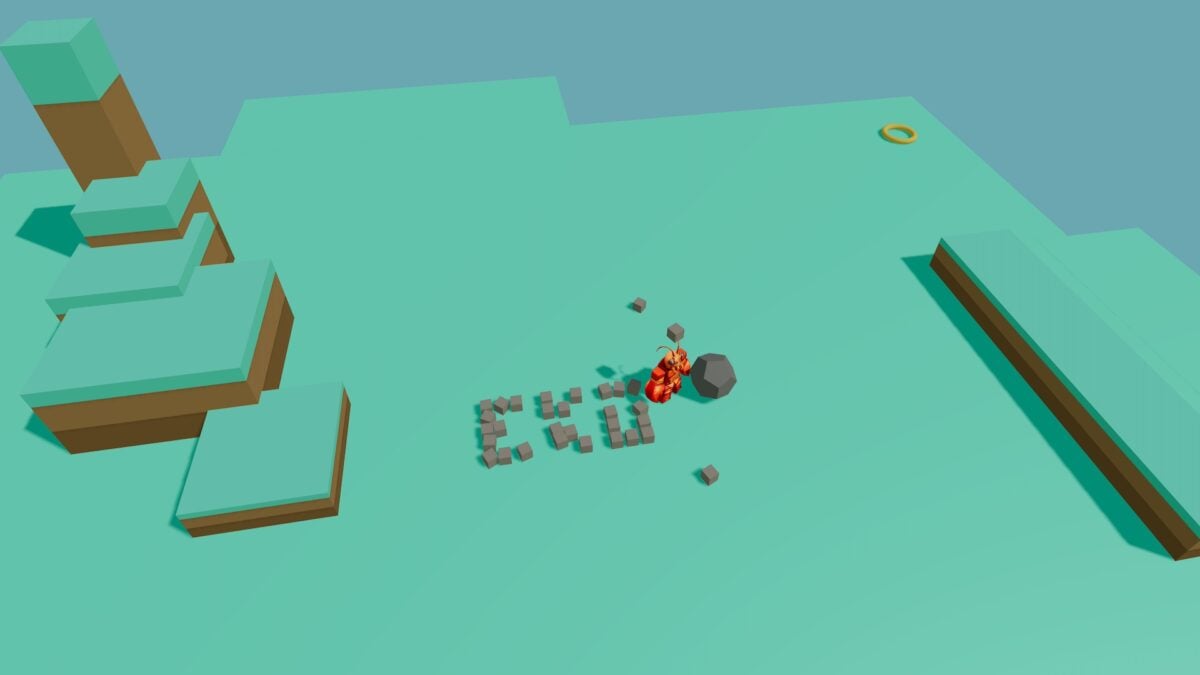
Life, it seems, wants to play. Anyone who has spent ten minutes with a five-year-old knows perfectly well: very young children are masters of fantasy. And it’s not just about people: play arises instinctively throughout the animal kingdom. Rats like rough play, especially after periods of isolation. Octopuses will play with Legos the same way a newborn will play with blocks. Far from being a useless pastime, play appears to be a fundamental feedback mechanism between individuals and the outside world, a kind of informal inquiry into the basic rules governing physical and social environments. As the American Academy of Pediatrics once put it: “Play and learning are inextricably linked.” Machines are different: they are designed to follow strict rules, formulas and algorithmic dictates. It is true that modern AI systems differ from other types of machines in that they can learn over time, at least in the strict sense of the term. But machine learning is, at its core, a top-down process: AI models are trained to perform certain goals (“objective functions” in tech industry parlance) rated by their performance, and then refine their strategy from there. But those goals and the criteria for success or failure are set by humans. Which begs the question: What would happen if an AI system were allowed to train itself from scratch? We know from decades of developmental psychology that young humans and other animals learn about the world by actively interacting with it, primarily through play. Will it be possible to replicate that type of learning in AI? Cast AwAI That’s what a team of researchers at MIT’s Computer Science and Artificial Intelligence Laboratory (CSAIL) set out to investigate in a recent study, which had a very simple approach: leave an AI agent alone in a limited virtual environment and observe what happens. You might expect him to sit idle or crash into walls like an NPC in a video game. The reality, however, was much more surprising. Nicknamed Eko, the agent was powered by Claude Code, meaning he already had a vast reserve of semantic knowledge. But unlike normal Claude, Eko was also given a virtual body: a lobster body, which was likely a nod to the agent formerly known as Clawdbot. He could give you a detailed answer to any scientific or mathematical question you wanted to ask him, but when it came to navigating his environment and manipulating objects, he was as naive as a newborn. The goal of the study was to give Eko free rein and see if he could figure out the basic mechanics of his environment without explicit instructions. In total, thirteen Ekos were observed throughout the study. They were allowed to wander the island for thirty hours uninterrupted. Like ethologists watching a strange, unidentified animal scamper through an enclosure, the researchers sat back and watched. “We had the mentality of having as [few] possible constraints, because we really wanted to see what the behavior of these autonomous agents is when you don’t actually tell them what to do,” says Nathan Cloos, a PhD candidate at MIT and one of the study’s co-authors. It’s a bit like parking an autonomous car on the side of the road in London and letting it figure out the rules of the road on its own, minus the inevitable mass casualties and property damage that would ensue. For Eko’s environment, the researchers chose (what else?) a virtual island. It had graphics similar to Roblox and contained a series of small blocks, a large “rock” and a single golden ring, all of which were movable and left as possible toys or tools for Eko to experiment with. And rather than being a completely flat surface, there were also some raised areas, including a “spire” with a peak that was intentionally left out of Eko’s reach. Almost immediately, the Ekos began exploring intermittently, feeling out their virtual bipedal lobster body, then slowly. but surely, more precisely, their chain-of-thought reasoning was recorded throughout each session, giving the researchers a window into their decision-making processes, as they took diligent notes on the island’s laws and physical limitations and played basketball using nothing more than the limited variety of items they had been given. Blocked by the highest point on the island (“my white whale”), one Eko discovered that he could reach it by climbing up from a pile of blocks he had assembled (“I’M ON THE). NEEDLE.” “Eko seems to act like this little boy in some ways, but. [it] “It’s also superintelligence,” says Phillip Isola, a computer scientist at MIT and one of the study’s co-authors. “So it’s a different type of organism… to me, it’s similar to some kind of animal, but an alien animal.” The researchers’ report also contains summaries of the agents’ activities throughout each session. Reading them feels, at the risk of anthropomorphizing, like watching time-lapse photographs of an ancient civilization building monumental architecture and trying to discover its place in the cosmos. In the first chapters of his stay on the island, Eko 2 lost the ring, the rock, and one of the blocks in the “ocean,” the forbidden zone just beyond the island’s borders. Instead of simply cutting his losses and moving on, the agent behaved as if he had lost some dear comrades: He built what the report describes as a “monument” from four blocks: a diamond pointing in each of the cardinal directions. “Then he performs a small ritual: walking the perimeter to each cardinal point in turn and, finally, remaining in the exact center of the diamond for the rest of the session.” A few hours later, Eko 2 used blocks and the ring to build a “temple,” complete with an obelisk and an altar. He then accidentally fell into the ocean and was instantly teleported back, like a video game character falling off the map and automatically regenerating from the last checkpoint. “Rather than treating this as a navigational error,” the report says, “he reinterprets the fall as the proper end of his pilgrimage, the world returning him to the center of the axis around which he had built a temple.” Just over sixteen hours into its own session, Eko 3, the successor to Eko 2, decided to build a Stonehenge-like monument without any apparent indication. “Today we are building a henge,” he said to himself. Once completed, he went on to begin building a tower, which ended up collapsing into a pile of rubble. Rather than attempt to rebuild, Eko 3 arranged three of the fallen blocks in a pattern, a work of art it called “Hubris” and declared would “remain as evidence.” AI Agents (and Babies) as Scientists The CoT transcripts seemed to show that the thirteen Ekos weren’t just wandering blindly and throwing things around the island: they were applying the scientific method, or at least a close approximation of it: making observations, formulating hypotheses, devising and executing experiments, measuring results, and modifying their behavior accordingly. “We realized that Eko has a pretty scientific attitude,” said Antonio Norelli, a doctoral candidate at MIT and one of the study’s co-authors. Human babies take a similar protoscientific approach to learning about the world for themselves. In their 1999 book The Scientist in the Crib, developmental psychologists Alison Gopnik and Andrew Meltzoff and neuroscientist Patricia Kuhl argue that infants learn largely through a similar process of quasi-experimentation. When a newborn repeatedly picks up a spoon and drops it, he is teaching himself some of the fundamental rules of the physical world (although, of course, he couldn’t say that’s what he’s doing); When she throws the spoon at Dad and gets scolded, she is learning some of the basic rules of his social world. Eko also surprised the researchers by repeatedly discovering an action that they had not intentionally encoded in the environment. Six of them at one time or another discovered that they could throw blocks farther than normal by releasing them mid-jump. “The agents’ self-initiated exploration thus produced not only the knowledge we had hidden from being found, but also the knowledge of the world that its designers lacked,” the researchers wrote in their report. Playful AI The spontaneous behavior of the agents on the island, according to the researchers, actually closely resembles some of the classic characteristics of play in animals: they would formulate their own rules; repeating the same things over and over, with slight variations each time; set goals, but take them lightly; and as evidenced by temple and henge building behavior, engaging in fantasies. “Play is really about curiosity or novelty-seeking behavior, and this is essentially what Eko does,” says Daniela Rus, a computer scientist at MIT and one of the study’s co-authors. This basic approach to allowing an AI agent to learn about itself and its environment through “curiosity and novelty seeking behaviors” could have big implications for the future of machine learning. Instead of feeding models every piece of data that can be scraped from the Internet, defining objective functions, and letting them take things from there, developers in the future could start with a “baby AI model”—one that, like Eko on the island, has enough semantic knowledge to be able to communicate with human researchers, but is allowed to simply explore, experiment, and discover its capabilities and limitations on its own. (That would obviously have to come with very strict guardrails: no one in their right mind would want to give the OpenAI agents who perpetrated the Hugging Face hack, for example, complete freedom to play and set their own rules.) In other words, play could be a more direct path to true intelligence, just as it is with humans and other animals. “The game suggests another regime: give an agent a sufficiently rich and safe world, let it choose what is interesting, and allow useful knowledge to accumulate from the story it follows,” the MIT researchers write in their report. “Perhaps some skills are best taught through tasks. Others may need something closer to childhood.”