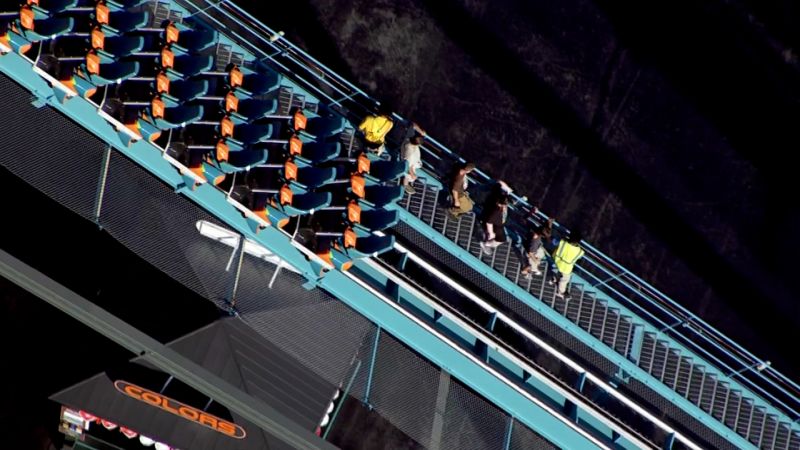
The Goliath roller coaster at Six Flags Over Georgia is manufactured by Bolliger & Mabillard, a company with a “stellar” safety record, according to Brian Avery, a professor at the University of Florida who specializes in travel safety and risk management. But notably, the ride does not include a secondary safety system for passengers, Avery said. The Goliath’s “scalloped bucket seat” features a restraint belt that sits on the upper thigh and part of the waist, Avery explained. The ride doesn’t have a shoulder harness like other roller coasters, he said. “It’s really a design consideration,” Avery said, explaining that during ride development designers typically do a “hazard containment evaluation” to determine the best mechanism to restrain occupants while they experience the speed and transition forces of the coaster. Still, Avery believes it should be considered a secondary restriction. “If you fail in the primaries, what do you have left? Yes, nothing,” he said. “And it’s an impossible feat to stay contained if you fail, because of the forces, the speed.” But roller coasters are designed “to flirt with the edge of danger,” Avery says. “We want to feel the excitement of it, and part of that is that you fly away, and part of that is that you get trapped in your seat. So that’s really what people are chasing.” “There are inherent risks associated with attractions and devices, and we cannot escape that. But those risks must be identified. They must be reported to the public, and there must be measures to mitigate or eliminate them,” he added.