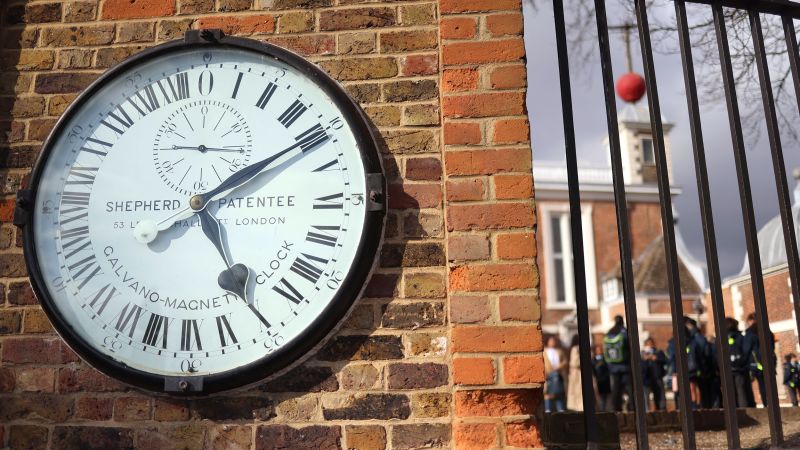
London — When the sun reaches its highest point on the meridian line that travels north to south from the 351-year-old Royal Greenwich Observatory in London, it is noon, Greenwich Mean Time, a tangible, physical reference point that helped establish the world’s time zone system. Timekeeping has long been based on the Earth’s spin and the location of the sun or moon in the sky. Before observatories like Greenwich, humans used sundials, essentially a stick stuck in the ground that casts shadows when the sun moves overhead. But this ancient link between Mother Earth and today’s clocks seems to be about to be broken. International timekeepers are on track to vote Thursday on a proposal to eliminate what is known as the leap second, a small but many say important link between Earth’s rotation and the global time standard used in critical infrastructure such as telecommunications, power grids and computers. Inserted into global clocks 27 times since 1972, the leap second essentially allows two time systems to operate in sync: astronomical time, long anchored by the Earth’s rotation and measured by observatories, and Coordinated Universal Time, or UTC, the global standard set by ultra-precise atomic clocks first developed in the 1950s. These cutting-edge laboratory clocks are based on tracking the natural vibrations (or ticks) of the atoms. The two methods of telling time differ because the Earth doesn’t spin at a constant rate but instead wobbles, essentially making it a “lousy” clock, said Jeff Sherman, group leader of the Time and Frequency Division at the National Institute of Standards and Technology in Boulder, Colorado. This wobble is due to several factors, such as the gravitational pull of the Moon, profound changes in the planetary core, and the movement of water and ice on the Earth’s surface, an effect that is exacerbated by the melting of the polar caps due to the climate crisis. “We have to decide whether or not the most important thing is a sense of time given by objects in the sky directly above, say, Greenwich longitude,” he said, referring to the Greenwich meridian that marks 0 degrees longitude. “Or you decide to follow what you think are more stable, man-made laboratory clocks,” Sherman added. Leap seconds have served as a compromise between the two time measurement systems. Most people never notice them, unlike a leap year, which adds an extra day to February every four years to account for the discrepancy between the Gregorian calendar used in most of the world and the time it takes the Earth to complete one orbit around the sun. But the addition of leap seconds, which occurs at irregular intervals and is announced only six months in advance, creates problems for operators of data servers, high-frequency financial trading systems and other infrastructure that depends on precise timekeeping to function properly. The extra second crashed Reddit and LinkedIn and knocked out Qantas’ reservation system in 2012. And when the most recent leap second was added in late 2016, customers of cloud computing provider Cloudflare briefly experienced outages or delays after its servers couldn’t properly handle the introduction of a leap second. Big tech players like Meta have been calling for its demise, describing the leap second as “a major source of pain.” The 69 member states of the International Bureau of Weights and Measures, an intergovernmental organization that determines measurement standards, will meet this week in Versailles, near Paris. The group, known by its French acronym BIPM, will vote on a resolution to eliminate the leap second, a measure that would take effect in May 2027. A majority is needed to support the proposal, said Patrizia Tavella, director of BIPM’s time department. When atomic time was first introduced, Tavella said, it was important to keep it tied to astronomical time because navigation tools still relied on traditional celestial methods and timekeeping. However, with the advent of GPS, that was no longer the case. “This correction over time has become a serious problem for modern applications,” he added. BIPM members have discussed the move to what Tavella called Continuous Coordinated Universal Time for more than 20 years, he noted. At the group’s last meeting in 2022, member countries voted in favor of a resolution calling for a plan to phase out the leap second by 2035 or sooner. In the past, some countries, such as Russia and the United Kingdom, have opposed eliminating the leap second, he noted. Russia’s opposition to 2022 arose from the fact that its Global Navigation Satellite System, or GLONASS, incorporates leap seconds, unlike other satellite navigation systems, such as the United States’ GPS and the European Union’s Galileo, which do not. The United Kingdom was once opposed due to its cultural attachment to the pivotal role Greenwich played in the history of weather, but its stance has since changed, he added. Since the world’s timekeepers last met in 2022, the debate over whether the leap second needs to be abolished has become urgent because of the prospect of something unprecedented: It will soon be necessary to subtract rather than add a second, known as a negative leap second, according to experts. The long-term trend of Earth’s rotation is slowing, but in the short term it appears to be accelerating, which could require a one-second subtraction from Coordinated Universal Time to maintain coincidence between astronomical and atomic time. A 2025 report from the International Earth Rotation and Reference Systems Service, a Frankfurt, Germany-based consortium tasked with tracking Earth’s rotation, estimated that the probability of a negative leap second would increase dramatically in the coming years, reaching a 30% probability by 2035, according to BIPM. Eliminating a second has never been attempted before and could wreak havoc in today’s digital timestamped world. BIPM said critical infrastructure operators are “largely unprepared” for such a move. “Preparation would create, for industries that rely on time synchronization, a need for financial investment, the amount of which is estimated to be similar to their preparations for the millennium bug,” the organization said, referring to Y2K, a computer flaw that programmers thought could cause serious systemic problems after December 31, 1999. However, not everyone agrees that getting rid of the leap second is necessary. The technical challenges of incorporating leap seconds, whether negative or positive, into digital systems were exaggerated, according to Marek Ziebart, professor of space geodesy at University College London, who said there was value in keeping the world’s fundamental time scale aligned with the Earth’s rotation. “We have a system that uses leap seconds. It works. It maintains the time scale that we all use on a day-to-day basis,” Ziebart said. “If you eliminate the leap second, a lot of things will have to change. People will have to check their software, redesign it, and fix it.” He added that it was also “intellectually comforting” to maintain a time scale tied to the Earth’s rotation. “There is an intrinsic relationship for humans between rotation and time,” he said. “It relates to us as animals. We are driven by these periodicities of sunrise and sunset.” Instead of juggling positive and negative leap seconds, the BIPM resolution essentially proposes that atomic time would be allowed to gradually move away from astronomical time. Doing so would mean that official timekeeping would become independent of the Earth’s rotation and another leap second would never be added to clocks. However, the proposal does recommend that the maximum difference between atomic and astronomical time not exceed 3,600 seconds or one hour. It would take more than 3,000 years for such a difference to occur, BIPM’s Tavella said. The move essentially shifts the problem to future generations, who would have to decide whether or not to take a “leap hour,” said Louise Devoy, senior curator at Royal Greenwich Observatory. The timing could look dramatically different then. Perhaps today’s atomic clocks, tuned to the constant vibrations of cesium atoms, may one day seem as quaint as sundials. “I can’t imagine us changing it so drastically that it would then show up in our daily lives. We still have our daily routines, our natural circadian rhythm, our need to be in daylight,” Devoy said. For most, including herself, getting rid of the leap second would be a behind-the-scenes change that would make little material difference. “It’s just the way our lives have changed,” he said. “Now we are very dependent on technology.” Subscribe to CNN’s Wonder Theory science newsletter. Explore the universe with news about fascinating discoveries, scientific breakthroughs and more.