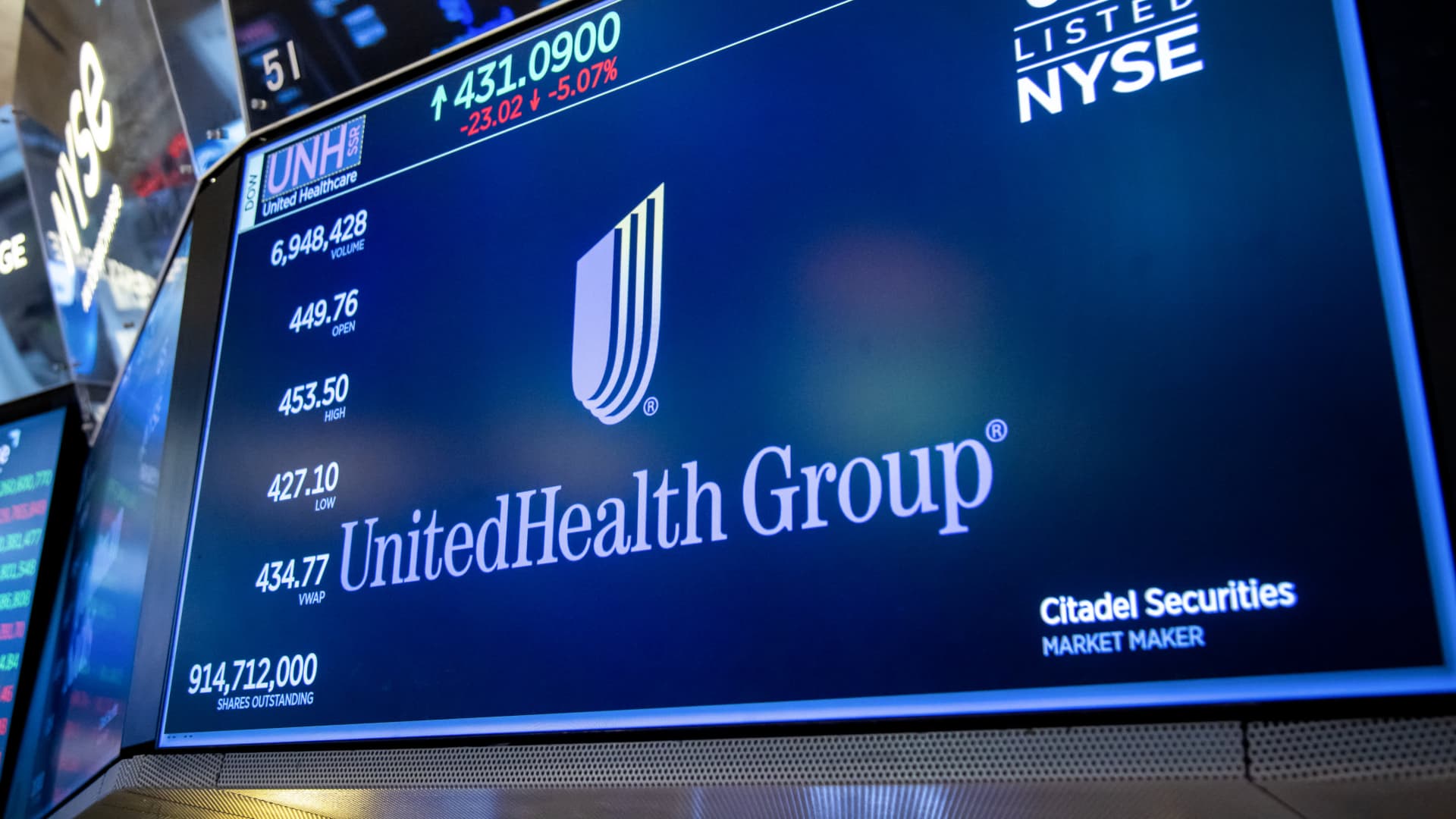
UnitedHealth Group signage on the floor of the New York Stock Exchange on April 21, 2025.Michael Nagle | Bloomberg | Getty ImagesUnitedHealth Group on Tuesday posted third-quarter earnings that beat estimates and raised its full-year profit outlook, as the company continues to manage high medical costs and sees investments in value-based care and artificial intelligence take hold. The nation’s largest private insurer said it expects fiscal 2026 adjusted earnings of at least $20.50 per share, down from a previous outlook of $19.50 to $20 per share. The healthcare giant’s turnaround plan is gaining momentum after three straight strong quarters this year. UnitedHealth is working to stabilize margins by reducing membership, terminating unprofitable contracts and increasing investments in artificial intelligence and value-based care, which tie physician and facility compensation to patient health outcomes, quality of care and profitability rather than the volume of medical services provided. “You’ll see in the quarter that we continue to execute not only the financial aspects of our business, but we really do them with a simpler approach and an approach that really focuses on investing heavily in value-based care,” Chief Financial Officer Wayne DeVeydt said in an interview. The company’s shares rose about 3% in premarket trading. Here’s what the company reported for the third quarter compared to what Wall Street expected, according to a survey of analysts by LSEG: Earnings per share: Adjusted $4.69 vs. $4.14 expected Revenue: $112.69 billion vs. $111.40 billion expected The company posted third-quarter net income of $4.11 billion, or $4.56 per share, in comparison. with $2.35 billion, or $2.59 per share, in the same period a year ago. Excluding items such as business divestitures, restructuring and the expected reduction in reserves for unprofitable contracts, UnitedHealth earned $4.69 per share. Revenue fell to $112.69 billion from $113.16 billion in the prior-year quarter. The company’s insurer, UnitedHealthcare, and its health care unit Optum beat analysts’ operating profit estimates for the quarter, according to StreetAccount. Managing High Costs Notably, UnitedHealth’s medical cost ratio (a measure of total medical expenses paid relative to premiums collected) was 88.4% in the third quarter. Analysts expected a ratio of 89.9% for the quarter, according to StreetAccount. A lower ratio generally indicates that the company collected more in premiums than it paid out in profits, resulting in higher profitability. Still, DeVeydt told CNBC that medical costs in the quarter “continue to be elevated compared to historical norms,” an issue that has plagued insurers, particularly those that operate private Medicare Advantage plans, for more than two years. “I think it’s something we need to keep an eye on. I think you’ll see that our health care rate has improved quite a bit, but I don’t want this to be misleading in terms of [medical cost trends]” DeVeydt said. He said the independent dispute resolution (IDR) process under the No Surprises Act is adding at least 100 basis points, or 1 percentage point, to total medical costs. That federal law, which goes into effect in 2022, aims to protect consumers from unexpected medical bills. The IDR process allows providers and insurers to resolve disputes over out-of-network payments. DeVeydt said those changes are increasing the costs of company claims, which may ultimately be passed on to consumers through higher premiums. DeVeydt added that costs for inpatient and pharmacy services, particularly expensive specialty pharmacy medications for cancer and rare diseases, remain high. He highlighted the company’s value-based care efforts, which are helping control medical costs by directing patients to the right providers and emphasizing preventive care, DeVeydt added. “More members are finding access. to a lower-cost care environment, but more importantly they are entering the care environment that they really want to be in,” he told CNBC. “So we think we’re really balancing quality and cost.” UnitedHealth is also implementing AI-powered ambient listening tools to reduce the administrative burden on doctors and free up time for scheduling appointments made by patients rather than with the help of a consultant. The provider was up 27% year over year, DeVeydt said. He hopes those initiatives have a compounding effect on medical cost management during the fourth quarter and into 2027 as programs expand.