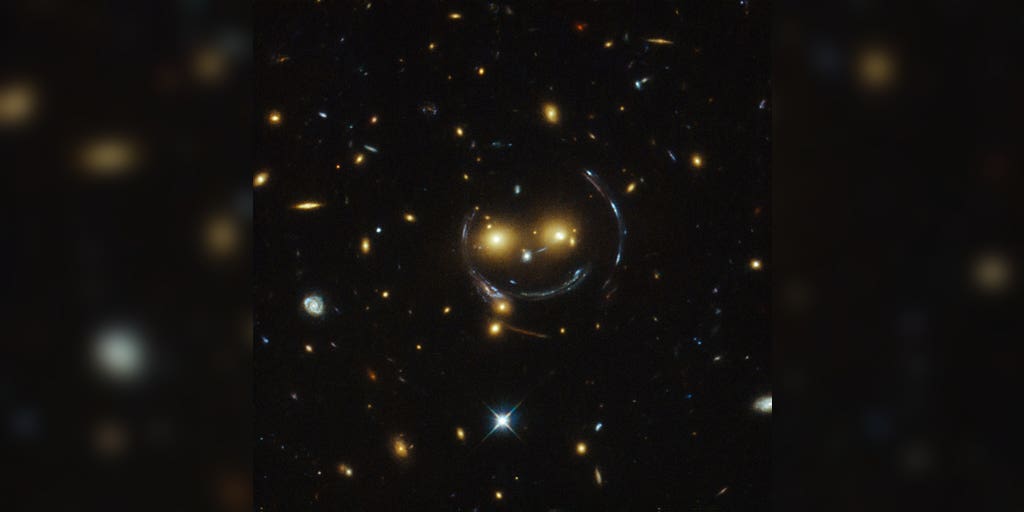
NASA’s Hubble Telescope captures stunning images of the Trifid Nebula in deep space, nearly 5,000 light years from Earth. Astronomers are fascinated by new images captured by NASA’s Hubble Space Telescope that appear to show a smiling face in our vast universe. NASA officials used the Hubble Space Telescope to capture a galaxy cluster in the dark corners of our universe, arranged to look like a smiley face. According to officials, the two bright dots that form the smiley’s eyes are orange galaxies, while a white galaxy forms the small nose and arc of the smile; the shape of the head is caused by gravitational lensing. The galaxy cluster forms a smiling face in the dark corners of the universe. (@NASA/X) Gravitational lensing is a natural effect that occurs when a massive object, such as a galaxy cluster, warps space and time, causing light to bend, distort and magnify as it passes around the object. Albert Einstein was one of the first to describe this sequence of events, merging space and time into a term known as “spacetime” and describing gravity as the curvature of spacetime. Many other orange and white galaxies are scattered across the universe, along with a bright star with diffraction spikes. at the bottom of the image. SKY OBSERVATION GUIDE IN OCTOBER: THE HUNTER’S MOON, METEOR SHOWERS, SATURN IN OPPOSITION AND MORE YOU CAN’T MISS NASA Solar Archive: Archive: The Dynamics Observatory captured the Sun “smiling.” (@NASASun / Twitter / NASA) SAY CHEESE! THE SUN SHOWS A SMILING APPEARANCE In the past, astronomers were able to observe a similar event in 2022, when officials at NASA’s Solar Dynamics Observatory found that the sun developed a face-like pattern during a solar eclipse.