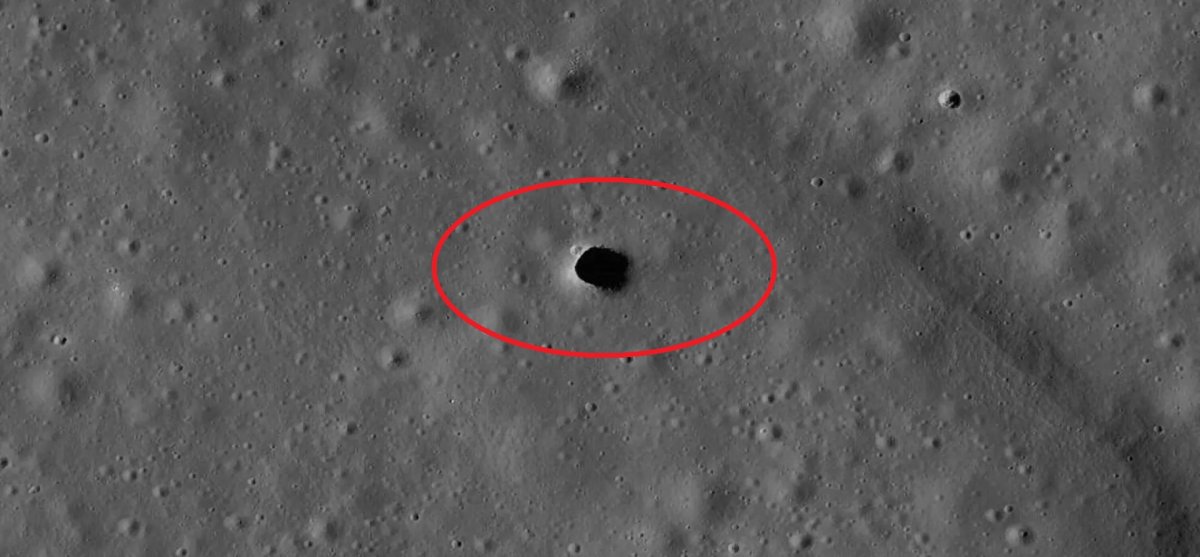
Sign up to see the future today. Unmissable innovations from the cutting edge of science and technology. Beneath its craggy, pockmarked exterior, the Moon is believed to harbor a network of caves and tunnels from its volcanic past. Now, NASA has selected a mission to investigate a promising window into the underground secrets of our space rock. Gaping into outer space, as if storming the cameras of orbital satellites, is the Marius Hill Pit, a hole in the lunar surface believed to be up to 150 feet deep and up to 300 feet wide. Scientists believe it is an example of a skylight: the collapsed roof of an underground lava tube, which forms a circular opening in the ground. If the feature is indeed a skylight, it could give scientists a glimpse into the Moon’s volcanic history. But scientists are also intrigued by the possibility of using these underground cavities as a shelter for astronauts or even as the location of lunar bases. Until now, the hole has only been investigated from orbit. The Geophysical Marius Lunar Well Investigation Instruments (GIMLI) aim to do this from Earth. To determine whether the hole opens into a larger cave, scientists at the Planetary Science Institute will equip a lunar rover with specialized instruments, including ground-penetrating radar, seismic probes and a sensor that measures the strength of the gravitational field called a gravimeter, to investigate it from the surface of the Moon. The rover will also use cameras to take images of exposed parts of the well. “Confirming a substantial lava tube would give us insight into how volcanism operated on the Moon,” Gareth Morgan, senior scientist at the Planetary Science Institute and deputy principal investigator of the GIMLI program, said in a statement. Most of the instruments will be built by Honeybee Robotics. The project is funded through NASA’s Lunar Surface Payloads and Investigations program, and the spacecraft will arrive through a private venture in NASA’s Commercial Lunar Payload Services initiative. The area near the MHP has a rich history of volcanic activity, according to a PSI statement, with exposed layers of regolith and lava flows. Studying these layers could reveal how lava once flowed across the Moon. But the Moon’s underground structures have gained appeal among scientists because they could serve as an ideal sanctuary for astronauts. With hardly any atmosphere, the lunar surface is constantly bombarded with radiation. Seeking shelter underground would provide a natural shield against those nasty solar and cosmic rays, and offer an environment with more manageable temperatures – essential elements if we ever want to establish a long-term presence up there. More on the Moon: Patriots quarterback Drake Maye is a real moon landing, prompting NASA response