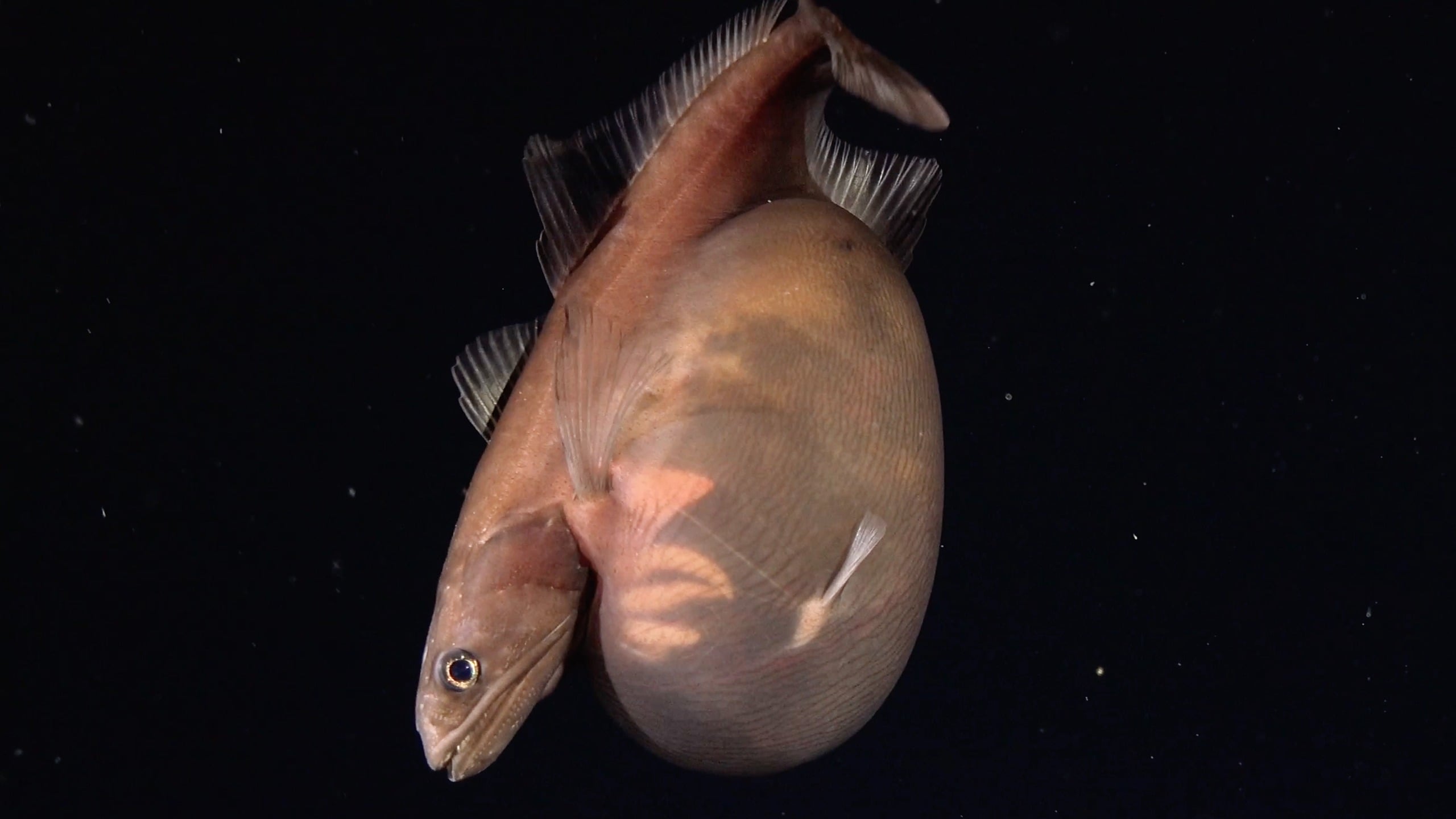
There is always a bigger fish in the sea. For most of us, that idiom is a warning, but for a little deep swimmer, it’s a blessing. The black swallower fish (Chiasmodon niger) is a small creature that grows, on average, between 10 and 20 centimeters (3.9 to 7.9 in) long and is no more than a bench ruler. Still, that doesn’t stop him from aiming high. This modest fish can devour prey up to ten times its mass. It’s certainly an underdog moment, like David eating Goliath, and in a spectacularly rare event, scientists just caught it on camera. During a recent deep-water dive near the islands of Trinidad and Tobago, a remotely operated vehicle captured a black swallower fish 1,259 meters deep, dragging a stomach so distended it looks like a sidecar. The skin stretches almost transparent, to the point where you can actually see its internal organs and intestines.”[Black swallower fish] They are notoriously rare to see in the wild. I saw it for the first time almost a decade ago in the Gulf of Mexico,” says Diva Amon of the Schmidt Ocean Institute, chief scientist of the expedition. “I never imagined I would get a second chance. But this expedition had a BIG result.”A black swallower fish (Chiasmodon niger) swims to a depth of 1,259 meters during a dive with a remotely operated vehicle off Trinidad and Tobago. (ROV SuBastian/Schmidt Ocean Institute)Black swallower fish have evolved to make the most of their deep-sea environment, where food is scarce, Amon explains. They have a dislocated jaw and a stomach that stretches like a balloon. That way, if they see a tasty morsel swimming around, they can swallow it whole, even if it is larger than themselves, however, like most of us, the black swallower fish can sometimes bite off more than it can “chew”. Oceanographic Woods Hole describes the sight of this distended stomach as “a semi-transparent spare tire hanging from their bellies.” This new sighting is very special because the fish swims in its natural habitat and its stomach is much more distended than in other live fish. referrerpolicy=”strict-origin-when-cross-origin” The downside is that, deep in the ocean, it’s impossible to know what the animal actually ate. “If only we had a CT scanner at sea,” says Amon. “The mystery of what this little guy had for lunch may never be solved.” This elusive fish and its special use for “eating well” remain poorly understood. Some scientists have speculated that the creature eats its prey’s tail first, slowly “walking” the food back to its belly with its unique set of hooked, rearward-pointing teeth. But unfortunately, that’s just speculation based on appearance. Who knows if we will ever see the fish in hunting action. This article was fact-checked by Rachel Garner and edited by Peter Dockrill. While we take pride in our process, we are human. If you spot an error, please let us know.