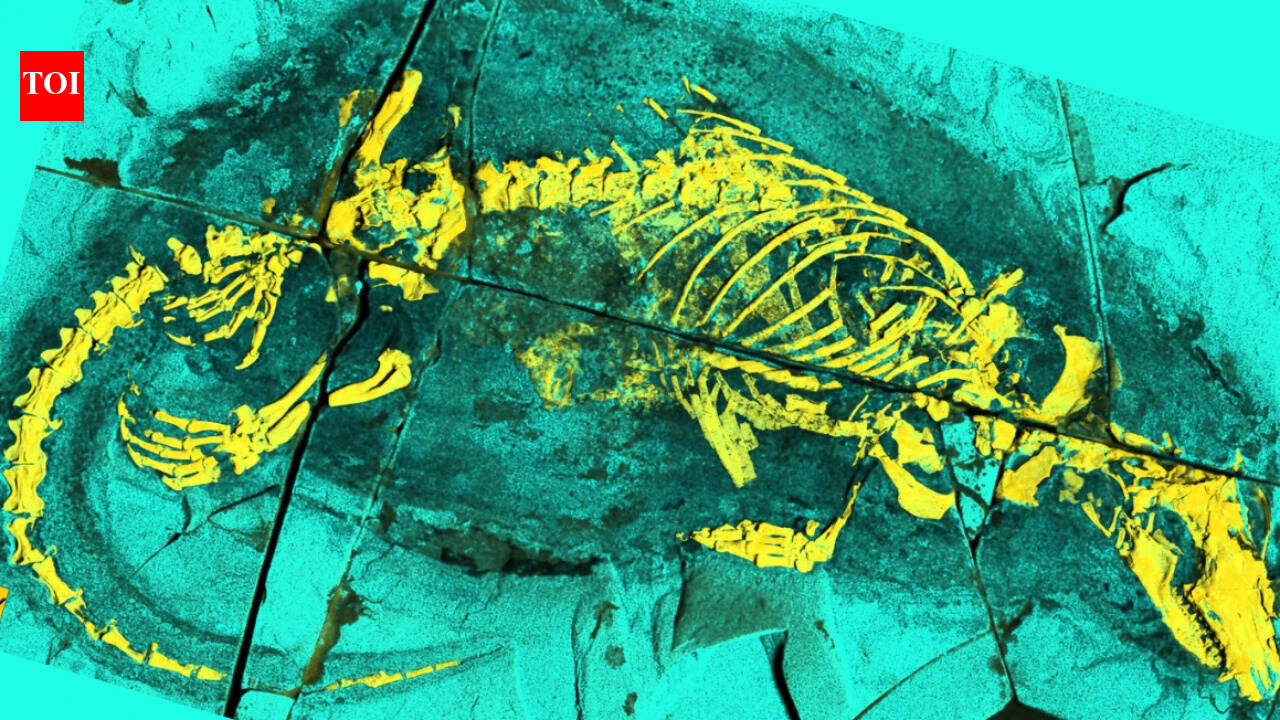
An X-ray photograph of the Megacauda fossil Scientists examined a 165-million-year-old fossil found in China and identified a mammalian predecessor that had a broad swimming tail and throat bones similar to those found in modern mammals. The discovery suggests that some of the earliest mammalian relatives had already developed ways of chewing and swallowing food millions of years before modern mammals evolved. The newly identified species, called Megacauda sungei, lived during the Jurassic period. Researchers at the University of Chicago studied its well-preserved fossil and found that the animal had strong hind limbs, a flattened tail, and specialized throat structures. Their findings were published Wednesday in the journal Natureon. The animal belonged to an extinct group called docodonts, which were close relatives of mammals during the Mesozoic Era. It was between 40 and 50 centimeters long and weighed between one and two kilograms. Its physical characteristics suggest that it spent time on both land and water, much like modern semi-aquatic mammals. What makes the discovery important is the combination of their swimming adaptations and feeding structures. The fossil contains delicate bones that helped support the muscles involved in swallowing. According to the researchers, these structures provide some of the first evidence of a feeding mechanism that later became important in the evolution of mammals with different diets. Ancient animal swallowed like modern mammals One of the most important finds concerns the hyoid bones, which help connect the mouth and throat in mammals. In modern mammals, including humans, these bones are part of a structure that supports the muscles used during swallowing. The bones form a U-shaped structure that is attached to the skull by smaller bone segments. This structure helps mammals chew food before swallowing it into smaller pieces, unlike animals like alligators, which can swallow large chunks of food or even prey whole. It also helps young mammals suck milk from their mothers. The researchers discovered that Megacauda had similar structures under its skull. The preservation was detailed enough for scientists to examine the arrangement of the bones and understand how they supported the muscles involved in feeding. Zhe-Xi Luo, professor of organismal biology and anatomy at the University of Chicago and lead author of the study, explained why this development was important. “This is an incredibly important evolutionary innovation. After mammals chew their food, whether it’s plants or meat, they all swallow it in the same efficient and effortless way,” Luo said. “Once the first mammals had this apparatus, each group could develop specialized teeth and diversify into a huge variety of food resources. They could be carnivores, insectivores, herbivores, omnivores or anywhere in between.” According to study co-author Peishu Li, the animal’s throat anatomy can be compared to the throat muscles of the modern opossum. Its hind limbs had long outer toes similar to those of a platypus. The tail contained broad H-shaped vertebrae and had a broad outline that would have helped propel the animal through the water. The skull also contained strong canine teeth and sharp molars capable of cutting and chewing meat. However, the arrangement of these teeth differed from that of modern carnivorous mammals. The researchers also found small pieces of vertebrate bones preserved in the animal’s stomach. This suggests that it fed on small animals, possibly including salamanders, whose fossils have also been found in the same geological deposits. Based on these characteristics, scientists believe that Megacauda followed a semi-aquatic lifestyle, entering the water to hunt while also spending time on land. The discovery adds to previous evidence that docodonts occupied different habitats. In 2006, Luo’s team identified another swimming docodont named Castorocauda. The recently studied Megacauda fossil is older and preserves more skeleton. “The new fossil is particularly interesting because it is older than Castorocauda. Although both docodonts occupied the same niche in the water, the new fossil is more complete,” said April I. Neander, a scientific artist and CT imaging specialist at the University of Chicago. How scientists examined the fossil The remarkable fossil was unearthed in the Inner Mongolia region of China. During the difficult times of the COVID-19 pandemic, one of the study’s co-authors, Chang-Fu Zhou, affiliated with Shandong University of Science and Technology, undertook the complex task of transporting the specimen to a variety of research laboratories for extensive examination and analysis. To delve deeper into the features of the fossil, scientists employed advanced techniques such as computed tomography and X-ray fluorescence photography. Given the considerable nature of the original slab, it became necessary to divide it into smaller sections to facilitate the scanning process. Neander subsequently used these scans to meticulously reconstruct and systematically examine in great detail the preserved anatomical structures. Additionally, the researchers conducted a comparative analysis between the new specimen and Microdocodon gracilis, a significantly smaller docodont that had been previously identified by Luo and his colleagues in 2019. This smaller creature, which is known to have existed during roughly the same geological period, also displayed mammal-like hyoid bones, adding to the intrigue. The newly discovered fossil adds substantial evidence to the growing body of research indicating that complex throat structures were already emerging among the earliest relatives of mammals during the Jurassic period. Luo highlighted that this almost complete specimen significantly helps researchers obtain information about the lifestyles of these ancient animals within ecosystems that were mainly dominated by dinosaurs. The results of these findings indicate that significant evolutions in swallowing and feeding anatomy were already occurring long before the modern mammal lineage diverged from its evolutionary predecessors. These evolutionary changes later played a crucial role in allowing mammals to develop specialized teeth and adapt to a wide range of food sources.