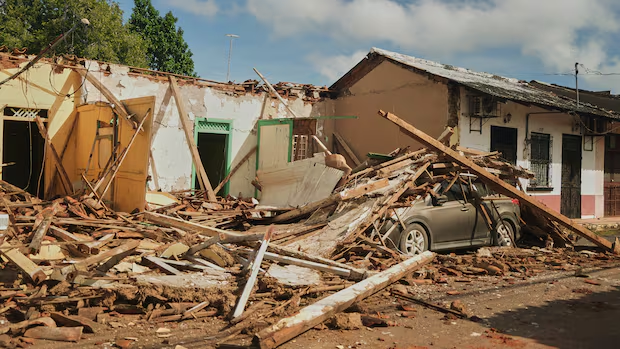
Panama’s government declared a state of emergency on Saturday as aftershocks from two powerful earthquakes that hit the country shook communities for hours. Authorities did not attribute any deaths to the earthquakes, but reported damage in all 10 Panama provinces and two indigenous territories. Friday’s magnitude 7.7 and 6.6 earthquakes toppled buildings near the epicenter and prompted evacuations across the Central American country. Seismologists recorded more than 100 aftershocks, including some of magnitude 5.8, 5.5 and 5.2. The earlier earthquake, which was also felt in neighboring Colombia, was centered about 10 kilometers southwest of the remote community of Pitaloza Arriba in the central province of Herrera, according to the U.S. Geological Survey. It hit at a depth of 10 kilometers. The Minister of the Presidency, Juan Carlos Orillac, announced the emergency during a press conference in the capital, Panama City. He said homes, schools, health centres, roads and hotels were among the facilities damaged. Malitzie Rivera, deputy director of the National Civil Protection System, told reporters that the state had reports of 27 people with injuries, ranging from minor to moderate. Hundreds of homes were damaged. Most of the damage was concentrated in the central provinces of Veraguas, Herrera, Coclé and Los Santos. It also reported that seven hotels, at least 13 churches and nine bridges were affected by the earthquakes. In La Villa de Los Santos, a colonial-era community about 40 miles northeast of the epicenter, homes and a historic Catholic church collapsed. People who spent the night on the streets waited for government guidance on what to do next.WATCH | Canadian in Panama suffers live aftershock :Canadian in Panama suffers live aftershock | Hanomansing LiveTwo powerful earthquakes of magnitude 7.7 and 6.6, followed by a series of aftershocks, shook southern Panama, collapsing buildings near the epicenter and prompting evacuations across the country. Phil MacIntyre, a Canadian in Panama, experienced the earthquake firsthand and a live aftershock. It shows the damage around your house. “We’ve been here since 1 p.m. yesterday; we haven’t moved,” said Tony Jiménez, whose house partially collapsed, as he sat with his relatives under a tent. “It was a terrible thing. I can tell you with absolute certainty that in my 90 years, I have never experienced anything like it. It was intense, truly intense.” The collapsed Church of Saint Athanasius was declared a National Historical Heritage Site in 1938. Images of collapsing buildings and deep fissures cutting off roads added to fears in a Latin American region hit by a series of devastating earthquakes in recent months. Two consecutive 7.2 earthquakes and 7.5 magnitude earthquakes shook the Venezuelan state of La Guaira in June, killing more than 6,500 people and leaving 17,000 homeless. In August, a 7.4 magnitude earthquake in Colombia killed at least 289 people. The noticeably lower number in nearby Panama may be due to the country’s strict building codes, especially those governing the construction of skyscrapers in the capital, said Carlos Valdés, head of the Department of Seismology at the National Autonomous University of Mexico. Rising sea levels prompted evacuations. Authorities reported no missing people on Saturday, but said some communities remained isolated due to landslides and road damage. Cana, off the Pacific coast of Los Santos, approximately 300 people were evacuated due to rising sea levels and strong waves. Meanwhile, in the city of Penonomé, about 150 kilometers from the capital, a shelter housed 13 people, including five children. The earthquakes caused a partial collapse and cracks in the cathedral in the district’s main square, as well as damage to the governor’s office building and the Dos Continentes hotel. In Panama City, one of the water treatment plants that supplies the area operated at 20 percent capacity on Saturday, and tents with cots were set up in six hospitals. Tocumen International Airport in Panama City, one of the busiest airports in the region with more than 20 million passengers by 2025, temporarily suspended operations after the first earthquake on Friday but reopened hours later. WATCH | Powerful earthquake hits Panama, prompting tsunami warnings :Powerful earthquake hits Panama, prompting tsunami warnings A powerful 7.7 magnitude earthquake struck near the southern tip of Panama on Friday morning, prompting tsunami warnings along the coast from Mexico to Peru. The tremors were felt more than 200 kilometers away, in Panama City, according to residents. But hundreds of travelers from major Panama-based airlines, such as Copa Airlines, were left stranded at airports in the region. Their connections through Tocumen, one of the region’s largest travel hubs, were canceled or delayed. At the Mexico City airport, airline employees struggled as families with babies slept on the floor Saturday while a Venezuelan woman screamed in panic that the flight through Panama was one of the only ways she could return to Caracas. The Panama Canal Authority said operations were continuing normally along the global trade route. It said its priority was the safety of employees, vessels and crews and that specialized technical teams were inspecting the facilities for possible damage. The last major earthquake to cause widespread damage in Panama occurred in 1991. A magnitude 7.4 earthquake, centered in nearby Costa Rica, killed 23 people, injured 559 and left thousands homeless in the border region of Bocas del Toro. A vehicle lies crushed under a collapsed building after an earthquake hit Penonomé, Panama, on Friday, October 9. 2026. (Aris Mariota/The Associated Press) Earthquakes are common, especially along Panama’s border with Costa Rica and its Pacific coast, due to the interaction of several tectonic plates, including the Cocos, Nazca and Caribbean plates. Panama lies along the “Ring of Fire,” a 40,000-kilometer arc of volcanoes and fault lines around the Pacific basin, where most of the world’s earthquakes occur. Countries offer help. Shortly after the earthquakes, support and offers of assistance poured in from across the region. Mulino on Friday thanked his fellow Latin American leaders for their support, saying he had spoken with the presidents of Chile, Uruguay and Guatemala, among others. The US State Department said Saturday it has mobilized a disaster response team to assist local authorities with expertise in search and rescue, as well as aerial and on-the-ground assessments. The US government also pledged $5 million for humanitarian assistance. The US Southern Command also said that two helicopters supported by the State Department’s drug control office had delivered 2,000 pounds of food to Panamanians. communities affected by earthquakes.