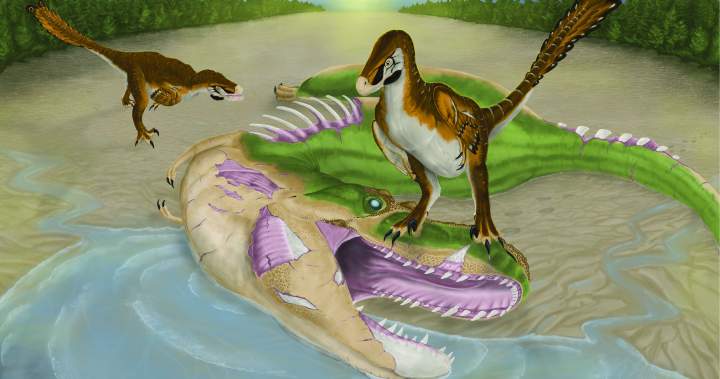
University of Alberta researchers say they have discovered what could be the first evidence of a small raptor feeding on a much larger tyrannosaur, offering insight into the eating habits of dinosaurs millions of years ago. The discovery centers on unusual bite marks found on the jaw of an Albertosaurus, an apex predator related to Tyrannosaurus rex that lived in what is now Alberta during the Late Cretaceous period. A study by U of A paleontology master’s student Joshua Doyon found that the most likely explanation is that an eight-year-old Albertosaurus died of unknown causes and was fed shortly after by a dromaeosaur, or raptor. The study describes the marks as the first evidence of a raptor feeding or scavenging on a tyrannosaur. 1:49 One of the world’s smallest dinosaur fossils discovered in Argentina “At that time, something happened to this dinosaur. It died. And right after it died, or shortly after, something bit it and was feasting on its meat,” Doyon told Global News on Friday. Doyon said he began studying the specimen as a student in 2023, comparing the spacing between the bite marks to the spacing between the teeth of carnivorous dinosaurs that lived alongside Albertosaurus. “We calculated it by measuring the space between each tooth mark on our fossil and comparing it to the space between the teeth of other carnivorous dinosaurs that coexisted with our Albertosaurus,” he said. University of Alberta researchers say bite marks on an Albertosaurus found near Drumheller in the Alberta Badlands could be the first evidence of a small raptor feeding on a tyrannosaur. Joshua Doyon through researchers at the University of Alberta narrowed the possibilities down to two possible culprits. Get the latest national news Get the latest Canadian news delivered to your inbox as it happens so you don’t miss any breaking news. Doyon said the most likely explanation is a raptor. The other, less likely possibility is a young Albertosaurus, which would mean that the dinosaur cannibalized another member of its species. “If this is a young Albertosaurus, this would be a cannibalism event by a baby, about two meters long, eating a larger subadult,” Doyon said. The largest Albertosaurus is estimated to have been about six meters long and weighed approximately 530 kilograms. Philip Currie, a professor of dinosaur paleobiology at the University of Alberta and Doyon’s supervisor, said evidence of one carnivorous dinosaur feeding on another is rare. “This is one of those rare occasions where we have information about a carnivore eating another carnivore,” Currie said. from Drumheller in the Alberta badlands and reported by a member of the public in 2022. 2:07 68-million-year-old triceratops skull revealed at Drumheller More on science More videos It was collected and prepared by the Royal Tyrrell Museum, where technicians discovered what they suspected were teeth marks. The specimen was then sent to the University of Alberta for further analysis. The researchers found no signs of healing around the marks, suggesting they were made around the time Albertosaurus died or shortly after and were the result of feeding or scavenging for food. University of Alberta researchers say bite marks on an Albertosaurus could be the first evidence that a small raptor preyed on a tyrannosaur. Joshua Doyon via University of Alberta Albertosaurus, whose name means “Alberta lizard,” was an apex predator that lived in what is now Alberta approximately 73 to 67 million years ago. Currie said examining details such as markings found on the specimen can help researchers learn more about dinosaur biology, while Doyon said the discovery could provide a better understanding of food interactions in the prehistoric ecosystem. “That could lead us to a better understanding of the interactions and who was eating who in that ecosystem,” Doyon said. 0:23 Thousands of dinosaur footprints found on cliff in Italy Previous video Next video © 2026 Global News, a division of Corus Entertainment Inc.