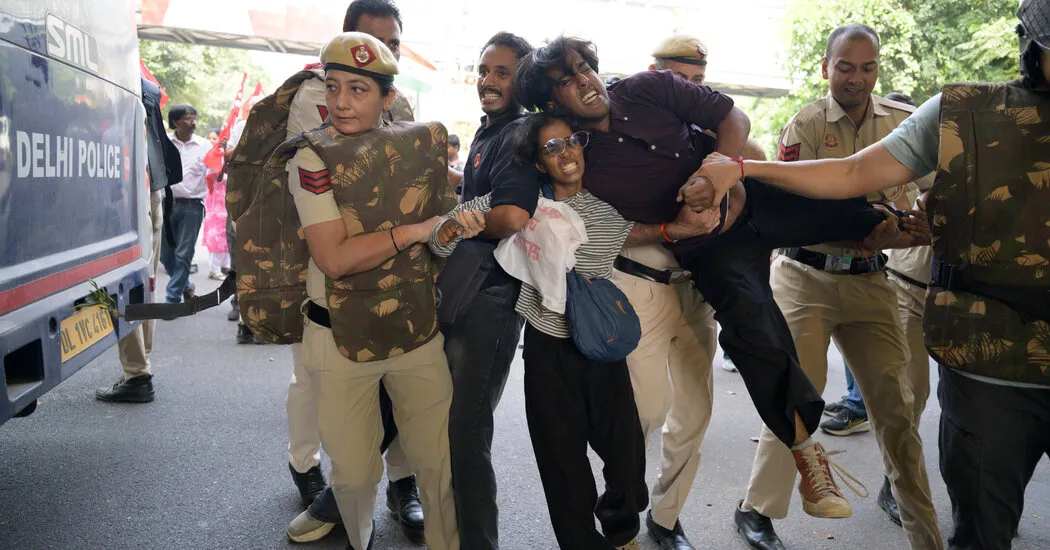
The young men and women were students, lawyers, farm labourers, doctors, engineers – the largest group of anti-government protesters to approach a protest site in New Delhi under lockdown on Saturday. The group of protesters, which would eventually grow to about 300 people, had gathered the night before at a Sikh temple, known as a gurdwara, and hoped that police would not take action against them in that sacred space. Motivated by the revision of the country’s voter lists, protesters early Saturday sought a way to cover the approximately 1,000 meters between the temple and the protest site. Their goal: to reach the site, known as Jantar Mantar, without clashing with thousands of security forces who showed zero tolerance toward the protests. Many of the protesters, supporters of the Generation Z movement known as the Cockroach Janta Party, had traveled for hours on trains and buses from distant towns in states such as Bihar. and Punjab, before finally reaching the marble courtyard inside the Sri Bangla Sahib gurdwara. Others living in New Delhi walked several kilometers. Simran, a 26-year-old lawyer from the outskirts of Delhi who goes by only one name, said police stopped her twice on her way to the gurdwara, although she was allowed to continue. “I felt like a criminal in my own country,” she said. On Saturday morning, male police officers entered the temple but then left due to the sensitivity of the site, after doing little more than glaring at a group of protesters, while a pair of female police officers walked inside. Finally, an agreement was reached. Gurdwara officials promised the police that they would not allow any kind of protest inside the premises. But they didn’t allow anyone to be arrested either. “Do whatever you want outside,” a temple official told protesters. “Maintain total decorum inside.” As the clock ticked, protesters waited patiently with pieces of cloth tied around their heads, as is the norm within this place of worship. They lacked formal leaders, but some young activists took on a coordinating role in determining when and how protesters should leave. Many appeared to be calling on other protesters to trace the whereabouts of Abhijeet Dipke, the leader of the Cockroach Janata Party, who had called for the large protest. After two students carried out a reconnaissance mission on motorcycles, the protesters agreed that gate number 3 of the gurdwara was the most promising. The police presence was lighter in that direction. “We want to wait for more protesters to join us here before we move,” said Bushra Rehman, 32, a Ph.D. student who had endured tear gas during 2019 protests against a controversial citizenship law. “I know we will be detained, but we must show resistance in the face of an autocratic government.” Some protesters sat in a circle to reflect on the carefully thought-out move. “We will just duck wherever the police stop us,” Abdullah Khan, 23, a German studies student at Jamia Millia Islamia, a university in the capital, told the group. “And no violence at all.” Around 10:30 a.m., the enthusiastic crowd started pouring out and spilled onto the main street, chanting slogans against Prime Minister Narendra Modi and Gyanesh Kumar, India’s chief election commissioner. Some captured the protests with cameras and selfie sticks attached to mobile phones. “Your time is up,” they shouted. “Pack your bags.” Then, they mocked the election commissioner with a nickname. “Gyanu, it’s done, brother,” said one sign. Just a few hundred meters from the protesters’ march, police presence increased on the road leading to Connaught Place, a major shopping district in the city center that is on the way to Jantar Mantar. Little by little, the police circle narrowed. After being caught off guard, officers called for backup and stopped the protesters in their tracks. The protesters chanted louder. The officers began dragging the men, one by one, to a bus waiting to take them to a detention center. Some of the protesters fled and the police pursued them, with limited success. About 30 protesters were expelled on one bus and 30 more on another. A group of female police officers expressed their satisfaction at having dragged a woman onto one of the buses. Some protesters managed to escape. In the end, no one managed to reach Jantar Mantar: it is a fortress. This did not surprise the protesters, who knew from the beginning that the odds were not in their favor. They were prepared to be stopped, dragged and detained, which is exactly what happened to many of them. Still, some were successful at least in demonstrating their willingness to resist the government. They said they would continue trying to regroup.