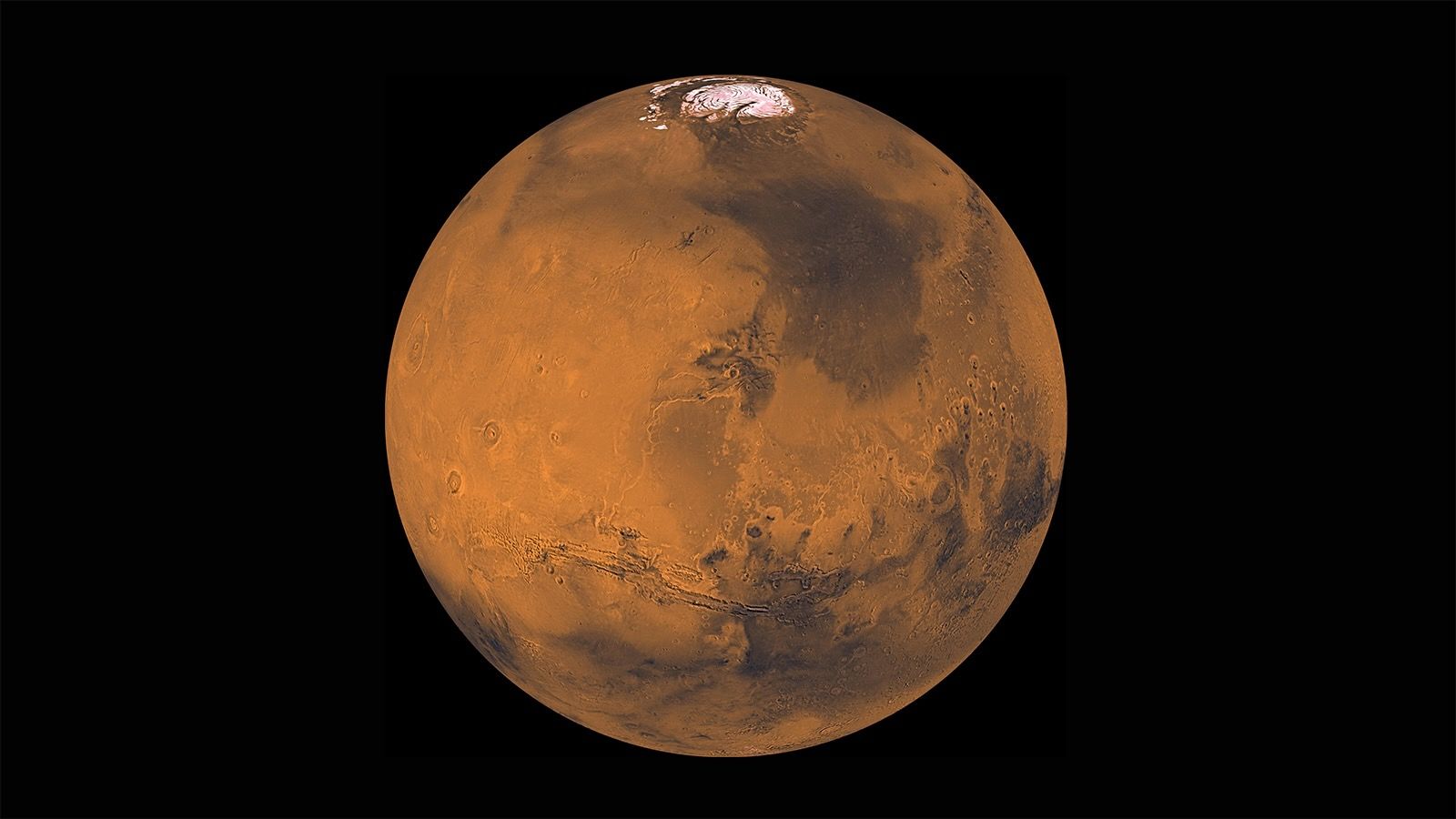
A new genetically engineered microbe could one day help humanity settle on Mars, a nonprofit biotech research startup suggests. Our species has launched nearly 50 missions to Mars since 1960, all of them robotic. If all goes according to plan, everyone has been moving toward a manned flight to the Red Planet, which remains a high priority for both national space agencies and private companies. Ideally, human crews won’t rely on shipment after shipment from Earth, but instead can make use of whatever resources they can discover on Mars for air, food, water, building materials, and more. Perhaps the most radical possible outcome of this approach is the concept of terraforming Mars: transforming the cold, arid world to support life as we know it. Now, researchers at Pioneer Labs in Emeryville, California, have developed a microbe that they suggest may be a useful and safe first step toward terraforming Mars. “On Mars, nature will do the same work for us that it does on Earth: create fertile soil, shelter, oxygen and food,” Erika DeBenedictis, CEO of Pioneer. Labs, told Space.com. You may like A key problem with the idea of terraforming Mars is that the surface of the Red Planet is essentially toxic. While raw materials potentially useful for life on Earth are found in abundance on Mars, they are mixed in the soil with toxins such as perchlorate, as well as salts that would hinder the growth of most organisms. Previous strategies for growing plants on Mars included rinsing off these poisons, bringing in supplemental fertilizers from Earth, or avoiding Martian soil altogether and using hydroponics. However, Pioneer Labs maintains that these approaches do not scale well in terms of time and expense. Today, Pioneer Labs announces our first step toward terraforming Mars. 🚀🌼 With equipment that fits into a single rocket launch, we can convert Martian soil, water and air into enough building materials to build a small city on Mars. To do this, we created the first microbe for Mars. We found the best microbe on Earth and used evolution to teach it how to get all its nutrients directly from Martian materials. The first astronauts will be welcomed into a safe haven already filled with water, oxygen and rocket fuel for the return journey. This is the first step toward using biology to make Mars a place conducive to life. It allows us to live off the land and helps us build the next great frontier. It is the first of the five organisms we need to green Mars ⬇️September 22, 2026 The organization has developed a microbe, called sPL.001, that can live on artificial and chemically precise versions of Martian soil, water and air. You can do this by removing toxins or adding fertilizer. Additionally, it can generate bioplastics (a class of materials used today on Earth for items as diverse as compostable cups and 3D printing filaments) that could be useful for building habitats on the Red Planet. “Mars has all the raw materials for life in abundance,” DeBenedictis said. “Life can grow entirely using nutrients in the raw Martian regolith. That’s special and different from other places, like the moon, which have no nutrients in the regolith.” In a new study, scientists revealed how they took microbes from Earth that could make bioplastics and slowly exposed them to increasingly Mars-like conditions over time. What to read next “It wasn’t obvious that this was going to work,” DeBenedictis said. “The first time we tested the growth of terrestrial microbes in Mars conditions, none of them grew! We had to move on and test many more organisms before we realized we had been unlucky the first time.” “Life finds a way!” To survive, the new microbe needs to grow inside a heated and agitated bioreactor that protects it from extreme temperatures, radiation and the thin Martian atmosphere. It must also receive a processed form of air that provides the microbe with the valuable nutrient nitrogen in the form of acetate, since normal Martian air has levels of nitrogen that are too dilute for microbes to live on. The organism is also not photosynthetic, so it cannot produce its own food. SpaceX’s vision of a human settlement on Mars, which the company believes its Starship megarocket will help make a reality. (Image credit: SpaceX) In another study, researchers suggested that these limitations ensure that their microbe cannot survive if it ever finds its way to the outside of Mars. These measures reduce the risk that their microbe could contaminate the Red Planet as an invasive organism, especially if Mars ever developed life of its own that could still exist in underground aquifers or within ancient salt crystals. Samuel McKee, a DNA repair scientist at the University of Reading in England, found it credible that such a microbe could not accidentally terraform Mars. “Many adapted or edited microbes on Earth do not survive outside of a fixed environment despite their evolution, or without a certain food supply,” McKee, who was not involved in the new research, told Space.com. In a third study, scientists estimated that, thanks to the microbe, mission planners could fit everything needed to build a city on Mars on a single rocket. “The biggest limitation of what we’ve done is that the simulated Mars is not the real Mars,” DeBenedictis said. “We reconstructed the relevant chemistry of the Martian regolith as carefully as we could from high-quality rover data from multiple locations on Mars. But ultimately the real test will be doing this with real Martian regolith.” Such research could find use beyond Mars. “I’m excited about how these avenues of research could impact our management of climate change on Earth or extreme environmental habitats,” McKee said. “Microbes can be used to generate much of the material and needs we have thanks to gene editing.” Ultimately, “we will be watching in anticipation when these microbes are finally released to the Martian surface,” McKee said.