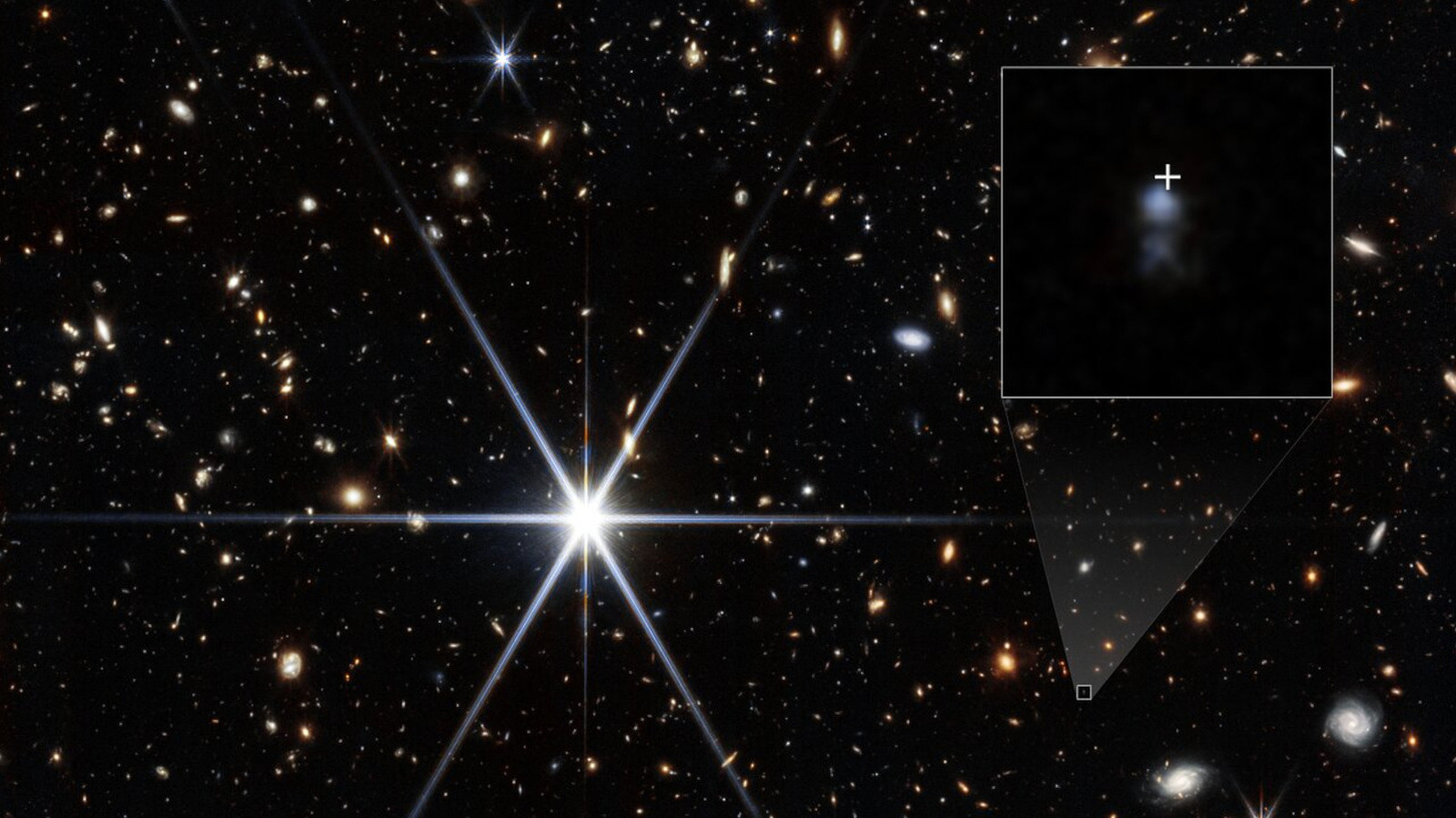
And the data it provided sheds light on the origins of fast radio bursts. NASA, ESA, CSA, STScI, T. Nanayakkara (USYD). Image processing: J. DePasquale (STScI) In 2024, scientists detected the most distant fast radio burst we have ever seen to date, thanks to observations made by the MeerKAT ground-based telescope array. Fast radio bursts are ultrafast radio waves from deep space, lasting a fraction of a second but releasing as much energy as the sun emits in three days. They were first discovered in 2007 and not much is known about them. Now, astronomers have used the James Webb telescope to pinpoint the origin of the explosion detected in 2024, and it could shed light on the origins of the phenomenon. Webb’s near-infrared instruments detected a galaxy in the correct location of where the explosion had occurred. Based on measurements of the way its light spreads, the rapid radio explosion occurred just 3 billion years after the Big Bang. Its home galaxy existed long ago, when star formation was at its peak in the universe. In addition, the galaxy that produced it is also 1,000 times smaller than expected. The previous rapid radio bursts we detected took place billions of years later in massive star-forming galaxies. There are a couple of theories about how quickly radio bursts occur. One proposes that they are generated by the merger of two neutron stars. But it takes billions of years before two neutron stars (the collapsed cores of massive supergiant stars) collide, meaning the explosions can only come from older galaxies. Another theory suggests that the explosions may come from massive stars exploding in a supernova and leaving behind magnetars, which are a rare type of neutron stars that have very powerful magnetic fields. “Our work suggests that it is very unlikely that this [fast radio burst] was produced by a merger,” said Manisha Caleb of the University of Sydney, Australia, who was the lead author of the study published in Science. In other words, her work shows that the origin of this explosion was probably a supernova, supporting the theory that fast radio bursts can come from a certain type of stellar explosion.