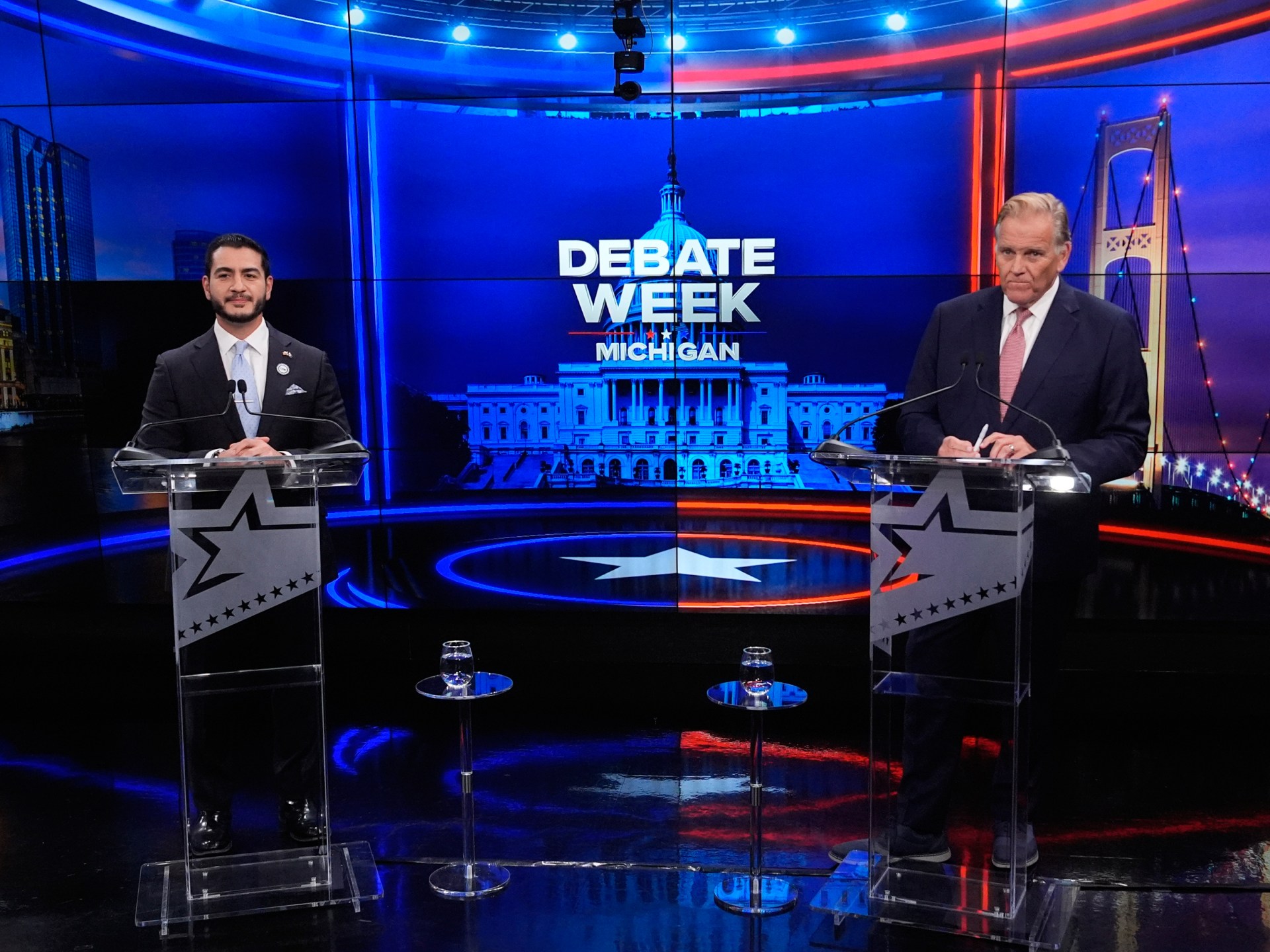
The leading candidates in Michigan’s heated Senate race have faced off in their first televised debate, with the US midterm elections less than a month away. Thursday’s hour-long debate was a microcosm of how tense the race has become. out of touch with ordinary voters. For his part, Rogers, a former member of the US House of Representatives, leveled accusations against El-Sayed that he was soft on “terrorism” and had foreign sympathies. Michigan-born El-Sayed has repeatedly faced Islamophobic attacks during his election campaign, and Republican President Donald Trump labeled him an “extremist and terrorist sympathizer” whose history “dates back to the days of Jihad.” If elected, El-Sayed would be the first Muslim member of the United States Senate. The two candidates spent much of their hour together on stage talking over each other, while trading scathing barbs. “He cannot condemn a terrorist act that occurred on our territory in the state of Michigan. He cannot condemn himself…” Rogers began, referencing a March attack on a synagogue. “I condemned him,” El-Sayed said, intervening. “No, you didn’t,” Rogers responded, with El-Sayed quickly responding: “You make things up. You make things up.” The Senate race in Michigan is seen as key to the battle for control of the U.S. Senate. Democrats are trying to flip both chambers of Congress, but flipping control of the Senate will be a more difficult prospect given that only a third of their 100 seats are on the Nov. 3 ballot. Host Rick Albin at times struggled to keep the debate on track as tensions rose. “We have dozens of questions we want to get to. You can’t litigate all of them with 14 different rebuttals, so please work with me,” Albin told the two candidates on One Point. Here are the key takeaways from the evening’s debate. Republican candidate Mike Rogers, right, speaks during a televised debate with Democratic candidate Abdul El-Sayed. [Paul Sancya/Pool via AP Photo]Rogers hints at El-Sayed’s family ties to ‘terrorism watch list’ The ferocity of the debate was underlined by the high volume of ad hominem attacks the candidates deployed against each other. But Rogers repeatedly pushed a series of attacks that appeared to focus on El-Sayed’s identity as a Muslim. In response to a question about health care, Rogers said El-Sayed has “taken money from individuals in his campaign who openly support Hamas, Hezbollah, Al Qaeda.” Later, when asked about his position on Flock camera surveillance, Rogers argued that such technology has helped capture people suspected of terrorism. He then implied that El-Sayed’s concerns about the cameras were suggestive. “Why would that bother you?” Rogers asked El-Sayed. “Well, if you have someone in your family who might be on the terrorism watch list…” El-Sayed interjected, seeming to challenge Rogers to continue his thought. “Are you going to go ahead and say I’m…go ahead and say it,” El-Sayed said. “You’ve been tiptoeing around about it the whole time. Just say it. Just say it. Go ahead and say it.” Muslim and Arab candidates in the United States have frequently been the target of Islamophobic attacks during the election campaign, accusing them of supporting “terrorism” and Islamic fundamentalism. Republican Mike Rogers hinted that El-Sayed might have family members on the ‘terrorism watch list.’ [Paul Sancya/Pool via AP Photo]Both sides agree to end the Iran war. However, there were issues on which both candidates found some common ground. Both Rogers and El-Sayed agreed that the US-Israel war against Iran should end, but they had opposing views on Washington’s relationship with Israel and its role in the conflict. High gas prices and inflation, El-Sayed said, were directly caused by the Iran war, and he blamed the Trump administration for Iran’s decision to close the Strait of Hormuz, a critical trade point. route. “This is what happens when you start wars you should never be fighting,” El-Sayed said. “We literally taught the Iranian regime that it has a chokehold in the Strait of Hormuz, and now we live in that reality.” Rogers agreed that “we need [the war] come to an end,” but also justified the conflict, saying Iran’s uranium enrichment program had been “twenty years behind schedule,” echoing a frequent talking point in the White House. The Trump administration has argued that the war was necessary to prevent Iran from creating a nuclear weapon, a goal Tehran has long denied. Rogers’ position led El-Sayed to accuse him of “encouraging” the war and the Trump administration. Democratic candidate Abdul Abdul El-Sayed pushed for an end to unconditional support for Israel. [Paul Sancya/Pool via AP Photo]Rogers supports continued aid to Israel, El-Sayed calls for its end. As part of the debate over US foreign policy, the candidates were also pressed on their positions on the US alliance with Israel. The country is considered the largest overall recipient of U.S. aid since World War II. From the start of Israel’s genocidal war against Gaza in October 2023 until September 2025, experts estimate that Israel received nearly $21.7 billion in military aid. El-Sayed has openly called for an end to aid to Israel and has repeatedly denounced the conflict in Gaza as a genocide, according to assessments by United Nations experts and human rights watchdogs. During the debate, he indicated that he preferred American taxpayer dollars to be spent on domestic concerns such as education and health care, rather than Israeli aid. “He wants unconditional support for a foreign government,” El-Sayed said of Rogers. “I want unconditional support for the children in our schools, unconditional support for our health care and child care.” He also blamed Israel for US military action in Iran. “I don’t want Israel to push me into war and I don’t want to be at war with Iran,” El-Sayed said. Meanwhile, Rogers has joined most of his fellow Republicans in continuing to support aid to Israel. He argued that the country had “the right to defend itself in a very difficult neighborhood.” “Is there anything Israel can do to lose their support?” the debate host asked. “Listen, if you’re talking about using nuclear weapons, you’d definitely lose my support,” Rogers responded. Abdul El-Sayed, right, and Mike Rogers shake hands before the debate. [Paul Sancya/Pool via AP Photo]Rogers says crackdowns on immigration are “not appropriate.” Another hot topic during the debate was Trump’s crackdown on immigration. The Republican leader has pledged to carry out the largest mass deportation effort in US history, and his campaign has spurred human rights concerns. When asked how they would approach the crackdown, both Rogers and El-Sayed agreed to moderate the militarized nature of the campaign. In several cities, including Minneapolis, Minnesota, immigration authorities have been accused of racial profiling and using excessive force against immigrants and protesters, in addition to violating their due process rights. Multiple fatal shootings have occurred during immigration enforcement operations, including the deaths of Renee Good and Alex Pretti in January. Rogers indicated he would not have supported such confrontational operations, but repeated a claim by Trump that the raids were taking dangerous criminals off the streets. “I think the public efforts in Minnesota were probably not appropriate,” Rogers said. “You always want to stay quiet, catch the bad guy, get out of the neighborhood so you’re in less trouble. So, to me, that was something they could have done differently.” He later claimed that under Trump, the country had seen “the largest decrease in murders ever recorded.” Meanwhile, El-Sayed has previously expressed support for abolishing Immigration and Customs Enforcement (ICE), a key agency in Trump’s deportation campaign. He defended that position on the debate stage. “Right now, ICE is not about immigration enforcement. ICE is about terrorizing our streets,” he said. Mike Rogers speaks to reporters in the spin room after the October 8, 2026 debate. [Jim Vondruska/Reuters]Candidates debate trade war and Canada tariffs Donald Trump’s trade war with Canada, keenly felt in neighboring Michigan, was another key topic of conversation. El-Sayed described Rogers as an uncritical supporter of Trump and his tariffs and linked him to previous free trade agreements, such as the North American Free Trade Agreement (NAFTA), which paved the way for companies to move their manufacturing facilities out of the US, although Rogers did not enter Congress until 2001, eight years after NAFTA was passed. He did that, man. That was their policy, that was their policy,” El-Sayed said. Rogers tried to distance himself from the ongoing trade war, but expressed support for a deal with Canada that would relax some of Ottawa’s tariffs on American goods. “I would like to see the deal done,” Rogers said, adding that high Canadian tariffs on American goods “should be eliminated.” tariffs, favored by some industries and unions as a means of protecting domestic jobs.