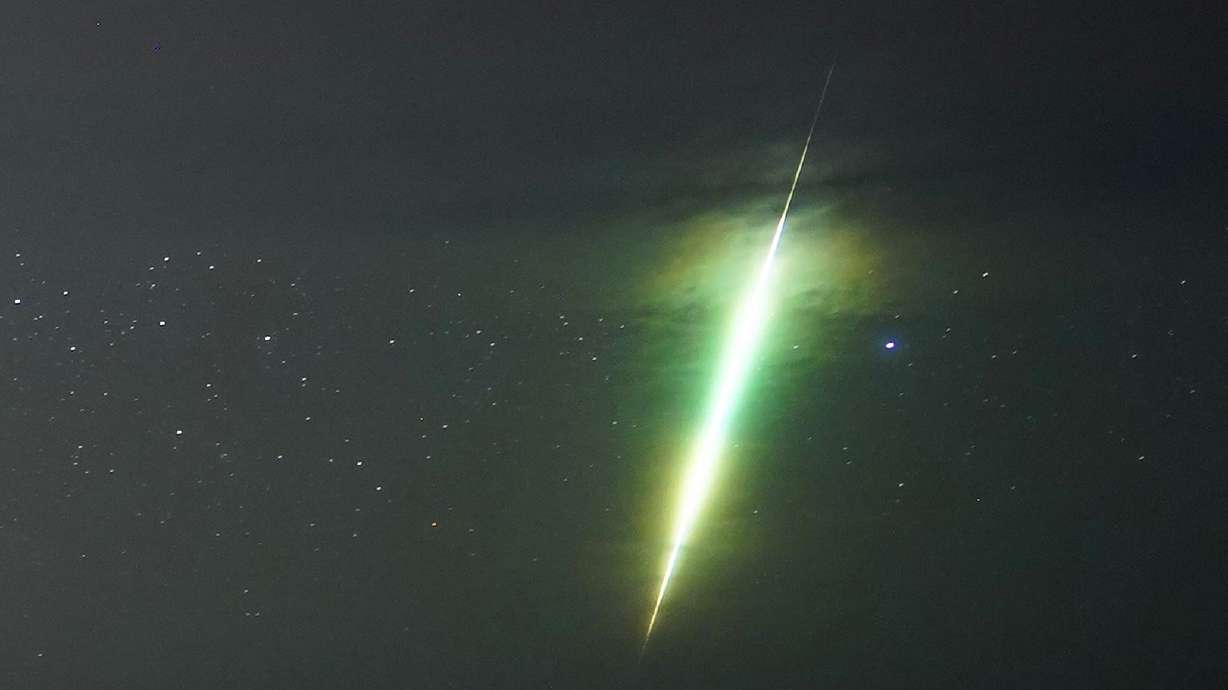
NEW YORK – The Draconid meteor shower will briefly light up the sky Thursday night, and won’t even keep viewers out after midnight. The shower is expected to peak at 7 p.m. MDT on Thursday, but depending on the location of viewers, the meteors will be visible until the early hours of Friday morning, according to EarthSky. The Draconids are best seen from the Northern Hemisphere, but skywatchers in the Southern Hemisphere can catch a glimpse of some meteors by looking close to the horizon just after dark. falls.Fortunately, a waning crescent moon is not expected to be bright enough to obscure the shower, in which 10 meteors can streak across the sky per hour. Draconid meteors move more slowly than those observed during other showers, recording approximately one or two seconds of visibility rather than a fraction of a second. Unlike most other meteor showers that peak early in the morning, the Draconids are best seen just after dark and during the evening hours due to the location of the shower’s radiant point, where the meteors appear to come from in the night sky. The Draconids could cause a meteor storm. The shower gets its name because the meteors appear to arc from the direction of the constellation Draco the Dragon. Eltanin and Rastaban, stars that form the dragon’s head, are in the far northern sky in October, according to EarthSky. Meteor showers occur when our planet passes through debris trails left by comets and asteroids, which eject chunks of rock and ice as they orbit the sun. The Draconids are the result of Earth’s intersection with a trail from comet 21P/Giacobini-Zinner, and occur in October each year as the planet approaches the comet’s orbit. The Draconids are also known as Giacobinids after the discoverer of that comet, Michel Giacobini, who detected the celestial object in 1900. While the Draconid meteor shower is considered much smaller compared to the later larger ones. This year, sky watchers prefer this celestial event because of the possibility of a meteor storm. Meteor storms can occur when debris from a comet gathers near the comet, rather than dispersing, as Earth passes through the trail, and may depend on how close the comet comes to our planet during its orbit around the sun. Hundreds or thousands of meteors may be visible per hour during a meteor storm. Comet 21P/Giacobini-Zinner completes its orbit around the Sun approximately every seven years, and scientists reported an increase in meteorite activity in September 2018, as the comet moved closer in its orbit to Earth. The comet also approached Earth in March 2025 and remains relatively close this year, meaning that for this unpredictable shower, an explosion is always possible, according to EarthSky. The best way to watch the meteor shower is to sit in a reclining lawn chair or lie on your back and look up at the sky with a wide view. No special equipment is needed, but if you want the best viewing conditions, it helps to be as far away from artificial light as possible. Upcoming Meteor Showers There are more meteor showers to look forward to as the end of the year approaches. These are the peak dates to glimpse these dazzling celestial events, according to the American Meteor Society. Orionids: October 21-22 Southern Taurids: November 4-5 Northern Taurids: November 11-12 Leonids: November 16-17 Geminids: December 13-14 Ursids: December 21-22 Key findings in this article were generated with the help of extensive language models and reviewed by our editorial team. The article itself is written solely by humans.