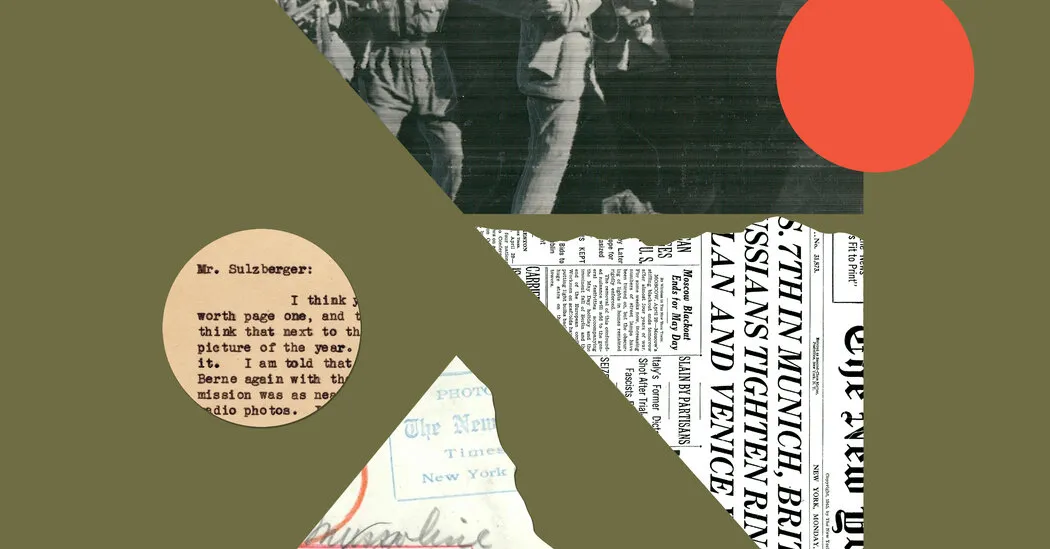
This story is part of a series commemorating 175 years of in-person journalism at the New York Times. Read more here. It was an incredible thing to see firsthand: the battered bodies of deposed Italian fascist leader Benito Mussolini and his lover, Clara Petacci, dumped like trash in a Milan public square in the final days of World War II. New York Times correspondent Milton Bracker was there that day, April 29, 1945 (nine days before VE Day, the end of the war in Europe) to take the measure of the moment. “Benito Mussolini returned last night to the city where his fascism was born,” Bracker wrote in a front-page article in the next day’s newspaper. “He returned to the floor of a closed moving van, with his corpse thrown over the bodies of his lover and 12 men shot with him.” Bracker’s account, written in the first person with an unusual undertone of moral indignation, reflected the gravity of the event, the sense that history had suddenly veered in a new direction. It told how, losing his support, Mussolini had headed north in an attempt to escape to Switzerland. Before he got there, Bracker wrote, he was caught, “like Marie Antoinette on the run.” The story was full of details. Mussolini’s quick trial and summary execution by firing squad along with a group of his followers at Giulino di Mezzegra in northern Italy. How their bodies were piled up in a van and deposited in Milan’s Piazzale Loreto, of symbolic importance “because 15 patriots were recently executed there.” The bodies were then savagely attacked by angry partisans. Bracker said he and other American reporters had been “thrown into the circle of death” by spectators eager to show them what had happened. An unknown photographer shows the reporter on the scene in his military uniform, notebook in hand, interviewing a soldier while the corpses of Mussolini and his lover lie at his feet. Bracker watched two young men brutally kick the slain dictator’s head, causing a “hideous crack that completely disfigured the once proud face,” he wrote. “It was naturally one of the darkest moments of our lives, but at least it will serve to give absolutely authentic eyewitness accounts,” he added. It’s one thing to read about such an event in a newspaper; It’s another thing to see a photo of it. Bracker’s story was accompanied by a four-column front-page photograph depicting the chaotic scene: the bodies of Mussolini and Petacci atop the pile of corpses (Mussolini is easily identifiable by his bald head) while a crowd of armed onlookers pushes and shoves them. The next day, May 1, the newspaper printed two additional photographs. One showed the corpses of Mussolini, Petacci and others hanging by their ankles from a pole in an abandoned service station, where they had been hanged by the mob; another showed the lieutenant. General Achille Starace, an ally of Mussolini, in the final moments before his own execution by firing squad. The publication of these photographs was a blow to The Times. Transmitting photos around the world in the Internet age is such a simple task that it’s easy to forget how difficult it once was. In the early days of news photography, the only method of getting a photograph from one place to another was to physically transport the film, an exercise in delayed gratification if, for example, it was a boat trip across the Atlantic. A breakthrough came in the 1920s with the development of the practical technology of radiophotography, a technique by which photographs were scanned and their tones converted into electrical pulses. The pulses were then sent wirelessly to New York, in the case of The Times, where they were transformed back into photographic images for publication. Along with several other major news organizations, including The Chicago Tribune and The Christian Science Monitor, The Times created a company in 1929 called Press Wireless that circumvented commercial telegraph monopolies. The company built its own shortwave radio transmitting and receiving stations, allowing its members to transmit articles and images much more efficiently. But broadcasting was still subject to logistical challenges, particularly during the war. At the time of Mussolini’s death, the Press Wireless broadcast office closest to Milan was in Geneva, about 155 miles away as the crow flies. So, in order to get the photographs (which were taken by an Italian photographer whose name remains stubbornly lost to time) to New York, someone first had to take them to Geneva. Bracker was busy writing his article, the first draft of the story. But the mysterious photographer knew Daniel T. Brigham, a Times correspondent based in Bern, Switzerland, and offered to personally transport the photographs to Ponte Chiasso, on the Italian-Swiss border, and put them on a train bound for Bern. Even that was not an easy task in a war-torn country. The photographer had to hitchhike to the border, navigating “roads blocked by bewildered compatriots and kept fermenting by roving partisan gangs,” wrote Meyer Berger, a former Times correspondent, in his book about the Times’ first century, “The Story of The New York Times 1851-1951.” But the photographer got there and put the package on the train. “Oh boy, I have something special!” Brigham exclaimed when he called the Times that night to say he had picked up the package in Bern. He asked the Press Wireless office, normally closed on Sundays, to prepare to receive his broadcast. Meanwhile, he prepared to go to Geneva. After securing gas for the trip and obtaining permission from a military censor to use the photographs, Brigham set out alone on a dangerous trek through the Alps in the middle of the night. “He headed into a mountain snowstorm, sliding and skidding over black precipices on the dark, narrow alpine roads,” Berger wrote. At one point, one of his tires blew out and Brigham had to change it in the storm. At 11:30 pm New York time (5:30 am in Geneva) images began emerging from the Press Wireless receiver at The Times. They arrived too late for the first edition. But after some changes to the newspaper’s layout by night editor-in-chief Raymond H. McCaw, the first photo, of Mussolini lying on the pile of corpses, was placed on the cover of the second edition. It was strange to print such a graphic image in the newspaper, especially on the cover. But the photographs were irrefutable proof that Mussolini was dead. And they were a crucial visual complement to the story of what happened, told in Bracker’s accompanying article and analyzed in a Times editorial that same day. “Benito Mussolini’s miserable end marks a fitting end to a miserable life,” the editorial said. “The man who once boasted that he would restore the glories of ancient Rome is now a corpse in a public square in Milan, with a baying crowd cursing, kicking and spitting on his remains.” 1,” he wrote. “Personally, I think that after the Iwo Jima flag raising, this was the second best photo of the year,” he added, referring to the famous photo, taken by Joe Rosenthal of The Associated Press, of six Marines raising the American flag on the island of Iwo Jima two months earlier. Sulzberger’s Western Union message to Brigham in Bern that same day was probably no less heartfelt, despite being written in the strange syntax without punctuation peculiar to telegrams. “Congratulations on getting a unique image of Mussolini,” he wrote.