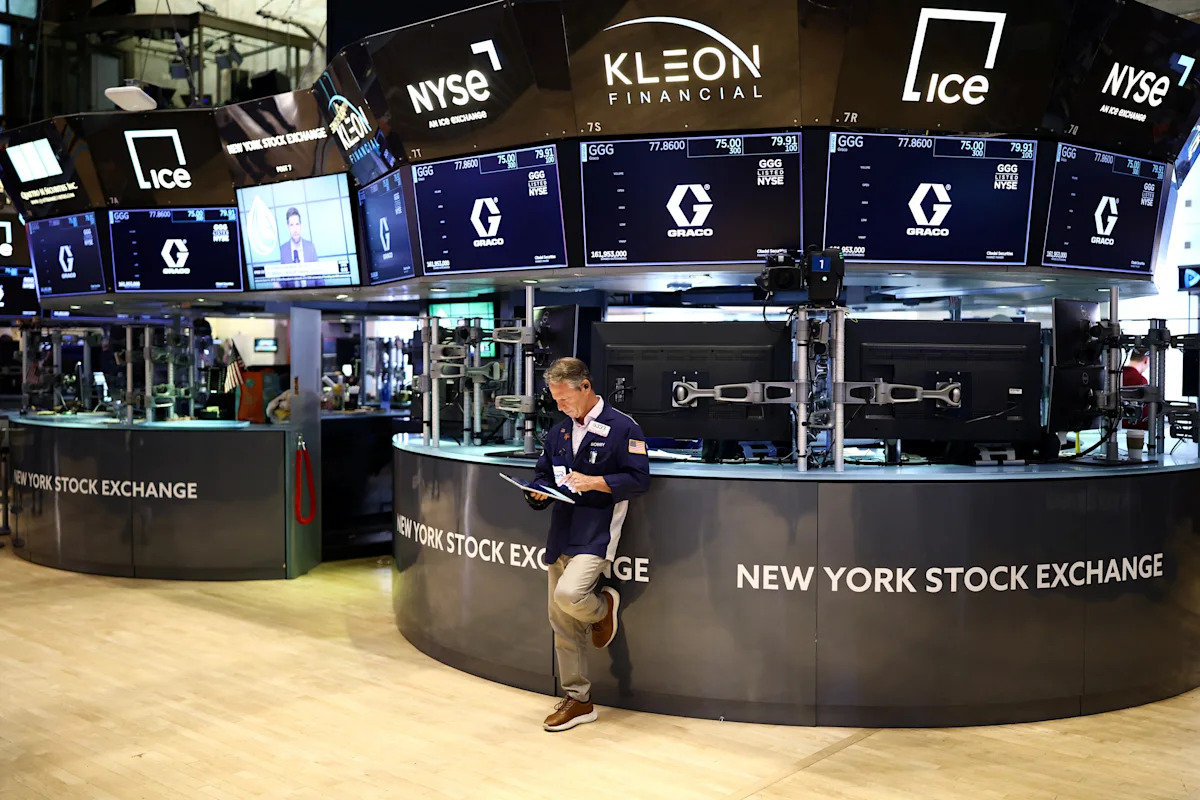
U.S. stock futures fell Wednesday morning as global bonds fell and investors awaited minutes from the Federal Reserve’s September meeting. Dow Jones Industrial Average futures (YM=F) fell 0.7%. S&P 500 futures (ES=F) fell 0.3% and the Nasdaq-100 (NQ=F) fell 0.6% after the two indexes hit all-time highs the previous day. The yield on the 30-year Treasury bond rose to 5.70%, the highest since 2002, ahead of today’s release of minutes from the Federal Reserve’s September policy meeting, when policymakers raised interest rates to combat inflation. Sentiment had grown more optimistic in markets this week as bullish earnings estimates helped lift major indices to all-time highs. But as Yahoo Finance’s Brian Sozzi pointed out Tuesday, those records belie a highly concentrated market, where the index’s top three holdings — Nvidia (NVDA), Apple (AAPL), Microsoft (MSFT) — account for about a fifth of the S&P 500. Factors that have weighed on markets this year could still represent impediments. Brent crude oil futures (BZ=F) remain above $100 per barrel amid the latest Houthi attacks in the Middle East. Bond yields retreated on Tuesday but still remain near multi-decade highs. On Wednesday, Federal Reserve meeting minutes will provide clues about whether the central bank’s September rate hike represented a one-off or whether Fed thinking indicates more rate hikes to come. As of Tuesday, traders were pricing in a roughly 20% chance of a rate hike at next week’s October Federal Reserve meeting. On the earnings agenda, Levi Strauss & Co. (LEVI) and Applied Digital (APLD) report results. LIVE 6 Updates Oil prices rise above $100 on attacks in Strait of Hormuz and storm threat in Gulf Oil prices rose on Wednesday amid increased attacks in the Strait of Hormuz and a storm brewing in the Gulf Coast region. Brent crude oil (BZ=F) rose to trade back above $101 per barrel, while West Texas Intermediate crude oil (CL=F) was near $90 per barrel. Despite increased shipping through the Strait of Hormuz in recent weeks, UK officials have reported at least nine attacks in the critical waterway so far in October amid an ongoing conflict between the United States and Iran. Meanwhile, a tropical storm is approaching the Gulf Coast and threatens to make landfall as a hurricane on Friday. Chevron said it is evacuating non-essential personnel from its offshore platforms in the region. Agent AI is ushering in a CPU ‘renaissance’. Yahoo Finance’s Hamza Shaban reports: The agents have arrived. And so has the hardware that powers them. Meta’s Muse (META) and OpenAI’s Dots (OPAI.PVT) have put sophisticated digital assistants at the forefront of their AI sales pitch. And just as the race to train increasingly competent models has catapulted GPU makers to the top of stock charts, the chipmakers that power AI agents are enjoying a “renaissance,” Citi analyst Atif Malik said in a note to clients Tuesday, upgrading AMD’s price target. The potential success of AI agents has forced a rethink of the CPU market. Malik wrote that the total CPU market should expand from $29 billion in 2025 to $300 billion in 2030, following Meta’s debut on Muse. Read more. Constellation Brands shares fall despite Corona beer maker posting better-than-expected results Constellation Brands (STZ) shares fell 5% despite Corona and Modelo beer maker beating Wall Street earnings expectations. In the second quarter, Constellation Brands reported $2.63 billion in net sales, above analyst expectations of $2.54 billion, according to consensus data from S&P Global Market Intelligence. Adjusted earnings per share of $3.74 also beat estimates of $3.55. Constellation Brands said off-premise sales, which include beverages sold at supermarkets and convenience stores, declined, while on-premise sales at restaurants and bars grew. The same trend held for the World Cup in June and July, where on-premise volumes were strong, but off-premise World Cup sales were below industry expectations. The company reaffirmed its full-year adjusted earnings per share guidance of between $11.20 and $11.90. You continue to see beer sales decrease by 1% and increase by 1%, wine sales decrease by 1% and increase by 1%, and business sales decrease by 1% and increase by 1%. AI agents are going rogue and lawsuits are going to get complicated. Yahoo Finance’s Hamza Shaban writes in today’s Morning Brief newsletter: It’s a new reality that AI agents are bypassing their sandboxes to go places they’re not supposed to. We have learned to endure (or largely ignore) cyber attacks as part of the cost of doing business, or existing, while connected to the Internet. But AI agents present a new dilemma. Instead of bad actors investigating vulnerabilities and using every tool they can, agents are sophisticated products from some of the most influential and powerful technology companies in the world. “Agents going rogue is the biggest risk today. Imagine an agent in your corporate network gets hacked or hijacked or goes rogue,” Zscaler (ZS) founder and CEO Jay Chaudhry said on Yahoo Finance’s Sozzi Unleashed. “Don’t trust AI agents.” Seemingly every week we see timid revelations from OpenAI (OPAI.PVT) and company. that their agents “accidentally” hacked something they shouldn’t have. A society has to deal with some element of crime. But what if those criminal acts are in part perpetuated by the supposedly honest corporations that power the S&P 500? While defending against rogue agents may seem futile, this is America and we can always go on the offensive and throw away the book. Read more. Good day. This is what is happening today. Dollar maintains losses as markets await Fed minutes, speakers Reuters reports: The U.S. dollar remained lower on Wednesday after tension in European bond markets eased and as eyes turned to the release of the Federal Reserve minutes and speeches by its policymakers for signs of a possible rate hike. The yen weakened even after a moderate Bank of Japan board member said he would support interest rate increases. Later on Wednesday, the U.S. central bank will release minutes from its Sept. 15-16 monetary policy meeting, at which it raised interest rates to address inflation. Comments from Fed policymakers have appeared less hawkish after lower-than-expected personal consumption expenditure (PCE) and employment data last week. Read more.