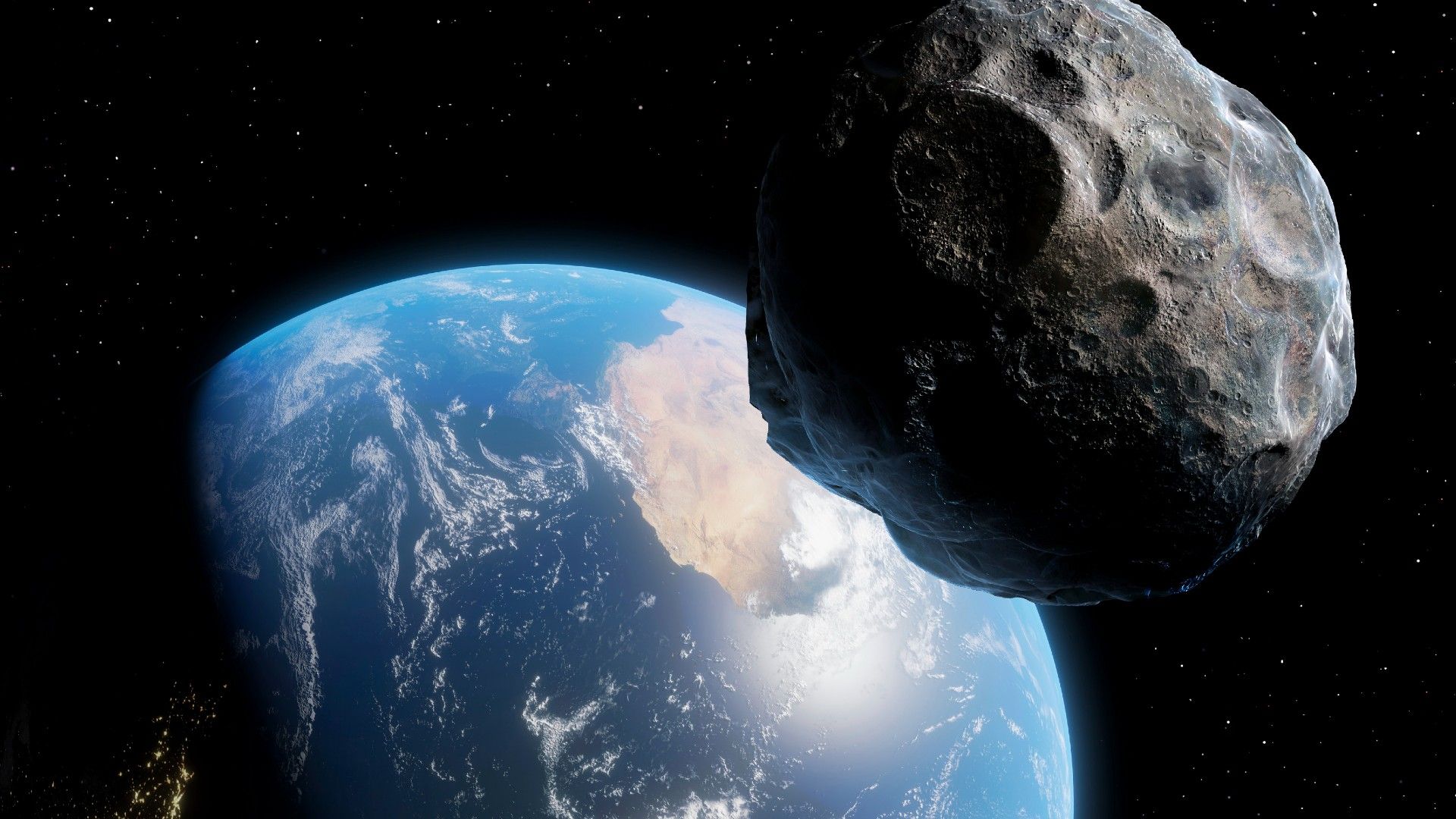
An ancient crater buried beneath the Oklahoma city of Ames has been discovered to be nearly 100 million years younger than previously thought, connecting it to one of the five major mass extinction events in Earth’s history. The crater, which extends about 16 kilometers (10 mi) in diameter, is buried under 2.7 kilometers (9,000 ft) of sedimentary rock and was not discovered until seismic readings revealed it in 1991. The age of the crater is due to the discovery of the tooth in a rock found at the impact site. It was identified as belonging to an ancient eel-like creature called a conodont, which existed during the middle of a geological period known as the Ordovician, in a rock found within the impact site. This period was marked by a dramatic asteroid bombardment known as the Ordovician Meteorite 467.5 million years ago, which left nearly two dozen craters scattered around the world, all within a 30-degree radius of the equator. This equatorial pattern suggests that there may have been a ring of material from a disintegrated asteroid surrounding Earth’s equator. However, a team led by Elizabeth Catlos of the University of Texas at Austin came to a different conclusion and found that the crater is 370 million years old. So instead of being part of the Ordovician Meteor Event, this new dating places it at the time of the Late Devonian mass extinction, also known as the Frasnian-Famenian boundary extinction. “With this research, we are basically taking an important pawn from the Ordovician Meteorite Event and throwing it into the Frasnian-Famenian event and saying, ‘this is where this impact belongs,'” Catlos said in a statement. You may like New evidence of the age of Ames Crater comes from zircon crystals. Zirconium is a silicate mineral and zirconium crystals can be dated by analyzing the amount of uranium and lead they contain. When zircon crystals form, they contain uranium and thorium, but the formation process expels the lead atoms. Therefore, a newly formed zircon crystal does not contain lead, but over time uranium radioisotopes decay into lead atoms, so the more lead a zircon crystal contains, the older it is. A geological map of Ames Crater, showing the different types of rocks and the places where fossil fuels are extracted. (Image credit: Catlos et al) The pressure from the impact that opened Ames Crater would have formed new zircons. Working with a team at NASA’s Johnson Space Center, Catlos’ group was able to image the zircon crystals using cathodoluminescence and electron backscatter diffraction. Cathodoluminescence bombards materials with electrons, causing the materials to emit photons at different wavelengths depending on the composition of the material. Electron backscatter diffraction, on the other hand, is a technique that uses a scanning electron microscope to study how different atoms diffract electrons at different angles. “No matter what technique we used, it came back to this younger signal,” Catlos said. So what about fossil conodont teeth? The teeth were probably in the rock a long time before impact and simply mixed in with the violence that formed the crater. While the impact alone was not large enough to cause a mass extinction, it may have contributed. Other possible causes of the extinction include a reduction in oxygen, supervolcanism or a nearby supernova, or possibly all of these events operating together. What to read next When the impact occurred 370 million years ago, what is now Oklahoma was submerged under a shallow sea, which is how the 2.7 kilometers (1.6 miles) of sedimentary rock that today covers the crater was deposited. The impact also fractured the Earth’s crust beneath it, and these fractures have allowed oil and natural gas to seep out. The wells found oil three kilometers deep inside the crater and since 1991 have produced 17.4 million barrels of oil and a volume of 79.5 billion cubic feet (2.25 billion cubic meters) of natural gas. Danny Stockli, dean of the Jackson School of Geosciences at the University of Texas at Austin and co-author of the research, is effusive in his praise of the use of zircon crystals to date the ages of craters. The crystals allow us to go back in time and learn about major changes to Earth’s ancient landscapes,” Stockli said. “It would be great to do this at more meteorite impact sites across the continent so we can get a more accurate chronology of these big events.” The findings were published in July in the journal Meteoritics and Planetary Science.