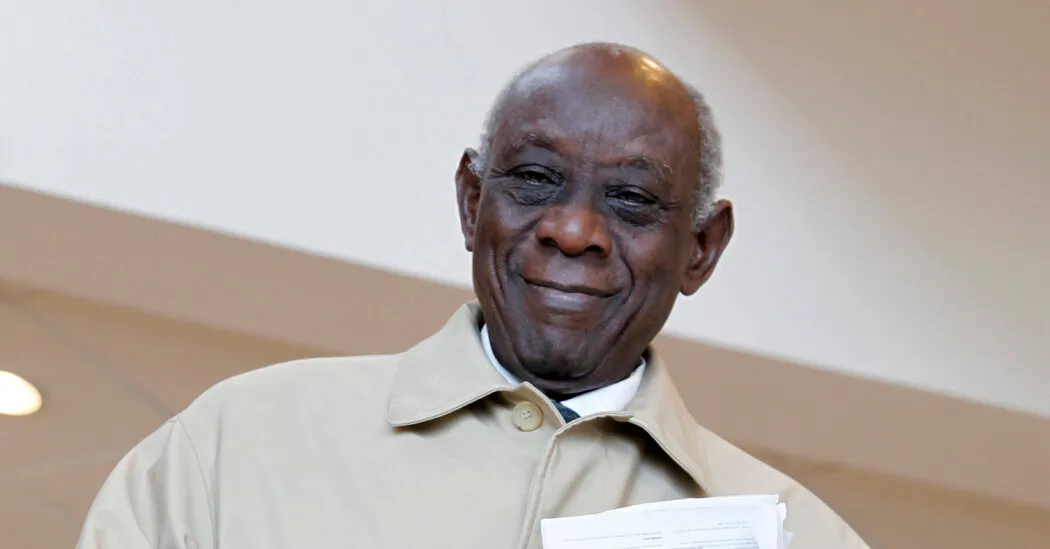
Cheikh Hamidou Kane, a Senegalese writer and civil servant whose 1961 novel, “Ambiguous Adventure,” reframed perceptions of the colonial relationship, has died. He was 98 years old. Kane’s death was announced by President Bassirou Diomaye Faye of Senegal on social media. He died Sunday at his home in Dakar, Senegal’s capital, according to his son Amadou Kane. “He gave generations of Africans the words to grapple with a question that still haunts us: that of opening ourselves to knowledge of the world without losing anything of who we are,” Faye wrote. “His work now belongs to the heritage of our nation and all of Africa.” Despite publishing only two novels, Kane achieved the status of a Pan-African seer and was praised as one of the founding fathers of African literature and as a writer who subtly captured the impact of colonization from the perspective of the continent’s people. In “Ambiguous Adventure,” Kane focused on the psychological trauma of colonization, especially on colonized elites. Kane, who was a young novelist writing at the dawn of African independence, himself inspired the novel’s main character, Samba Diallo. Samba, an alert young man with a love of learning and devoted to his Muslim faith, is torn between two civilizations. The “adventure” of the title refers to his journey to the world of the conqueror of his land and the blurred mark he leaves behind. When Mr. Kane wrote the book, he was also between two worlds. In the 1950s, he attended the schools of the French colonizers, first in Senegal and then in Paris; He obtained degrees in Law and Philosophy at the Sorbonne and trained in colonial administration at the National School of Overseas France. He returned to Africa in 1958 and shortly afterwards was appointed governor of a region near Dakar by the new government of independent Senegal. Unlike Nigerian author Chinua Achebe’s scathing anti-colonial novel, “Things Fall Apart,” published three years earlier, “Ambiguous Adventure” deals with the internal turmoil induced by colonization rather than the social disintegration it causes. The main character is imbued with the culture and traditions of the Islamized Fulani. aristocracy of the Senegal River valley, where it grows. But the fateful decision to attend a French school immerses him in the culture of the colonizers, which he couldn’t get rid of even if he wanted to, and he doesn’t. This internal conflict ends in tragedy, an outcome that seems to foreshadow West Africa’s struggle over the next half century to shed its lingering colonial imprint and find a path true to the old ways. The novel won the Black African Literary Grand Prize in 1962. Although the English translation received little attention in the United States (the book was not reviewed in The New York Times), it has long been considered essential in French-speaking Africa. It was read “in every country in sub-Saharan Africa,” Le Monde journalist Éric Fottorino wrote in a profile of Kane in 1996, adding that the book had sold “100,000 copies worldwide.” Kane was always explicit about his didactic intent. In an interview with the writer Maryse Condé on Radio France Internationale in 1974, she said that the book contains “a kind of political denunciation of what was, so to speak, the colonial adventure,” and explained: “I thought that the central problem was the conflict of cultures, of a traditional culture, the African, black and Muslim culture, with the culture of the colonizers.” of our being, of our identity,” he said. “For the white men who colonized us and wanted us to think that we were inferior beings,” he said. “I admired them but I had people in front of me who despised me,” he continued. “I had to fight to access a world that I admired but that wanted nothing to do with me.” “Ambiguous Adventure” is an educational novel, illustrated by the schooling of Samba Diallo, a young aristocrat who is preparing to become leader of his people, the Diallobé. He is first educated in the harsh discipline of a Koranic school by a character known as the Master. Kane evokes the panoply of corporal punishments used, then and now, in those schools. Like other main characters in the book, the Master is a symbol and named after his title. Samba’s aunt, the sister of the chief Diallobé, called the Royal Noble, intervenes and insists that he attend the local French school to learn the ways of the conquerors. right,” he tells the Master and Samba. “The fight is not over. The foreigner school is the newest form of war against us by those who have come here.” Kane describes the stark contrast between the spiritual outlook of the Diallobés (centered on prayer, eternity, God and the afterlife) and the harsh materialism of the French conquerors. “Their science is the triumph of evidence, a proliferation of the surface,” Samba’s father, the Knight, inspired by Mr. Kane’s own father, tells his fellow French official in the small northwestern Senegal town where They work. This dichotomy takes literal form in the narrative of the Fool, a Diallobé who has been to the white man’s country and has returned, altered by what he has seen. According to him, Samba undergoes a similar transformation when he travels to France. short, prayer-like. Upon his return, he resists a call to prayer, with serious consequences. “I wanted to underline the dramatic and tragic aspect of our intellectual and spiritual adventure,” Mr. Kane told Mrs. Condé. Cheikh Hamidou Kane was born on April 2, 1928, in Matam, in northern Senegal, the son of Mamadou Lamine Kane, an official in the colonial administration, and Yéya (Racine) Kane. He graduated from and then to the French primary school of Louga. He went to a secondary school in Saint-Louis, the colonial capital, and then to the Lycée Van Vollenhoven, in Dakar, in 1948. In 1951, he began studying at the Dakar Institute of Higher Studies, now Cheikh Anta Diop University, and then received a scholarship to attend the Lycée Louis-le-Grand in Paris, which prepared him for the Sorbonne and the school of administrators. colonialists who pitted the prime minister, Mamadou Dia, who supported a sharp break with France, against the French-leaning president, Léopold Sédar Senghor, Kane aligned himself with Dia, who was imprisoned in solidarity with Dia in 1962 and worked for the United Nations in Lagos, Nigeria, and Abidjan, Côte d’Ivoire, and later for the International Development Research Centre, an organization in Canada. 1976, after Mr. Dia’s release, Mr. Senghor appointed him Minister of Industrial Development. From 1981 to 1988 he was Minister of Planning during the presidency of Abdou Diouf. After retiring, he remained active in several notable non-governmental organizations promoting peace in Senegal, including ENDA Tiers-Monde, his 1995 novel, did not achieve the same celebrity as “Ambiguous Adventure I Was Carrying.” more than 30 years in works; poet Aimé Césaire had persuaded Kane not to publish it in 1965 because “it could have been used as a weapon against Senegal,” Kane told Le Monde in 1996, adding: “Criticism of African regimes could have been seen as a call for military takeover. In addition to his son Amadou, Kane is survived by three other children from his second marriage, to Marie Therese Bovis: Kadida Kane, Oumou.” Khairy Wane and Mamadou Lamine Kane; and two daughters from his first marriage, with Yaya Oumou Khairy: Yaya Touré and Hawa Kane. The “Ambiguous Adventure” endures as a classic plea for independence and the inherent value of African cultures, and is still taught in schools across the continent. existence of a black culture, of a black civilization, of a black culture. sensitivity.” Saikou Jammeh contributed reporting.