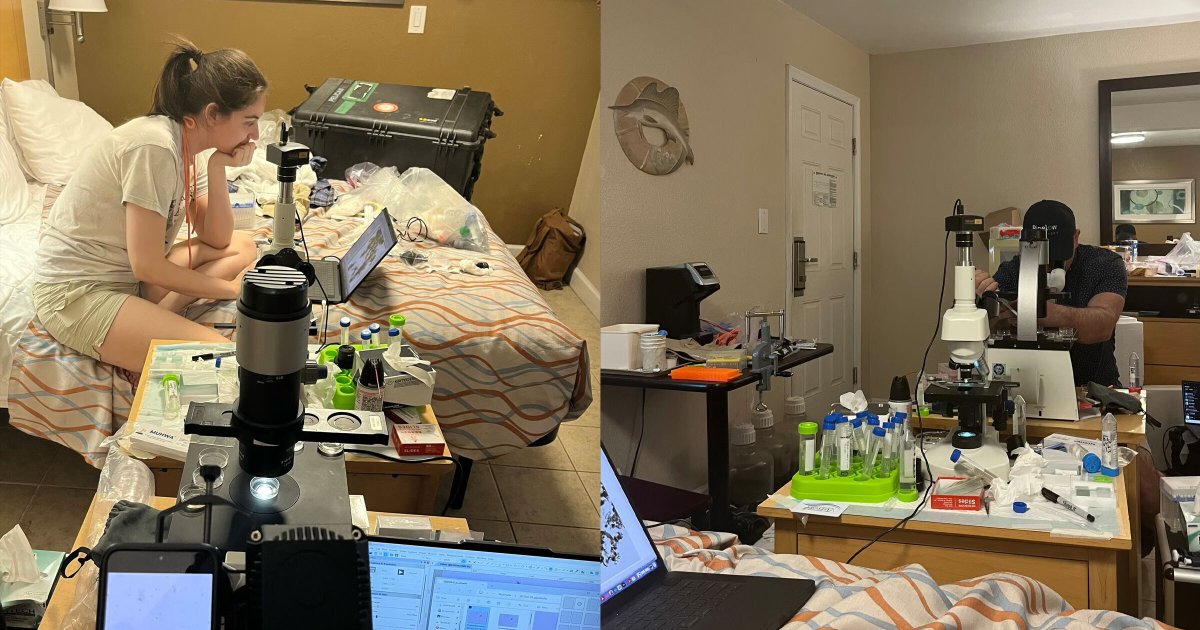
Sign up to see the future, today Unmissable innovations from the cutting edge of science and technology. Brought together by Trump’s funding cuts, Julia Van Etten and her ragtag team of biologists continued their research in a motel room. And it was in this makeshift laboratory that they made an incredible discovery: two new microscopic organisms that may be crucial to tracing the origins of life, the New York Times reports. The organisms are an elusive single-celled microbe called Paulinella. Including the recent discovery, reported in a study in the Journal of Phycology, there are now only six known species of Paulinella in the world. Scientists believe Paulinella could provide a window into a crucial event in the development of complex life, when a single-celled organism swallowed a photosynthetic bacteria and, instead of digesting it, reused it in its personal energy factory. This fusion would later evolve into the chloroplast cells that plants use to carry out photosynthesis. It was because of this that life blossomed from glorified self-replicating particles floating in a fetid stew into large, complex organisms. This occurred 1.5 billion years ago and was long thought to be a singular event. But it turns out that Paulinella underwent its own photosynthetic fusion just 100 million years ago. Angela Oliverio, a biologist at Syracuse University, explained that the fusion between the two organisms that make up Paulinella was not yet complete, giving us a snapshot of this evolutionary process in action. “It’s really surprising to me,” Oliverio told the NYT. This “represents the only other case at this time in which this chance evolutionary event occurred.” Van Etten, who led the work, became obsessed with Paulinella after fortuitously discovering one in a water sample he took while on vacation in North Carolina, a chance find that the NYT compared to “finding a needle in a thousand haystacks.” Soon, in an ironic twist, Van Etten would find other biologists to join her in her quest to find more microbes after the Trump administration began wreaking havoc on scientific funding. She was personally affected and cut off from her $60,000 grant from the National Science Foundation after Trump issued a memo freezing federal funding in 2025. The funding was eventually restored, but in the chaos in between, other scientists began seeking advice from each other and adopting their own ways of conducting research outside of an official laboratory. Van Etten and his team set one up in an $80-a-night motel room, where, while studying the Paulinella samples they collected, researchers noticed they were actually looking at two different species of the microbe. His hunch was confirmed by DNA sequencing performed by a laboratory in South Korea. It is not the only example of scientists resorting to unorthodox measures to finance their research. A team of researchers studying groundhogs turned to creating an Onlyfans account dedicated to groundhog content after Trump eliminated their federal research grants. More on biology: Scientists say they have found remains of a huge life-giving continent beneath Antarctica